The Hidden Cost of Modern Posture
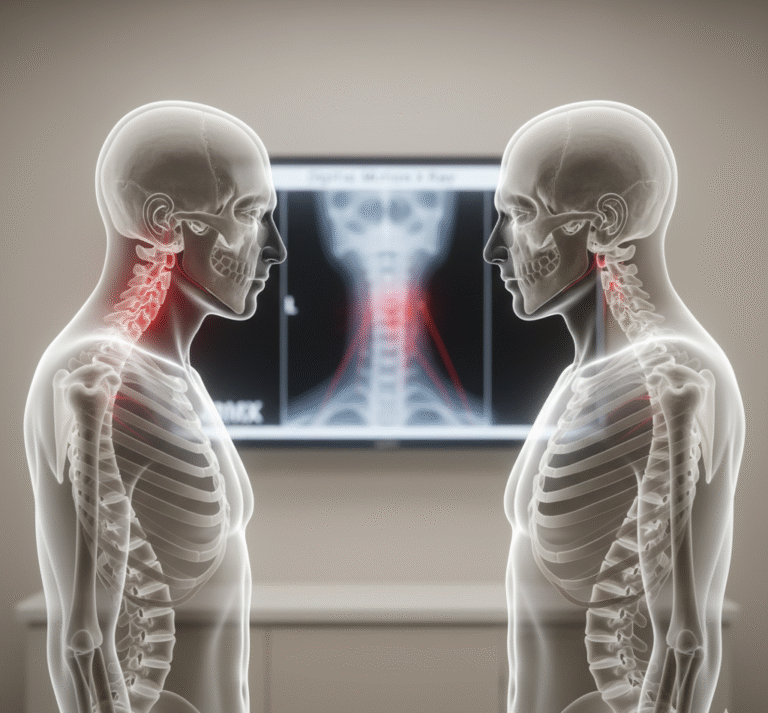
In today’s world of smartphones, laptops, and long commutes, forward head posture has become one of the most common and damaging spinal problems. This posture occurs when the head shifts forward relative to the shoulders, placing excessive strain on the neck’s muscles and ligaments.
Many patients in South Miami, Broward County, and Fort Lauderdale live with chronic neck pain, tightness, and even headaches often without realizing their posture is to blame.
At DMX Miami, we’ve found that poor posture doesn’t just cause stiffness it can lead to cervical ligament instability and even cervical kyphosis (loss of the normal neck curve). These conditions are often missed by traditional imaging, leaving patients in pain with no clear answers.
How Forward Head Posture Affects the Cervical Spine
For every inch your head moves forward, the effective weight on your neck doubles. A head that weighs about 10–12 pounds can create 30–40 pounds of stress on the upper cervical ligaments and muscles when it’s even slightly misaligned.
Over time, this constant tension causes:
- Stretching and micro-tears in the cervical ligaments.
- Muscle fatigue and chronic tightness.
- Disc compression and nerve irritation.
- Altered blood flow to the brainstem and upper spinal cord.
The ligaments especially the alar, transverse, and capsular ligaments are responsible for stabilizing the upper neck. When these are weakened, even normal movements can cause micro-instability that perpetuates pain.
Cervical Kyphosis: When Posture Becomes Structural
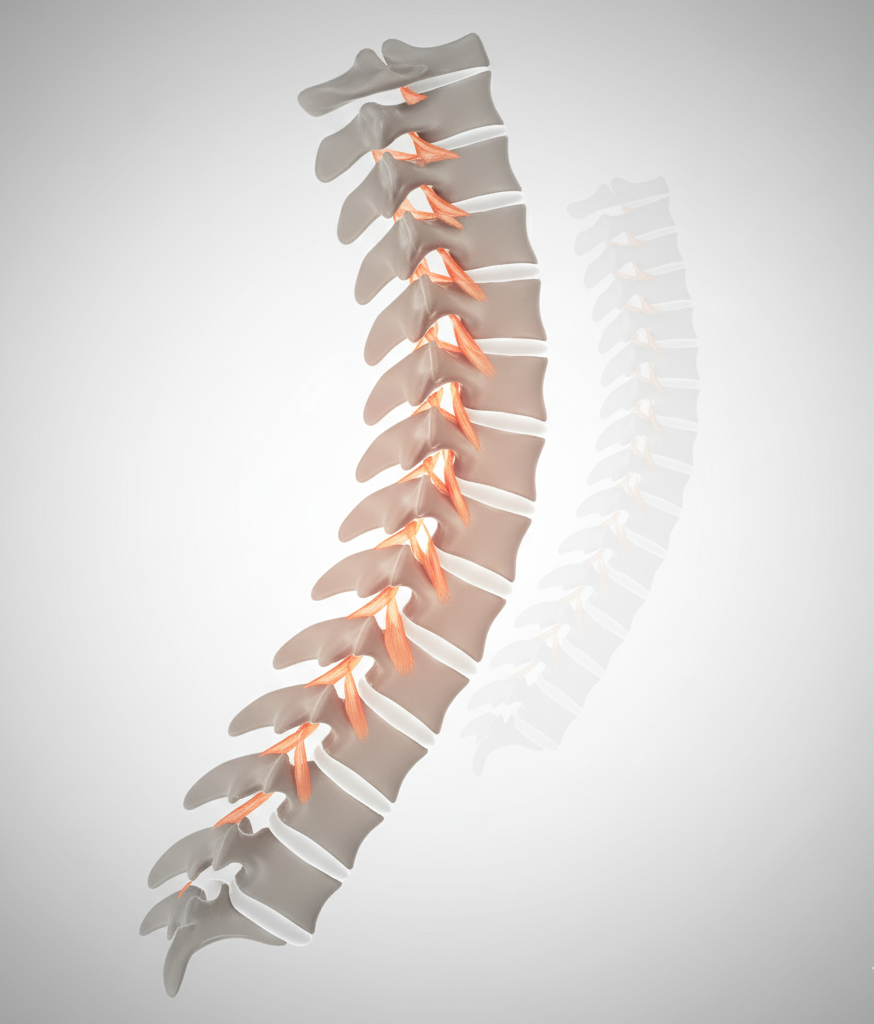
When forward head posture is left untreated, it can progress to cervical kyphosis a structural reversal of the neck’s natural curve. This abnormal curve changes the way the spine supports the head, creating:
- Pressure on the spinal cord and nerves.
- Limited range of motion.
- Chronic neck and shoulder pain.
- Headaches and muscle tension.
Patients often describe their pain as deep, aching, or radiating into the upper back or arms. Yet, their standard X-rays or MRIs often look “normal” because these scans can’t capture the instability during motion that causes the problem.
Why Standard Imaging Misses Ligament Instability
Traditional imaging, like MRI or CT scans, captures a static picture. But instability by definition happens during motion.
This means your neck might appear completely normal when you’re lying still during a scan, even though the vertebrae move excessively or abnormally when you turn or bend your head.
Digital Motion X-Ray (DMX) solves this problem by recording your cervical spine in motion, revealing the subtle shifts that occur when ligaments fail to stabilize the vertebrae properly.
How Digital Motion X-Ray (DMX) Works
At DMX Miami, we use real-time fluoroscopy to record your neck as you move through a series of gentle motions flexion, extension, rotation, and lateral bending.
This dynamic imaging allows our doctors to:
- Identify ligament laxity or instability between vertebrae.
- Detect abnormal joint mechanics linked to pain or posture issues.
- Correlate findings with symptoms like headaches, numbness, or dizziness.
- Document instability for personalized treatment planning.
Patients are often amazed to finally see on screen how their neck actually moves, and where it becomes unstable.
The Connection Between Ligament Damage and Postural Instability
When ligaments are overstretched, they can’t properly hold the cervical spine in alignment. As a result, the head begins to drift forward, forcing muscles to overcompensate.
This imbalance not only worsens posture but can also lead to:
- Fatigue and pain in the shoulders and upper back.
- Increased tension headaches.
- Jaw discomfort or ear fullness.
- Nerve irritation down the arms.
DMX imaging provides the missing link showing exactly which ligaments are injured and how that damage affects posture and movement.
Who Should Consider a DMX Scan
A Digital Motion X-Ray may be right for you if you experience:
- Forward head posture or visible rounding of the upper back.
- Chronic neck pain or stiffness.
- Dizziness, headaches, or facial pressure.
- Numbness or tingling in the arms.
- Persistent symptoms despite normal MRI results.
Our bilingual team (English and Spanish) works with patients from Florida, the U.S., and Latin America, providing clear answers and professional reports for ongoing care.
Why Patients Trust DMX Miami
Patients come to DMX Miami because we offer:
- Advanced motion-based imaging for accurate diagnosis.
- Detailed reporting for doctors, chiropractors, and therapists.
- Compassionate, bilingual care for local and international patients.
- Expertise in detecting ligament instability and postural damage.
We believe knowledge is the first step toward healing and DMX reveals what traditional imaging can’t.
Start Restoring Your Posture and Stability
If you’ve been told your imaging looks “normal” but still suffer from neck pain or poor posture, Digital Motion X-Ray (DMX) may finally provide the answers you’ve been searching for.
Learn more: Treatment
Schedule your appointment today: Appointments
Call 305-275-7475 or book your appointment online

Dr. Rodolfo Alfonso, D.C.
Dr. Mark N. Berry, D.C.
Sunset Chiropractic and Wellness
8585 Sunset Dr. STE 102
Miami, Florida 33143