
The Frustration of “Normal” Imaging Results
You’ve had pain for months maybe years. You’ve gone through MRIs, CT scans, and X-rays, and each time, you hear the same thing: “Everything looks normal.” Yet your neck still hurts, your head feels heavy, and your back tightens every time you move.
At DMX Miami, serving patients from South Miami, Broward County, and Fort Lauderdale, we see this story every day. The truth is, standard imaging methods like MRI and CT scans are powerful tools but they have one major limitation: they capture the body in stillness.
The spine, however, is not static. It’s dynamic made to move. And when ligaments are damaged, the instability only shows in motion. That’s where Digital Motion X-Ray (DMX) makes the invisible, visible.
Why Traditional Imaging Often Misses Ligament Damage
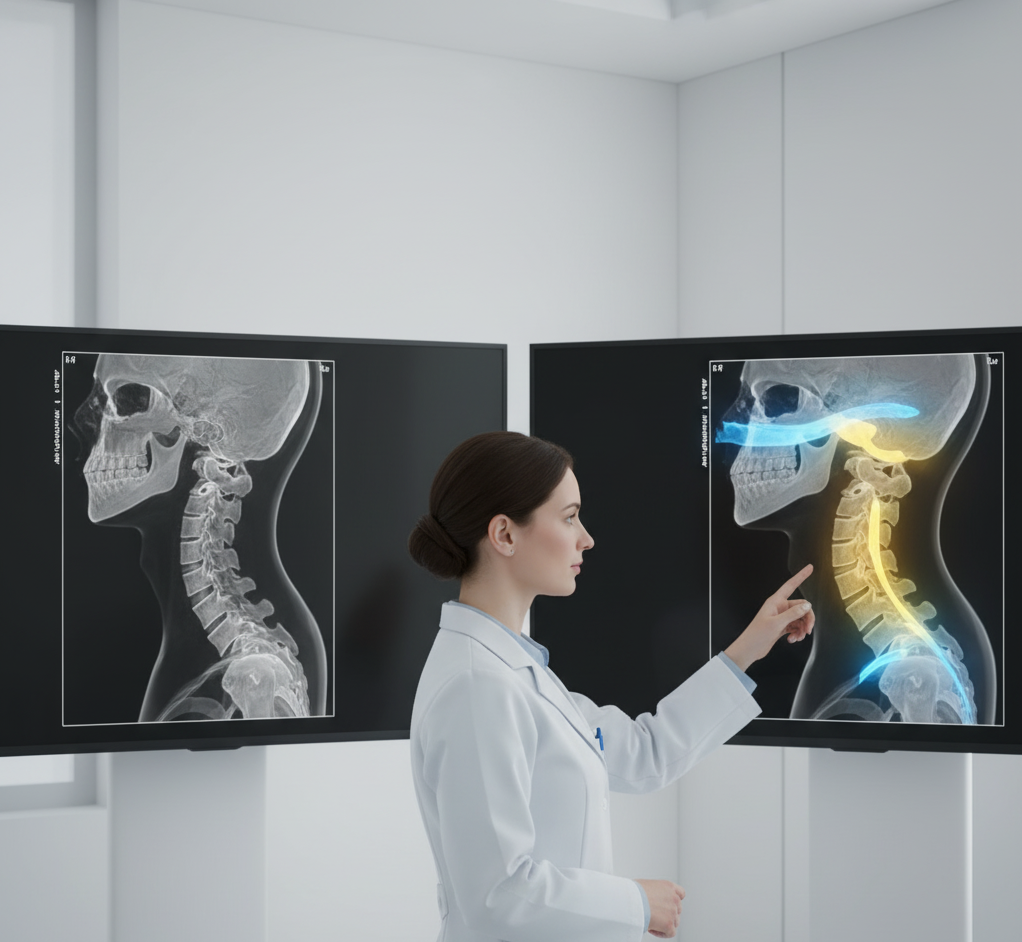
MRI and CT scans are excellent for identifying disc herniations, fractures, or tumors, but they often fail to show ligament laxity, micro-instability, or functional injuries that happen during movement.
Here’s why:
- Static imaging = false reassurance. MRIs are performed while lying down. Ligament instability often disappears without gravity or motion.
- Ligaments aren’t clearly visible. Soft-tissue structures like ligaments are small and often obscured on MRI or CT.
- Pain occurs during motion not rest. Patients describe pain when turning, bending, or lifting actions that traditional imaging never captures.
Digital Motion X-Ray fills this diagnostic gap by revealing real-time movement of the spine, allowing doctors to identify where abnormal motion and ligament damage truly exist.
How Digital Motion X-Ray Works
DMX uses advanced fluoroscopic technology to record the spine in motion bending, rotating, and extending while producing crystal-clear images of how each vertebra moves.
At DMX Miami, we use this real-time motion imaging to evaluate:
- Ligament laxity (overstretching or tears).
- Abnormal translation or rotation between vertebrae.
- Postural or mechanical instability.
- Alar or transverse ligament damage in the upper cervical spine.
- Hidden injuries from whiplash, trauma, or repetitive stress.
The result is a dynamic, moving X-ray study that captures the spine the way it actually functions not just how it looks when still.
The Real Source of Chronic Pain After Accidents
After car accidents, many patients suffer from ligament damage, especially in the cervical (neck) spine. Even “minor” collisions can overstretch ligaments, leading to instability between vertebrae.
This instability triggers:
- Chronic neck pain and stiffness.
- Headaches and migraines.
- Dizziness or vertigo.
- Numbness or tingling in the arms.
- Visual or balance issues.
Unfortunately, most of these patients are told their imaging is “normal” and are sent to therapy or pain management without ever finding the true cause.
With Digital Motion X-Ray, the instability becomes clear. It shows how the bones move abnormally due to weakened ligaments, validating what patients have felt all along.
Why Early Detection of Ligament Damage Matters
Ligaments act like the seatbelts of your spine. When they’re torn or stretched, the vertebrae shift too far, creating stress on discs, nerves, and joints.
Left untreated, ligament damage can lead to:
- Degenerative disc disease.
- Arthritis.
- Chronic nerve compression.
- Loss of spinal stability.
- Long-term disability
By identifying ligament damage early with DMX, doctors can create a more accurate diagnosis and a plan for true recovery rather than temporary relief.
Why Patients Travel to DMX Miami
Patients from all over Florida, the United States, and across Central and South America including Colombia, Mexico, Argentina, Chile, and the Caribbean come to DMX Miami because they want answers that standard imaging can’t provide.
Our patients choose us because we offer:
- Advanced motion-based imaging that detects hidden injuries.
- Expertise in ligament and instability diagnosis.
- Comprehensive reports for physicians, chiropractors, and attorneys.
- Bilingual care (English and Spanish) for local and international patients.
We help patients uncover what’s truly wrong and guide them toward proper treatment and long-term healing.
Who Should Consider a Digital Motion X-Ray
DMX is ideal for anyone who:
- Has chronic neck or back pain with “normal” imaging results.
- Suffered whiplash or a car accident injury.
- Experiences headaches, dizziness, or neurological symptoms.
- Has been through physical therapy without improvement.
- Needs objective proof of ligament instability for medical or legal purposes.
If this sounds like you, Digital Motion X-Ray can provide the missing piece to your diagnosis.
The Next Step: Find Out What’s Really Causing Your Pain
Don’t let another “normal” MRI report leave you without answers. If you’re still in pain, your ligaments may be the missing link. At DMX Miami, we specialize in detecting and documenting the real cause of chronic spinal pain the hidden instability that static imaging cannot see.
Learn more: Treatment
Schedule your appointment today: Appointments
Call 305-275-7475 or book your appointment online

Dr. Rodolfo Alfonso, D.C.
Dr. Mark N. Berry, D.C.
Sunset Chiropractic and Wellness
8585 Sunset Dr. STE 102
Miami, Florida 33143