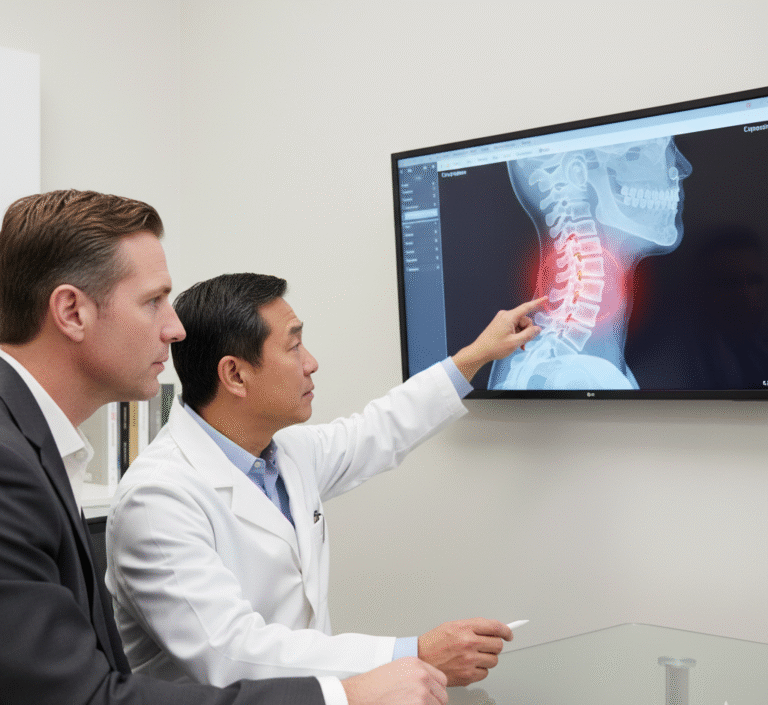
Giving Objective Evidence to Support Real, Ongoing Pain
When someone is injured in a car crash or other traumatic event, the most important questions are simple:
- What was damaged?
- How serious is it?
- How will it affect the person’s life going forward?
For attorneys, these answers impact liability, settlement value, and the ability to prove an injury in court. For doctors and chiropractors, they guide clinical decisions and long-term care. At DMX Miami, serving patients from Miami, Fort Lauderdale, Miami-Dade County, Broward County, and the Florida Keys, and from Florida, the USA, Central and South America (including Colombia, Chile, Argentina, and Mexico), and the Caribbean, Digital Motion X-Ray (DMX) often plays a crucial role in answering these questions.
The Challenge: Real Pain with “Normal” Imaging
Many injured patients face a frustrating situation:
- They are in real pain.
- They struggle with daily activities, work, sleep, or driving.
- Yet standard X-rays, MRIs, or CT scans do not fully explain their symptoms.
This can lead to:
- Insurance companies minimizing or denying claims.
- Confusion among providers about the true cause of the pain.
- Patients feeling invalidated and stuck without a clear path forward.
Often, the missing factor is ligamentous instability a functional problem that occurs during motion, not just in a still position.
How Digital Motion X-Ray Adds a Dynamic Perspective
Unlike static imaging, Digital Motion X-Ray captures the spine in motion. At DMX Miami, we use fluoroscopic technology to record a video of the neck, mid-back, or low back as the patient:
- Gently flexes and extends.
- Rotates or side-bends.
- Performs other controlled movements as appropriate.
From this motion study, we can:
- Measure abnormal translation or angulation between vertebrae.
- Identify joint gapping or compression patterns.
- Document instability related to ligament damage.
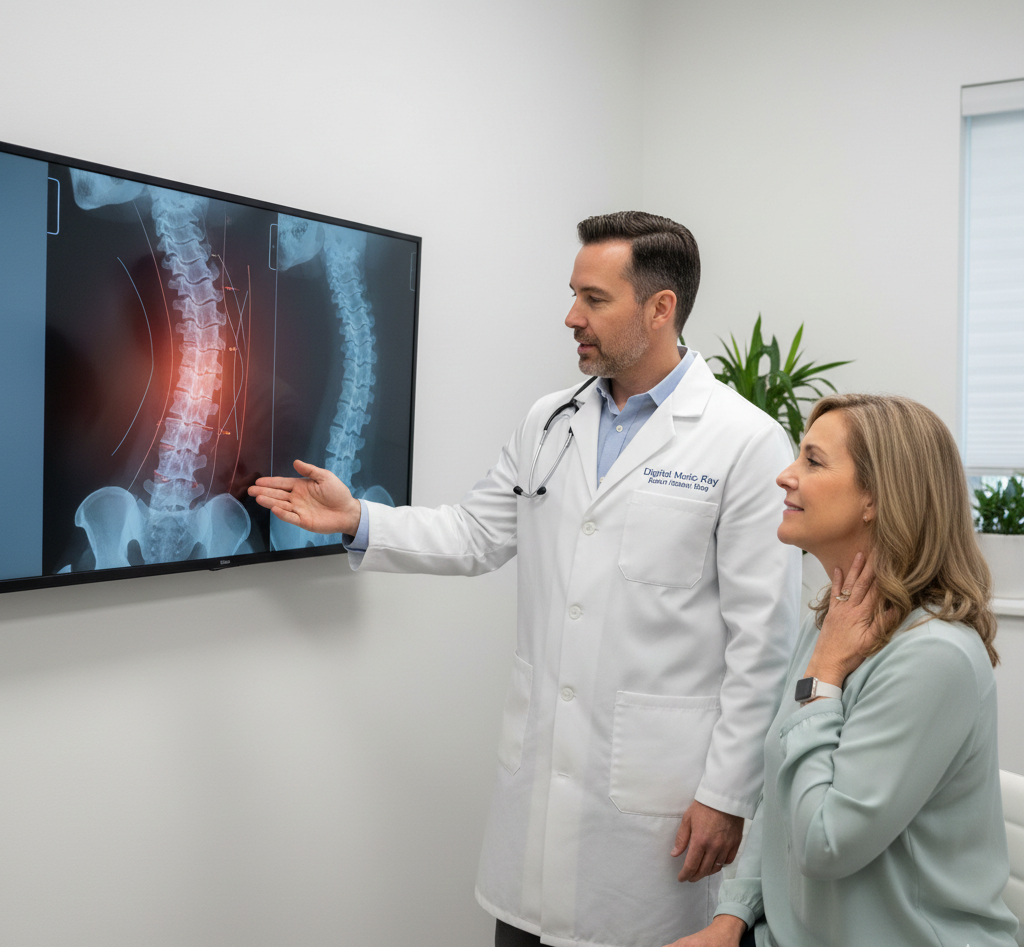
These findings are often quantifiable and visual, making them easier to communicate to doctors, patients, and legal professionals.
Why Attorneys Value DMX in Injury Documentation
For personal injury and accident cases, DMX can:
- Provide objective evidence of instability that correlates with the patient’s complaints.
- Help explain why a client still hurts despite “normal” static imaging.
- Support expert testimony regarding the nature and severity of the injury.
- Show that injuries are structural and mechanical, not simply “soft tissue soreness”
Clear images and motion measurements can help:
- Strengthen negotiations with insurance companies.
- Improve clarity in mediation or trial.
- Demonstrate long-term implications of ligament damage and instability.
While DMX itself does not determine legal outcomes, it can make the underlying medical picture much clearer.
How DMX Supports Doctors, Chiropractors, and Rehab Providers
For clinicians, DMX findings can:
- Identify specific spinal levels that require focused attention.
- Help determine whether instability is likely contributing to pain, headaches, or radiating symptoms.
- Guide decisions on manual therapy, stabilization exercises, or referrals for regenerative or surgical care.
- Provide a baseline for tracking changes over time.
With a clearer understanding of structural instability, providers can build treatment plans that:
- Respect the limits of injured ligaments.
- Emphasize stabilization and neuromuscular re-education.
- Coordinate care among different specialists more effectively.
Why DMX Miami Is a Referral Destination for Injury Cases
Attorneys and providers refer clients and patients to DMX Miami because we offer:
- Advanced motion-based imaging specifically focused on spinal instability.
- Detailed written reports and image sequences suitable for both clinical and legal use.
- Collaboration with treating providers, including chiropractors, physical therapists, physicians, and regenerative specialists.
- Bilingual support (English and Spanish) for patients and families from:
- South Florida: Miami, Fort Lauderdale, Miami-Dade County, Broward County, and the Florida Keys.
- The rest of Florida and the United States.
- Central and South America (Colombia, Chile, Argentina, Mexico).
- The Caribbean.
When to Consider DMX in an Injury Case
DMX may be appropriate when:
- Pain and functional loss persist long after the initial injury.
- Static imaging does not fully explain the symptoms.
- There is concern about ligament damage, instability, or abnormal motion.
- Attorneys or doctors need a clearer picture of structural injury to support decision-making.
Every case is unique, and DMX is one tool among many. But for the right patient, it can provide the missing evidence that ties together symptoms, clinical findings, and objective imaging.
When You Need Clearer Answers for Your Case
If you are an injured patient, an attorney, or a provider facing unanswered questions about ongoing pain after trauma, Digital Motion X-Ray may help bring clarity.
Learn more: Treatment
Schedule your appointment today: Appointments
Call 305-275-7475 or book your appointment online

Dr. Rodolfo Alfonso, D.C.
Dr. Mark N. Berry, D.C.
Sunset Chiropractic and Wellness
8585 Sunset Dr. STE 102
Miami, Florida 33143