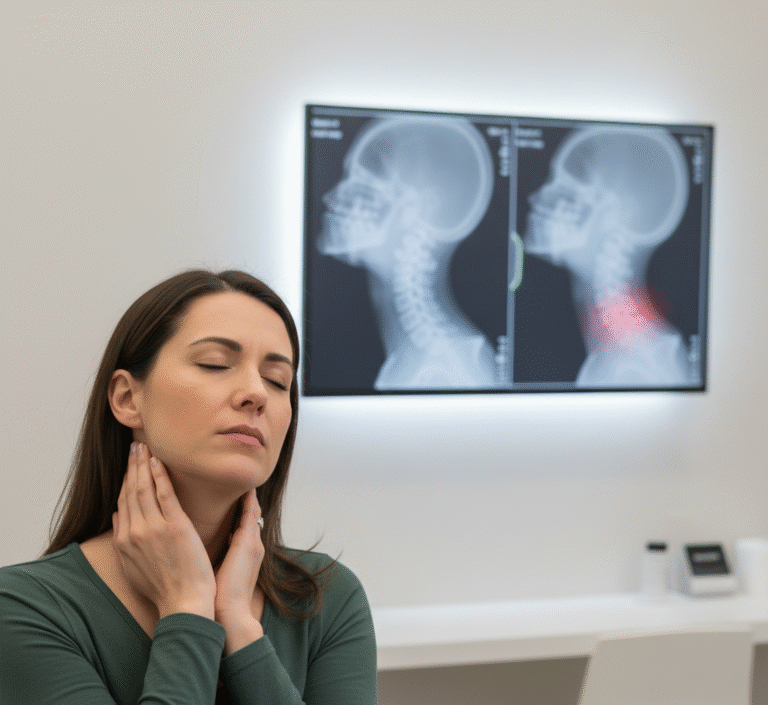
When “Tension Headaches” Are Really a Sign of Cervical Instability
After a car accident or whiplash injury, it’s common to feel sore for a few days. But what if the headaches never stop? Maybe you’ve been told they’re “tension headaches,” “stress,” or “migraine,” yet something about the timing doesn’t add up. Your pain started after the crash and it keeps coming back.
At DMX Miami, we see patients from Miami, Fort Lauderdale, Miami-Dade County, Broward County, and the Florida Keys, as well as from other parts of Florida, the USA, Central and South America (including Colombia, Chile, Argentina, and Mexico), and the Caribbean, who are living with chronic headaches and neck pain after trauma. Often, the hidden problem is cervical ligament damage and spinal instability that standard imaging hasn’t revealed.
Why Whiplash Injuries Can Lead to Chronic Headaches

During a rear-end collision, side impact, or sports injury, the head and neck can be whipped back and forth in milliseconds. This can:
- Stretch or tear the ligaments that stabilize the cervical vertebrae.
- Irritate joints, discs, and small nerves in the upper neck.
- Disrupt normal movement patterns between the skull and upper cervical spine.
Over time, this can create:
- Persistent neck pain and stiffness.
- Headaches that begin at the base of the skull and radiate forward.
- Pain behind the eyes or across the forehead.
- Worsening symptoms with certain positions like looking down at a phone or turning the head.
These are classic signs that the upper cervical spine may be involved.
Symptoms That Suggest Your Headaches May Be Cervical in Origin
You may notice patterns like:
- Headaches that started after a car crash, fall, or whiplash event.
- Pain that worsens with neck movement or poor posture.
- Tenderness at the base of the skull or along the neck muscles.
- “Band-like” pressure around the head that improves when you support the neck.
- Dizziness or a sense of imbalance accompanying the headaches.
If brain imaging (CT, MRI) is normal but these symptoms persist, the problem may be structural instability in the neck not a primary brain disorder.
Why Standard Imaging Often Misses the Cause of Post-Traumatic Headaches
Traditional imaging is invaluable for ruling out emergencies, but it has limitations:
- CT scans are excellent for detecting fractures, but not subtle ligament damage.
- Brain MRIs focus on the brain itself rather than the motion of the cervical spine.
- Static X-rays show alignment in one position, but not how the neck moves.
Ligament injuries and instability are often motion-dependent problems that appear only when the neck is flexed, extended, or rotated. When imaging is done lying down or standing still, these abnormal movements may be invisible.
How Digital Motion X-Ray Evaluates the Neck in Motion
Digital Motion X-Ray (DMX) uses fluoroscopy to record a real-time video of the cervical spine while you move in controlled ways. At DMX Miami, we can:
- Observe how the skull and neck bones move as you bend and rotate.
- Measure abnormal sliding or gapping between vertebrae.
- Identify instability at the upper cervical region (C0-C2) and throughout the neck.
- Correlate your pain-producing positions with visible motion abnormalities.
Instead of a single snapshot, DMX provides a dynamic view of your spine. This can uncover:
- Ligamentous laxity that allows too much movement.
- Joint dysfunction that irritates nerves and tissues.
- Motion patterns that help explain why certain positions trigger your headaches.
How DMX Findings Help Guide Your Care
DMX is a diagnostic tool, not a treatment by itself but it can be critical for building an effective plan. With clear information about where and how your neck is unstable:
- Chiropractors and physical therapists can tailor stabilization and rehabilitation strategies.
- Physicians and pain specialists can better understand the mechanical drivers of your pain.
- Regenerative medicine providers (PRP, prolotherapy, stem cells) can target injured ligaments more precisely.
- Attorneys and insurers can see objective evidence of post-traumatic injury in personal injury cases.
When your providers see the structural reality behind your headaches, they can stop guessing and start planning.
Why Patients with Post-Traumatic Headaches Travel to DMX Miami
Patients come to DMX Miami from:
- South Florida: Miami, Fort Lauderdale, Miami-Dade County, Broward County, and the Florida Keys.
- Across Florida and the rest of the United States.
- Central and South America (including Colombia, Chile, Argentina, and Mexico).
- The Caribbean.
They choose us because we offer:
- Advanced Digital Motion X-Ray focused on detecting cervical instability.
- Experience with complex headache and neck pain cases after trauma.
- Clear, detailed reports for doctors, chiropractors, and attorneys.
- Bilingual care (English and Spanish) for local and international patients.
You Don’t Have to Live on Pain Pills Without Answers
If your headaches and neck pain started after an accident and never fully went away, you deserve a deeper look at your cervical spine.
Learn more: Treatment
Schedule your appointment today: Appointments
Call 305-275-7475 or book your appointment online

Dr. Rodolfo Alfonso, D.C.
Dr. Mark N. Berry, D.C.
Sunset Chiropractic and Wellness
8585 Sunset Dr. STE 102
Miami, Florida 33143