
Why Static Images Can Miss Dynamic Problems in the Spine
One of the most frustrating things you can hear when you’re in pain is, “Your imaging looks normal.” You still hurt when you work, drive, or turn your head but your MRI and X-rays don’t explain why. That doesn’t mean the pain is in your head. It may mean the problem appears only when you move.
At DMX Miami, we serve patients from Miami, Fort Lauderdale, Miami-Dade County, Broward County, and the Florida Keys, along with patients from Florida, the USA, Central and South America (including Colombia, Chile, Argentina, and Mexico), and the Caribbean, who have been told their imaging is “fine,” yet they live with real, ongoing spinal pain.
The Difference Between Static and Dynamic Spinal Problems
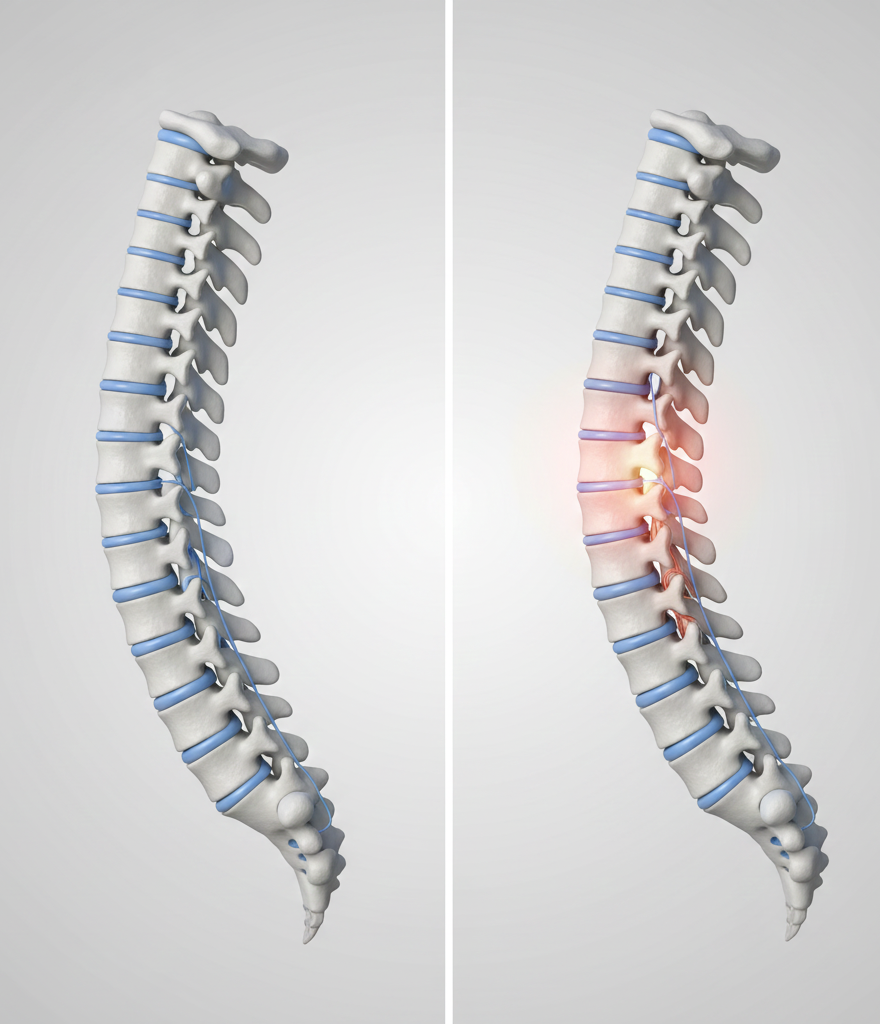
Traditional imaging X-rays, MRI, CT captures the spine in a single position:
- Lying down for MRI.
- Possibly standing still for certain X-rays.
- Limited movement, if any, during the study.
This works well for:
- Fractures.
- Large disc herniations.
- Severe degenerative changes.
But many painful problems are dynamic, meaning they show up:
- Only under gravity.
- Only when you bend, twist, or extend.
- Only during daily activities like driving or lifting.
If the primary issue is ligament instability or abnormal motion, static imaging may miss it entirely.
Signs You Might Have a Dynamic Spinal Problem
You could benefit from a motion-based study like DMX if you notice:
- Pain that changes with position: worse when you bend, twist, or look up/down.
- “Catching” or “locking” sensations with certain movements.
- Symptoms that improve lying down but flare when you’re upright.
- Radiating pain into the shoulders, arms, or legs that doesn’t match MRI findings.
- A long history of being told “everything looks normal” despite persistent pain.
These patterns suggest your spine may move differently under load than it appears on a static image.
What Digital Motion X-Ray Does Differently
Digital Motion X-Ray (DMX) uses fluoroscopy to record your spine in real time as you perform gentle, guided movements. At DMX Miami, we can:
- Record motion in the cervical, thoracic, or lumbar spine.
- Measure how individual vertebrae move as you flex, extend, and rotate.
- Identify points of abnormal translation, angulation, or joint gapping.
- Correlate your painful positions with the actual motion happening in your joints.
Instead of a still photo, DMX provides a video of your spine in action.
Types of Problems DMX May Reveal
DMX can help uncover:
- Ligamentous instability, where joints move too much due to damaged ligaments.
- Subtle joint dysfunction that irritates nearby nerves and soft tissues.
- Patterns of abnormal movement that contribute to chronic pain, headaches, or radiating symptoms.
- Instability in the upper cervical spine, mid-back, low back, or sacroiliac joints.
This information can be especially valuable when other tests have not explained your pain.
How DMX Helps Your Healthcare Team Help You
DMX is not a stand-alone treatment. Its value is in the clarity it provides:
- Chiropractors and physical therapists can build safer, more specific rehabilitation plans.
- Pain management and regenerative medicine specialists can target therapies (like injections) at the right levels.
- Surgeons can better determine whether structural interventions are appropriate.
- Attorneys and insurers can see objective evidence of motion-related injury in accident cases.
When you and your care team finally see how your spine behaves under load, it becomes easier to make informed decisions.
Why Patients with “Normal” Imaging Travel to DMX Miami
Patients come to DMX Miami from:
- South Florida: Miami, Fort Lauderdale, Miami-Dade County, Broward County, and the Florida Keys.
- The rest of Florida and the United States.
- Central and South America including Colombia, Chile, Argentina, and Mexico.
- The Caribbean.
They choose us because we offer:
- Advanced Digital Motion X-Ray with precise motion analysis.
- Detailed reports designed for both clinical and legal use.
- Experience with complex cases where symptoms and imaging don’t match.
- Bilingual support (English and Spanish) for local and international patients.
If Your Pain Is Real but Your Imaging Is “Normal,” You Deserve Better Answers
If your spine pain doesn’t match your MRI or X-ray findings, a motion-based study may be the missing link.
Learn more: Treatment
Schedule your appointment today: Appointments
Call 305-275-7475 or book your appointment online

Dr. Rodolfo Alfonso, D.C.
Dr. Mark N. Berry, D.C.
Sunset Chiropractic and Wellness
8585 Sunset Dr. STE 102
Miami, Florida 33143