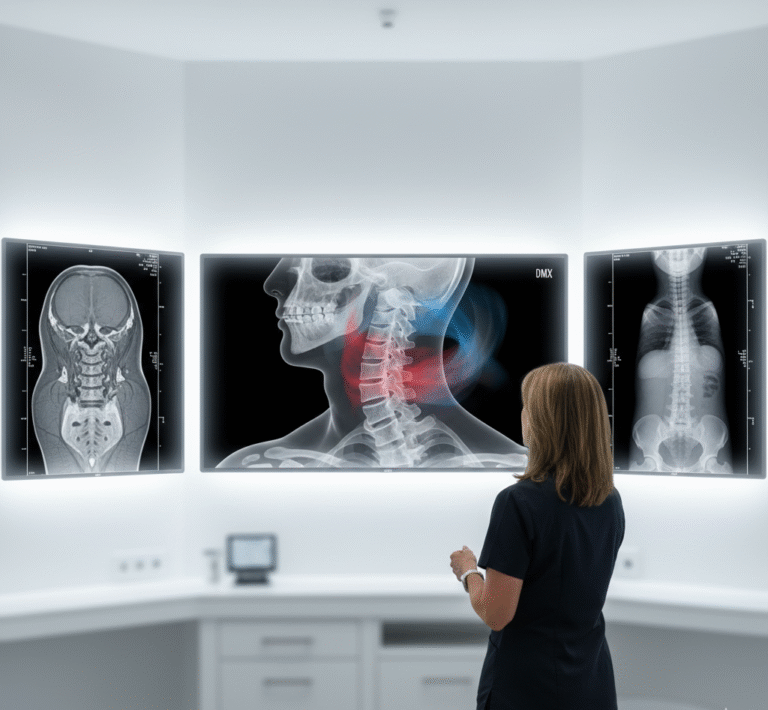
Understanding How Each Imaging Test Looks at Your Spine
If you’ve had neck or back pain after an accidentor from years of wear and tear you may already have a stack of imaging reports: X-rays, MRI, maybe even CT scans. Then someone mentions Digital Motion X-Ray (DMX) and you think, “Another test? What’s different about this one?”
At DMX Miami, we see patients from Miami, Fort Lauderdale, Miami-Dade County, Broward County, and the Florida Keys, as well as from Florida, the USA, Central and South America (including Colombia, Chile, Argentina, and Mexico), and the Caribbean, who are confused about why DMX is needed when they already have “normal” imaging.
What Standard X-Rays Show (and What They Don’t)
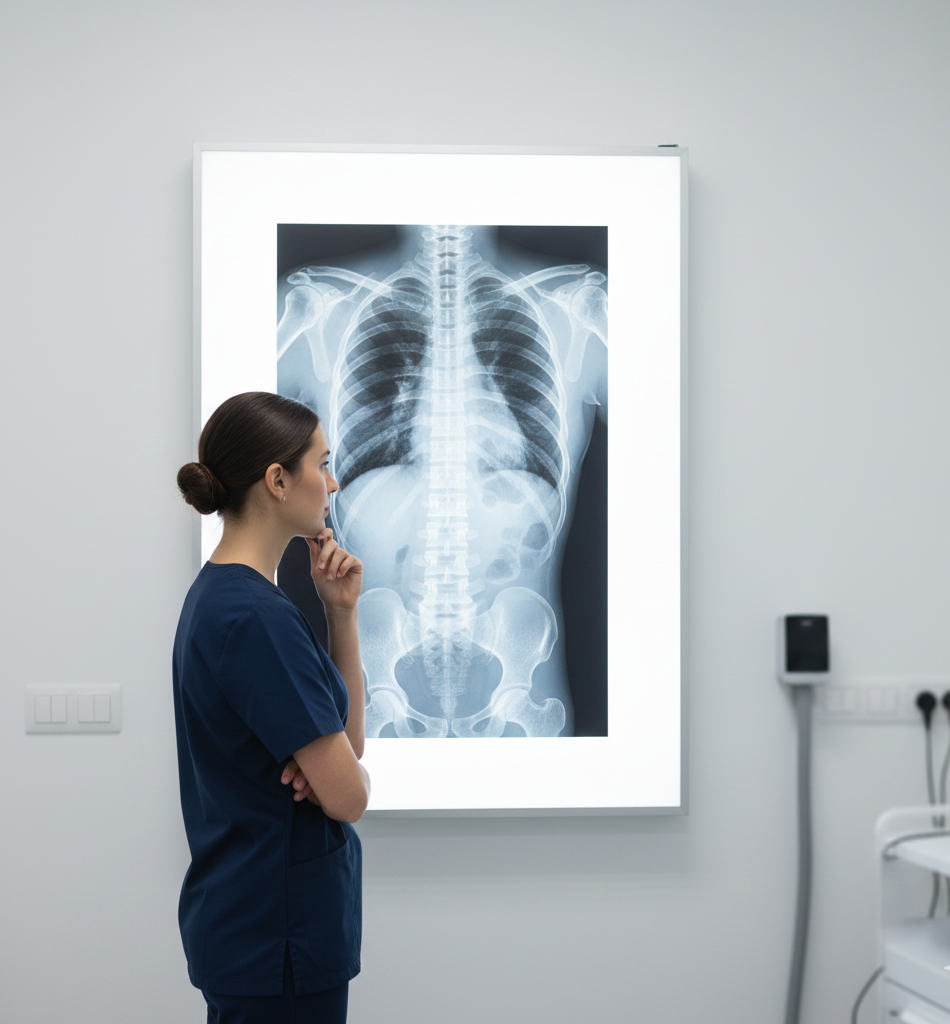
Static X-rays are often the first imaging test ordered. They’re helpful for:
- Detecting fractures.
- Seeing gross alignment issues (severe curvature, major shifts).
- Looking at overall posture and spinal structure.
But static X-rays:
- Are usually taken in one position (standing or sitting still).
- Cannot show how vertebrae move.
- Don’t reveal subtle ligament damage that only appears during motion.
If your main problem is instability or abnormal movement, regular X-rays may miss it.
What MRI Shows (and Why It’s Still Important)
MRI (Magnetic Resonance Imaging) is excellent for:
- Visualizing discs, nerves, and soft tissues.
- Detecting disc herniations or bulges.
- Identifying spinal cord compression or serious pathology,
However, MRI:
- Is almost always performed lying down, with no weight-bearing.
- Gives a snapshot instead of a moving picture.
- Focuses on structure more than function.
You can have a “clean” MRI and still have significant mechanical pain from instability that only appears when you’re upright and moving.
What Makes Digital Motion X-Ray Different
Digital Motion X-Ray (DMX) is a specialized type of fluoroscopy. Instead of a single still image, DMX records a video of your spine in motion.
At DMX Miami, we can:
- Record your cervical, thoracic, or lumbar spine as you bend, extend, and rotate.
- Watch how each vertebra moves relative to the others.
- Measure abnormal translation (sliding) or angulation (tilting) between bones.
- Correlate your painful movements with visible instability.
In other words:
- X-ray: still photo.
- MRI: detailed still photo of soft tissues.
- DMX: live video of your spine while it moves.
When DMX Adds Information You Can’t Get from Other Tests
DMX is especially helpful when:
- You’re still in pain after a car crash, slip-and-fall, sports injury, or work injury.
- MRI and X-rays are “normal” or don’t match your symptoms.
- Certain movements (looking up, rotating, bending, driving) clearly trigger your pain.
- Providers suspect ligament damage or instability.
- Attorneys or insurance companies need objective evidence of motion-related injury.
DMX doesn’t replace MRI or all X-rays. It complements them by asking, “What happens when this spine moves?”
How DMX Results Help Your Healthcare Team
The goal of DMX isn’t just “more images.” It’s better direction for your care:
- Chiropractors and physical therapists can see exactly where the instability is and design focused rehab.
- Pain management and regenerative providers (PRP, prolotherapy, stem cells) can target the right levels.
- Surgeons can better understand whether structural instability is contributing to pain.
- Attorneys can use the motion study as objective documentation in personal injury cases.
When everyone sees the same dynamic picture, it’s easier to create a plan that actually makes sense.
Do You Need All Three: X-Ray, MRI, and DMX?
Not everyone needs every test. But for many complex cases:
- X-rays rule out fractures and show baseline alignment.
- MRI rules out serious disc or cord problems and looks at soft tissues.
- DMX reveals how everything behaves under motion, especially after trauma.
Your doctor or referring provider can help decide which combination is appropriate based on your symptoms and history.
Why Patients from Florida, Latin America, and the Caribbean Choose DMX Miami
Patients travel to DMX Miami because we offer:
- Advanced Digital Motion X-Ray focused on detecting instability.
- Detailed, motion-based reports for doctors, chiropractors, and attorneys.
- Experience in post-traumatic, chronic, and complex spinal cases.
- Bilingual care (English and Spanish) for patients from:
- South Florida: Miami, Fort Lauderdale, Miami-Dade County, Broward County, Florida Keys.
- The rest of Florida and the United States.
- Central and South America: Colombia, Chile, Argentina, Mexico.
- The Caribbean.
When You’re Tired of Being Told “Everything Looks Normal”
If you’re still in pain and your imaging doesn’t explain why, a motion-based study like DMX may be the missing piece.
Learn more: Treatment
Schedule your appointment today: Appointments
Call 305-275-7475 or book your appointment online

Dr. Rodolfo Alfonso, D.C.
Dr. Mark N. Berry, D.C.
Sunset Chiropractic and Wellness
8585 Sunset Dr. STE 102
Miami, Florida 33143