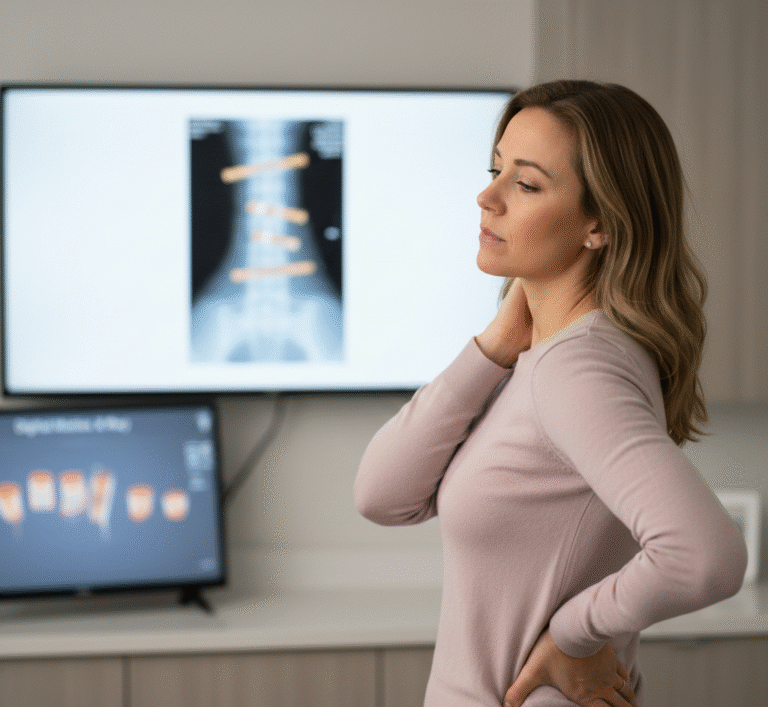
When Pain Continues Even After “Fixing” the Spine
Spinal fusion surgery is meant to stabilize a painful area of the spine. For many people, it does. But some patients continue to have neck or back pain even after their fusion looks “good” on X-ray or MRI. In some cases, the problem is not the fused level itself, but the motion and stress at the levels above or below.
At DMX Miami, we see patients from Miami, Fort Lauderdale, Miami-Dade County, Broward County, and the Florida Keys, and from Florida, the USA, Central and South America (Colombia, Chile, Argentina, Mexico), and the Caribbean, who are still in pain post-fusion and searching for answers.
How Fusion Changes the Mechanics of Your Spine

Fusion surgery permanently connects one or more vertebrae, reducing motion at those levels. This can:
- Decrease painful movement at a severely damaged joint.
- Protect the spinal cord and nerves in unstable areas.
However, when motion is removed at one level:
- Neighboring segments often have to move more to compensate.
- The joints above and below may experience increased stress and wear.
- Over time, this can affect discs, ligaments, and facet joints at those adjacent levels.
This phenomenon is sometimes called adjacent segment disease.
Common Post-Fusion Symptoms That May Involve Instability
You might notice:
- Persistent or new neck or back pain above or below the fusion site.
- Limited motion at the fused area but discomfort when trying to move the remaining segments.
- Headaches, arm pain, or leg pain that don’t match your initial pre-surgical symptoms.
- Stiffness in one area and a feeling of “too much movement” or strain in another.
Static X-rays or MRI may show that the fusion itself is intact, yet your symptoms continue.
Why Traditional Imaging Might Not Show the Whole Picture
Post-fusion imaging often focuses on:
- Whether the bone graft has fused correctly.
- Whether screws, rods, or plates are in good position.
- Whether there’s major disc herniation or nerve compression nearby.
But standard X-rays and MRI:
- Are usually taken in static positions lying down or standing still.
- Don’t always show motion-dependent stress at adjacent levels.
- May not reveal subtle ligament damage or abnormal sliding at non-fused segments.
That’s where Digital Motion X-Ray can provide more detail.
How Digital Motion X-Ray Evaluates the Spine After Fusion
DMX allows us to see how the non-fused segments behave in real time. At DMX Miami, we can:
- Record gentle, controlled motion of your cervical or lumbar spine.
- Measure how vertebrae move above and below the fused segment.
- Identify excessive translation or angulation that suggests instability.
- Correlate your painful movements with what we see on screen.
We are not evaluating the fusion hardware itself (that’s better for CT/MRI), but instead examining how the rest of your spine is coping with the altered mechanics.
How DMX Findings Can Help You and Your Providers
DMX can:
- Help chiropractors, physical therapists, and rehab professionals focus on stabilizing vulnerable levels.
- Assist regenerative medicine providers in targeting ligaments or facet joints under excess stress.
- Give surgeons more information if they are considering whether another intervention is truly necessary.
- Provide attorneys with a clearer understanding of post-surgical mechanical issues in injury cases.
The goal is not to “undo” the fusion, but to understand how adjacent segments are functioning so your treatment can be more precise.
Is DMX Safe After Fusion?
DMX uses controlled motion guided by your comfort level and the clinical judgment of the ordering provider. In appropriate cases:
- Movements are gentle, limited, and supervised.
- The focus is on segments that are safe to move not forcing motion through fused areas.
- Your history and prior imaging are reviewed to determine if DMX is appropriate.
Not every post-surgical patient is a candidate, but many are.
Why Post-Fusion Patients Travel to DMX Miami
Patients come to DMX Miami from:
- South Florida: Miami, Fort Lauderdale, Miami-Dade County, Broward County, Florida Keys.
- Across Florida and the United States.
- Central and South America: Colombia, Chile, Argentina, Mexico.
- The Caribbean.
They choose us because we:
- Provide advanced motion-based evaluation of the spine after fusion.
- Offer detailed reports that integrate with surgical, regenerative, and rehab care.
- Understand the complexity of pain that persists despite “successful” surgery.
- Offer bilingual care in English and Spanish.
If Your Fusion Looks “Fine” but You’re Still in Pain, You Deserve a Deeper Look
If you’ve had spinal fusion and still struggle with pain or new symptoms, a motion-based evaluation may help answer “why.”
Learn more: Treatment
Schedule your appointment today: Appointments
Call 305-275-7475 or book your appointment online

Dr. Rodolfo Alfonso, D.C.
Dr. Mark N. Berry, D.C.
Sunset Chiropractic and Wellness
8585 Sunset Dr. STE 102
Miami, Florida 33143