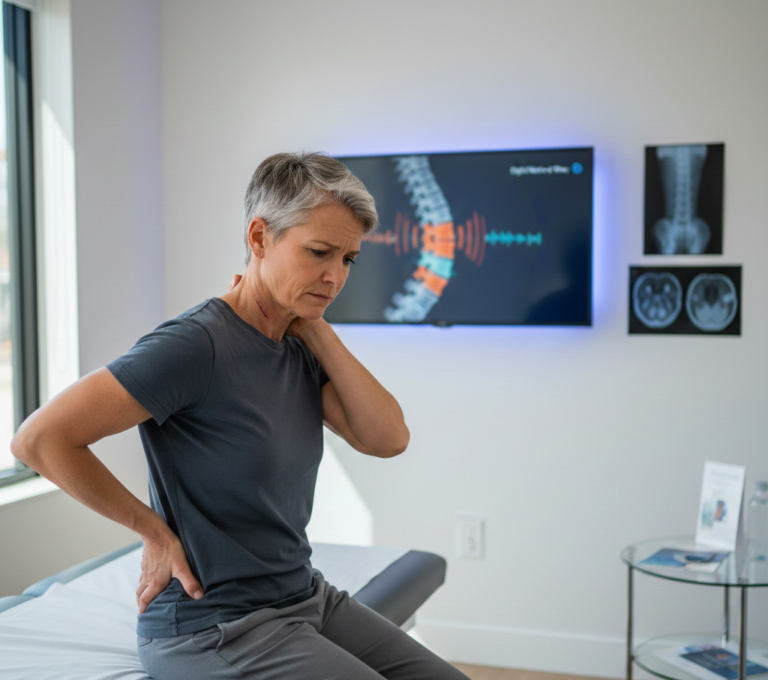
When “Successful” Surgery Doesn’t Match How You Feel.
Spine surgery is a big decision. Patients in Miami, Fort Lauderdale, Miami-Dade, Broward, the Florida Keys, and across Florida, as well as those traveling from the USA, Central and South America (Colombia, Chile, Argentina, Mexico), and the Caribbean, often hear:
- “Your surgery went well.”
- “The hardware looks fine.”
- “Your MRI looks much better now.”
But months later, they still feel:
- Persistent neck or low back pain.
- Ongoing headaches or arm/leg symptoms.
- Stiffness, fatigue, and difficulty trusting their body.
At DMX Miami, we frequently meet people whose post-surgical imaging looks “good”, but their pain and function tell a different story. One missing piece can be how the spine behaves in motion.
Why Surgery Doesn’t Always End the Story.
Spine surgery can:
- Decompress nerves.
- Stabilize severely unstable segments.
- Remove or repair damaged tissue.
But it can’t always:
- Restore perfect ligament function.
- Eliminate all abnormal motion at adjacent levels.
- Correct every existing mechanical problem.
Even if hardware and fusion levels look good on static X-ray or MRI, you might still have:
- Residual instability above or below the surgical site.
- Compensatory motion elsewhere.
- Ongoing stress on discs and facet joints near the fusion.
Static imaging alone may not fully explain ongoing symptoms.
What Standard Post-Surgical Imaging Shows and What It Doesn’t.
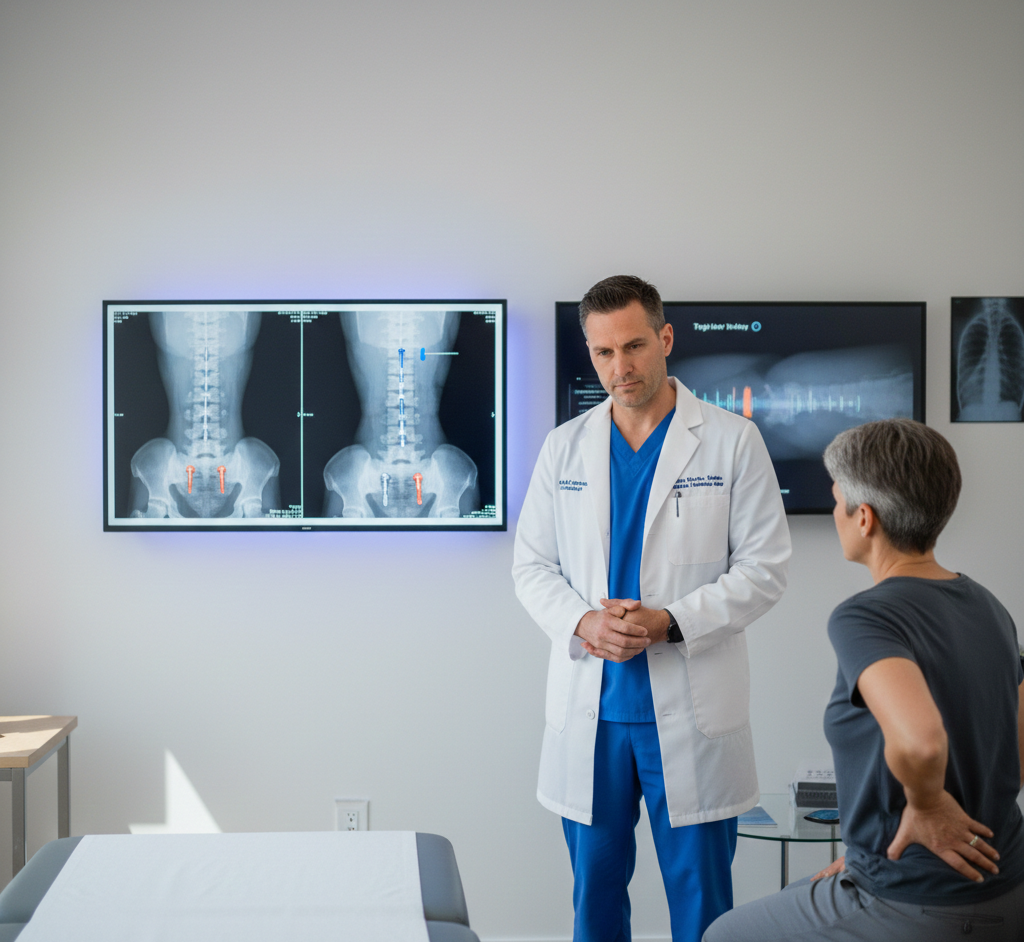
Post-surgery, you might have:
- X-rays to check hardware position and fusion.
- MRI or CT to look at discs, nerves, and bone healing.
These are essential. But they are almost always done:
- In still positions.
- Often lying down or standing with minimal motion.
They answer the question:
“What does your spine look like now?”
They do not answer:
“How does your spine move now?”
That’s where Digital Motion X-Ray (DMX) can add critical insight.
How Digital Motion X-Ray Evaluates the Post-Surgical Spine.
At DMX Miami, Digital Motion X-Ray:
- Uses fluoroscopic video X-ray to see the spine while it moves.
- Evaluates the cervical, thoracic, or lumbar regions under guided motion.
- Measures abnormal translation (sliding) and angulation (tilting) between vertebrae.
- Helps identify:
- Residual or new instability at segments above or below a fusion.
- Abnormal motion patterns that stress joints and soft tissues.
- Levels that may be contributing to pain even when hardware looks fine.
In other words, DMX helps you and your doctors understand how the spine behaves after surgery, not just how it looks.
How DMX Findings Can Help Your Care Team.
When your doctor orders DMX and the results reveal abnormal motion, they can:
- Adjust rehab toward segment-specific stabilization.
- Protect certain levels from excessive stress or manipulation.
- Target injections or regenerative approaches at the right segments.
- Provide more complete documentation if your surgery was related to a personal injury or work case.
DMX doesn’t replace your surgeon’s follow-up it complements it with motion-based information.
Who Might Consider DMX After Spine Surgery?
DMX may be worth discussing with your provider if:
- You’ve had cervical or lumbar surgery and still have significant pain.
- Your symptoms clearly worsen with certain motions or positions.
- Standard imaging doesn’t match the way you feel.
- You’re considering additional procedures and want the clearest picture possible.
Patients often travel to DMX Miami from across Florida, the USA, Central and South America, and the Caribbean to understand why they’re still struggling after surgery.
Surgery Was a Step, Not the Final Answer.
If your imaging report says “stable” but your body says otherwise, it’s reasonable to look deeper. Digital Motion X-Ray can help reveal whether continued pain is linked to how your spine moves, not just how it looks.
👉 If you’re still in pain after spine surgery, ask your provider whether Digital Motion X-Ray could clarify what’s going on, then contact our office.
Learn more: Treatment
Schedule your appointment today:Appointments
Call 305-275-7475 orbook your appointment online

Dr. Rodolfo Alfonso, D.C.
Dr. Mark N. Berry, D.C.
Sunset Chiropractic and Wellness
8585 Sunset Dr. STE 102
Miami, Florida 33143