
How DMX Evaluates Motion-Based Low Back Problems
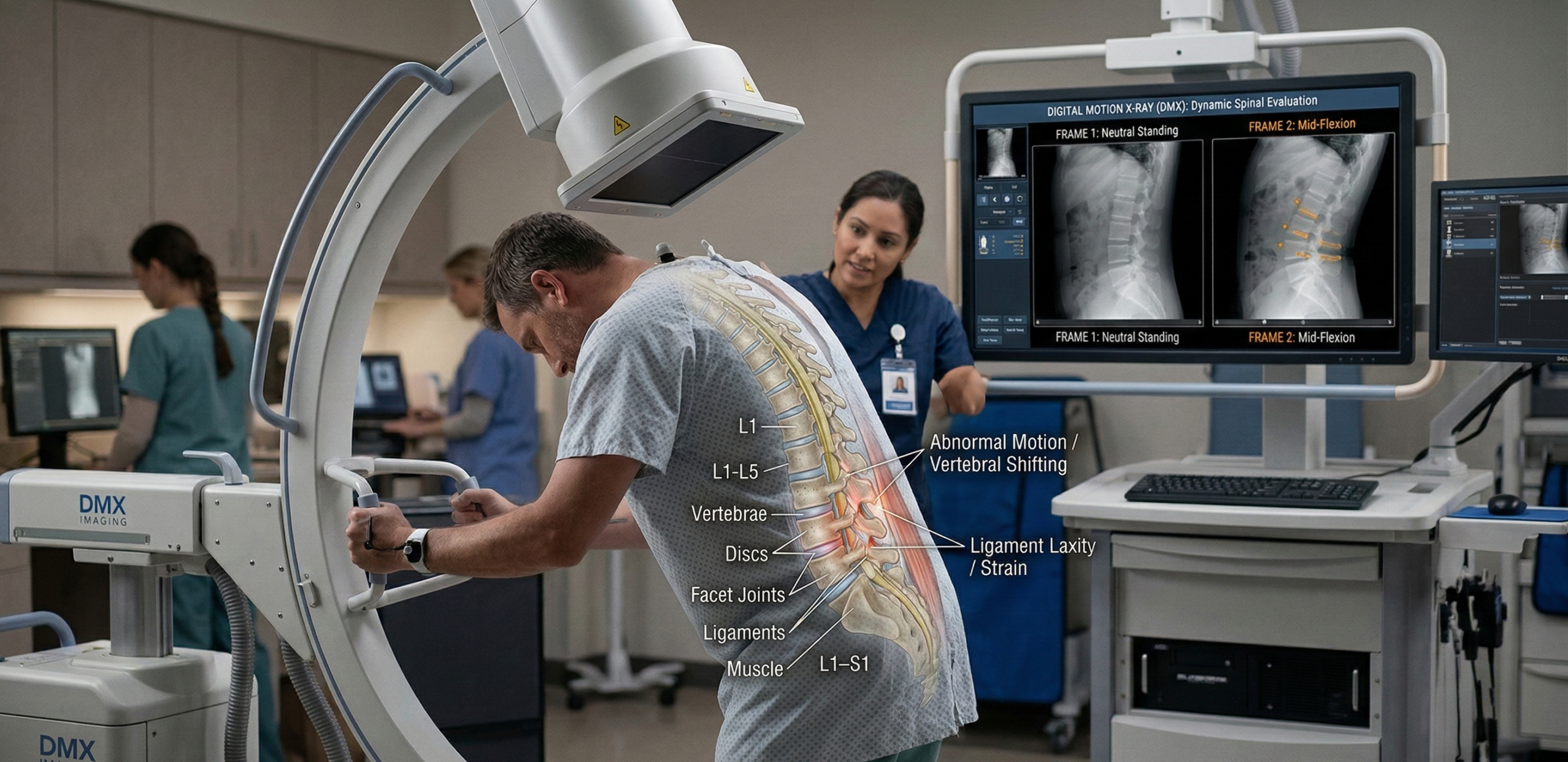
Many patients don’t just have low back pain they experience:
- Numbness or tingling in the legs.
- Heaviness or weakness when standing.
- Symptoms that improve when sitting.
- A sense that the back “gives out” after a short time upright.
Across Miami, Fort Lauderdale, Broward, Miami-Dade, and the Florida Keys, and in patients traveling from the USA, Central/South America, and the Caribbean, this pattern is commonly attributed to “sciatica.”
But sometimes the deeper cause is lumbar instability abnormal motion between vertebrae that stresses nerves and tissues when you’re upright.
Why Symptoms Can Be Worse Upright Than Sitting
Standing and walking:
- Load the lumbar spine.
- Increase demand on stabilizing ligaments.
- Reveal motion problems that aren’t obvious lying down.
That’s why a patient can have:
- A “not terrible” MRI.
- Mild degenerative findings.
- No obvious surgical lesion.
…and still have severe, position-dependent symptoms.
The Limits of MRI for Motion-Based Problems
MRI is excellent for discs and nerves, but it is usually:
- Done lying down.
- Static.
- Not evaluating how the spine behaves during movement.
If your symptoms are triggered by motion, posture, and loading, DMX can add important context.
How Digital Motion X-Ray Evaluates the Lumbar Spine
DMX records fluoroscopic video as the spine moves through guided ranges, allowing providers to observe:
- Segmental motion patterns.
- Excessive translation or angulation.
- Abnormal movement sequences that correlate with symptom triggers.
This can help your provider answer:
- Is one lumbar segment moving too much?
- Is motion uneven (one hypermobile level compensating for a stiff region)?
- Does instability correlate with leg symptoms?
When to Consider Lumbar DMX
You and your provider may consider DMX if:
- Leg numbness worsens when standing or walking.
- Symptoms improve significantly when sitting.
- Back feels unstable or “shifts.”
- Standard imaging does not fully explain severity.
- Your symptoms started after trauma (car accident, fall, heavy lifting injury.)
DMX Helps Shift from Guessing to Precision
When motion-based instability is found, providers can:
- Build a rehab plan focused on stability and control.
- Avoid movements that aggravate unstable levels.
- Target therapies and procedures more precisely.
- Better explain why symptoms are posture-dependent.
If Symptoms Are Motion-Dependent, Your Imaging Should Be Too
If your symptoms show up when you’re upright and moving, it makes sense to consider imaging that evaluates the spine the same way in motion.
👉 Ask your provider if lumbar DMX is appropriate for your case.
👉 Contact DMX Miami to learn more about Digital Motion X-Ray.
Learn more: Treatment
Schedule your appointment today:Appointments
Call 305-275-7475 orbook your appointment online

Dr. Rodolfo Alfonso, D.C.
Dr. Mark N. Berry, D.C.
Sunset Chiropractic and Wellness
8585 Sunset Dr. STE 102
Miami, Florida 33143