
How Digital Motion X-Ray Helps When Brain Imaging Looks “Normal”
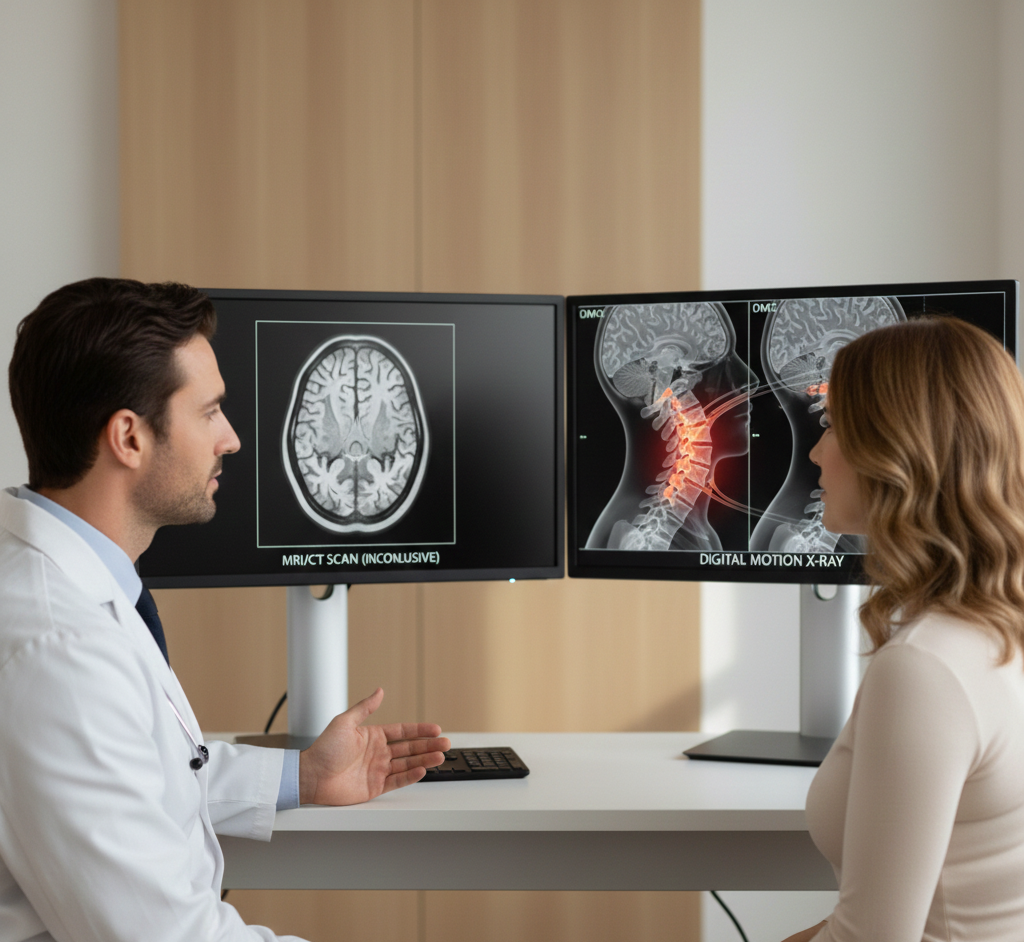
If you’ve been living with chronic headaches or migraines, you’ve probably already tried:
- Medications.
- Eye exams.
- Brain MRI or CT.
- Stress management, diet changes, and more.
Yet the pain keeps coming back often starting at the base of the skull or radiating from the neck into the head. Many patients at DMX Miami from Miami, Fort Lauderdale, Miami-Dade County, Broward County, the Florida Keys, and even from Florida, the USA, Central and South America (Colombia, Chile, Argentina, Mexico), and the Caribbean eventually discover that the missing link isn’t in the brain at all it’s in the cervical spine.
How the Upper Neck Can Trigger Headaches
The upper cervical spine especially the segments around C0–C2 contains:
- Critical ligaments that guide head and neck motion.
- A dense network of nerves and proprioceptors.
- Joints and muscles that are closely connected to headache pathways.
When these ligaments are stretched, torn, or unstable (often from whiplash, sports injuries, or repeated strain):
- The joints in the upper neck can move abnormally.
- Local nerves and muscles become irritated.
- Pain can be referred into the head, behind the eyes, or into the temples.
Result: headaches that feel “neurological” but are deeply mechanical and structural.
Signs Your Headaches Might Be Coming from Your Neck
Neck-related headaches (often called cervicogenic headaches) tend to:
- Start at the base of the skull and move upward.
- Worsen with certain neck positions (looking down, looking up, or holding the head in one posture).
- Come with neck pain, stiffness, or a heavy-head feeling.
- Be triggered by activities like long drives, computer work, or phone use.
These patterns don’t rule out other causes, but they strongly suggest the neck should be fully evaluated, not just the brain.
Why Standard Imaging Often Misses Cervical Instability
Brain MRI and CT are excellent for ruling out:
- Tumors.
- Bleeding.
- Major structural problems.
Static cervical X-rays can show:
- Fractures.
- Severe misalignments.
- Advanced degeneration.
But what they don’t show well is:
- How vertebrae move relative to each other during motion.
- Subtle ligamentous laxity that appears only with flexion, extension, or rotation.
That’s where Digital Motion X-Ray (DMX) comes in.
How Digital Motion X-Ray Evaluates Cervical Instability
At DMX Miami, we use Digital Motion X-Ray to take a real-time look at the neck in motion:
- You perform gentle, guided movements of the head and neck.
- The DMX system records fluoroscopic video sequences.
- We measure abnormal sliding (translation) and tilting (angulation) between vertebrae.
- We focus especially on the upper cervical levels that often correlate with headache patterns.
Instead of guessing, we can see which joints are stable and which appear to be moving too much.
How This Information Helps Your Providers
DMX findings can guide:
- Chiropractors and physical therapists in designing safe, targeted upper cervical stabilization programs.
- Pain management or regenerative physicians in deciding where precise treatments (like PRP or other regenerative options) may be helpful.
- Neurologists and primary doctors in understanding why headaches persist despite normal brain imaging.
- Attorneys and insurers in documenting post-traumatic ligament injuries in med-legal cases.
The goal is a coordinated plan that treats your head and neck as a connected system.
Who Should Consider DMX for Headache Evaluation?
DMX may be appropriate if:
- Your headaches started or worsened after a car crash, fall, or sports injury.
- Your brain imaging is normal, but neck symptoms are clear.
- Certain neck movements consistently trigger or increase your headaches.
- You’ve tried multiple treatments without lasting relief.
DMX does not replace emergency evaluation for sudden, severe headaches but it can be crucial when the acute danger is ruled out but chronic pain remains.
Why Headache and Migraine Patients Travel to DMX Miami
Patients come to DMX Miami from:
- South Florida: Miami, Fort Lauderdale, Miami-Dade, Broward, the Florida Keys.
- Across Florida and the United States.
- Central and South America: Colombia, Chile, Argentina, Mexico.
- The Caribbean.
They choose us because we:
- Specialize in motion-based spinal imaging, not just standard radiology.
- Understand the neck–headache connection in both traumatic and chronic cases.
- Provide clear, structured reports for your care team and, when needed, your attorney.
- Offer bilingual (English and Spanish) support for local and international patients.
When Your Head Hurts, Don’t Forget to Look at Your Neck
If you’ve been told “your brain is fine” but your headaches are not, your neck may still be asking for attention.
Learn more: Treatment
Schedule your appointment today: Appointments
Call 305-275-7475 or book your appointment online

Dr. Rodolfo Alfonso, D.C.
Dr. Mark N. Berry, D.C.
Sunset Chiropractic and Wellness
8585 Sunset Dr. STE 102
Miami, Florida 33143