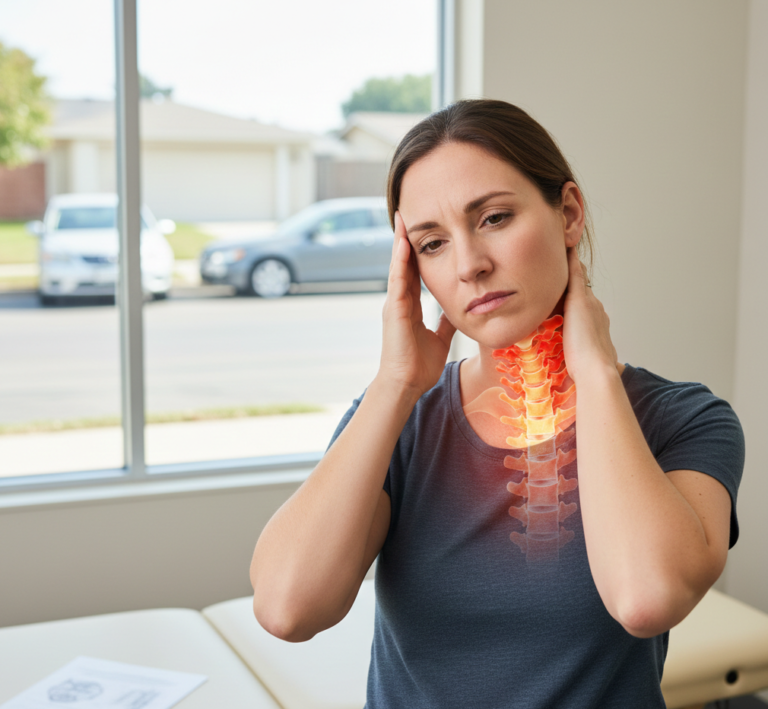
When Pain Pills and “Normal” Scans Aren’t Giving You Answers.
If you had a car accident, sports injury, or fall, you may have been told you had:
- A mild whiplash.
- Muscle strain or sprain.
- “Soft-tissue injury.”
Maybe you did some therapy, took medications, and went back to life. But months or even years later, you still have:
- Headaches that start at the base of your skull.
- Neck pain and stiffness, especially at the end of the day.
- Pain that radiates behind the eyes or into the shoulders.
- A sense that your head feels “heavy” or your neck fatigues easily.
At DMX Miami, we often meet patients from Miami, Fort Lauderdale, Miami-Dade, Broward, the Florida Keys, and throughout Florida, as well as visitors from the USA, Central and South America (Colombia, Chile, Argentina, Mexico) and the Caribbean, who are stuck in this exact situation. Their life is limited by headaches and neck pain, but their MRI and CT scans don’t fully explain why.
What Happens to the Neck in a Whiplash-Type Injury?

When your head and neck are suddenly forced into rapid flexion and extension, ligaments can:
- Stretch beyond their normal limits.
- Partially tear.
- Lose some of their ability to control and limit motion.
These ligaments are designed to stabilize the vertebrae and guide normal motion. When they’re weakened, vertebrae can begin to:
- Slide (abnormal translation).
- Tilt (abnormal angulation).
- Move too far, too fast, or in the wrong way.
This is called cervical instability.
How Instability Can Trigger Headaches and Neck Pain.
Instability in the cervical spine can:
- Strain muscles that are constantly trying to “brace” the area.
- Irritate joints, discs, and local pain-sensitive structures.
- Disrupt normal nerve and proprioceptive (position-sense) signals from the neck to the brain.
The result is a cluster of symptoms:
- Headaches starting in the neck and radiating upward.
- Pain with certain positions (looking down at a phone, working at a computer, driving).
- Stiffness relieved temporarily by massage or stretching but it always returns.
- Fatigue and soreness at the base of the skull.
This is especially common in people who spend long hours working at computers in places like Miami and Fort Lauderdale, or who travel frequently around the USA, Latin America, and the Caribbean.
Why Standard Imaging Often Misses Cervical Instability.
MRI and CT are essential tools, but they are usually done:
- Lying down.
- Completely still.
They are excellent for:
- Disc herniations.
- Nerve compression.
- Tumors, infections, and major structural changes.
However, they do not show how the cervical spine behaves when it moves. Instability by definition is a motion problem.
That’s where Digital Motion X-Ray (DMX) comes in.
How Digital Motion X-Ray Evaluates the Neck in Motion.
At DMX Miami, Digital Motion X-Ray:
- Uses fluoroscopic video X-ray to capture your cervical spine in real time.
- Records your neck while you perform gentle, guided movements like bending, extending, and rotating.
- Measures abnormal translation and angulation between vertebrae.
- Helps identify specific levels where ligaments may be failing to control motion.
Instead of a single still image, you get a movie of your neck in motion, which can explain why certain positions or movements always trigger your pain.
How DMX Findings Can Help Your Treatment Team.
When DMX reveals cervical instability that matches your symptoms, your healthcare team can:
- Focus rehab on stabilization, not just stretching.
- Modify manual techniques or chiropractic adjustments to avoid stressing unstable levels.
- Consider targeted procedures (including regenerative medicine or pain interventions) with more precise information.
- Provide better documentation in med-legal or personal injury cases when appropriate.
At DMX Miami, our role is diagnostic to give your providers the clearest view possible of what your neck is doing when it moves.
Who Should Consider Digital Motion X-Ray for Neck-Related Headaches?
DMX may be appropriate to discuss with your provider if:
- Your headaches started after an accident or trauma.
- You have persistent neck pain and stiffness that never fully resolved.
- Symptoms vary strongly with posture and movement.
- Standard imaging has not explained the severity of your symptoms.
Whether you live in South Florida or are traveling from the USA, Central or South America, or the Caribbean, Digital Motion X-Ray can be an important piece of the puzzle.
Your Headaches Aren’t “All in Your Head” Your Neck May Be Asking for Help.
Chronic post-traumatic headaches can be exhausting and discouraging. Understanding how your neck moves may finally give your team the information they need to treat the real problem, not just mask the symptoms.👉 Learn more: DMX Miami.
👉 Ask your provider whether cervical Digital Motion X-Ray could help clarify the cause of your headaches and neck pain, then contact our office to coordinate an evaluation.
Learn more: Treatment
Schedule your appointment today:Appointments
Call 305-275-7475 orbook your appointment online

Dr. Rodolfo Alfonso, D.C.
Dr. Mark N. Berry, D.C.
Sunset Chiropractic and Wellness
8585 Sunset Dr. STE 102
Miami, Florida 33143.