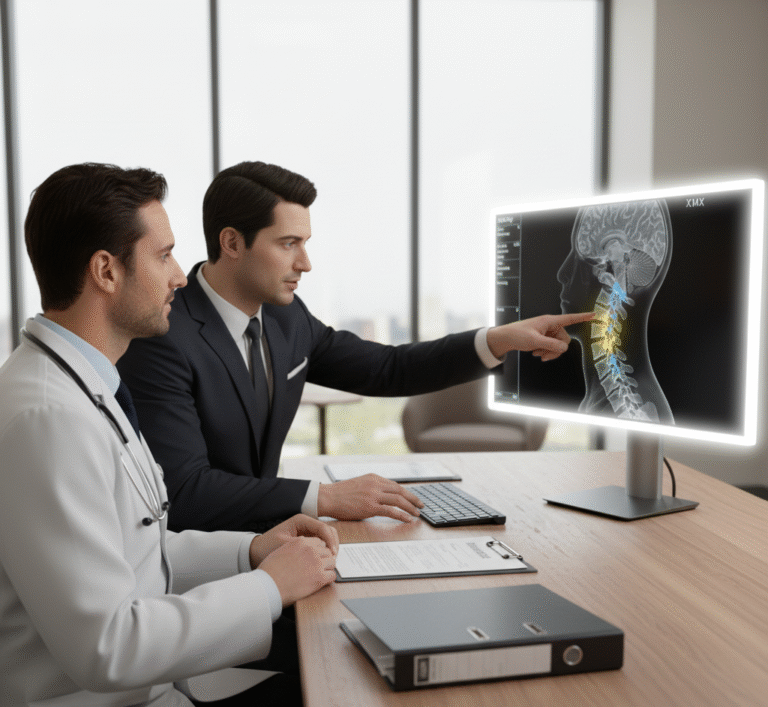
Why Motion-Based Imaging Changes the Conversation with Adjusters and Juries
Personal injury attorneys hear it all the time:
- “Minimal property damage.”
- “Normal X-rays.”
- “Soft-tissue sprain/strain.”
Meanwhile, your client in Miami, Fort Lauderdale, Broward, Miami-Dade, the Florida Keys, or beyond lives with ongoing neck and back pain that directly affects their work, family life, and long-term function. Without clear imaging of ligamentous instability, these cases can be unfairly minimized.
At DMX Miami, we provide Digital Motion X-Ray studies for clients from Florida, the USA, Central and South America (Colombia, Chile, Argentina, Mexico), and the Caribbean, giving attorneys objective, motion-based documentation to support their injury narrative.
The Problem with “Soft-Tissue Only” Documentation
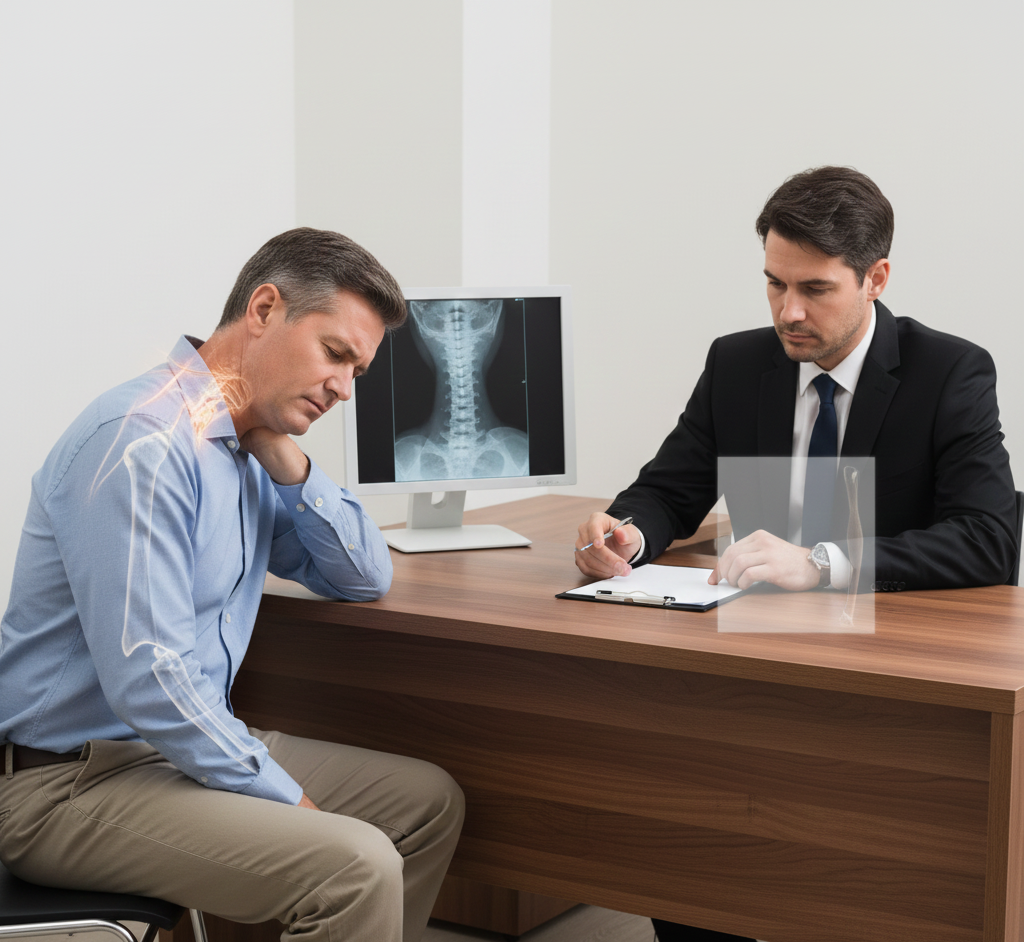
Realistic medical-legal concept image showing a patient with visible neck or back discomfort sitting across from a professional reviewing a thin or incomplete medical report. A standard imaging screen (X-ray or MRI) appears normal or inconclusive. In contrast, faint outlines of cervical or lumbar ligaments are subtly visible but not documented, symbolizing injuries that are overlooked when cases are labeled as “soft-tissue only.” Clean, modern clinic or consultation room, neutral professional lighting, calm but serious tone. No text, no logos.
Traditional imaging often focuses on:
- Fractures.
- Dislocations.
- Acute disc herniations.
When these are absent, reports often describe:
- “No acute osseous abnormality.”
- “No fracture or dislocation.”
- “Mild degenerative changes.”
For adjusters and defense experts, this can be spun as:
- “This is just a sprain that should have healed.”
- “There’s no objective evidence of serious injury.”
But we know that ligament damage and instability can persist long after the accident and that these injuries are real, measurable, and life-changing.
What Digital Motion X-Ray Shows That Static Imaging Can’t
Digital Motion X-Ray (DMX) at DMX Miami:
- Records real-time fluoroscopic video of the spine in motion.
- Measures abnormal translation (sliding) and angulation (tilting) between vertebrae.
- Documents ligamentous laxity and segmental instability.
- Correlates motion abnormalities with your client’s symptomatic areas.
In other words, DMX makes it possible to show dynamic injury instead of just static snapshots.
How DMX Strengthens the Med-Legal Story
With a properly performed DMX study, you can:
- Demonstrate that after the crash, the client’s neck or back is no longer moving normally.
- Show how instability can cause persistent pain, muscle guarding, and functional limitations.
- Support treating doctors’ opinions about permanence and impairment.
- Help rebut the argument that “nothing is wrong” because MRI and CT look mild.
This kind of objective, video-based evidence can be powerful in:
- Negotiations with adjusters.
- Depositions with defense experts.
- Mediation and trial, where jurors can see the injury, not just hear about it.
When Should Attorneys Consider DMX?
Attorneys often consider referring for DMX when:
- The case involves whiplash, multi-impact collisions, or low-speed crashes with major symptoms.
- The client has ongoing pain but “minimal” findings on standard imaging.
- Treating providers suspect ligamentous instability or excessive motion.
- The case may involve permanent impairment or long-term care needs.
DMX is particularly valuable in cases where your client’s story and their imaging appear misaligned.until motion-based imaging fills the gap.
Working with DMX Miami as an Attorney
At DMX Miami, we:
- Perform rigorous Digital Motion X-Ray studies focused on cervical, thoracic, and lumbar instability.
- Provide structured reports that:
- Identify levels of abnormal motion.
- Quantify translation and angulation.
- Explain how findings relate to mechanical pain.
- Coordinate with treating providers and, where appropriate, with your office for documentation.
- Offer imaging services to clients from South Florida, the rest of Florida and the USA, Central and South America, and the Caribbean
We are not a law firm and do not give legal advice. Our role is to provide objective, high-quality imaging that supports your case.
How DMX Helps Your Client’s Care, Not Just Their Case
Beyond legal documentation, DMX results can:
- Help providers design more precise treatment and rehab.
- Clarify when regenerative or interventional options might be appropriate.
- Set realistic expectations about long-term outcomes and restrictions.
This means you’re not just building a stronger case you’re helping your client receive more targeted care.
Why Personal Injury Firms Choose DMX Miami
Attorneys and their clients choose DMX Miami because we:
- Specialize in Digital Motion X-Ray rather than generic imaging.
- Understand med-legal needs while staying firmly within our clinical role.
- Provide clear, reproducible documentation of ligamentous instability.
- Offer bilingual support for clients from English- and Spanish-speaking regions.
If the Injury Only Appears in Motion, Your Imaging Should Too
When your client’s pain is clearly real but their static imaging doesn’t tell the story, it’s time to consider motion-based documentation.
Learn more: Treatment
Schedule your appointment today: Appointments
Call 305-275-7475 or book your appointment online

Dr. Rodolfo Alfonso, D.C.
Dr. Mark N. Berry, D.C.
Sunset Chiropractic and Wellness
8585 Sunset Dr. STE 102
Miami, Florida 33143