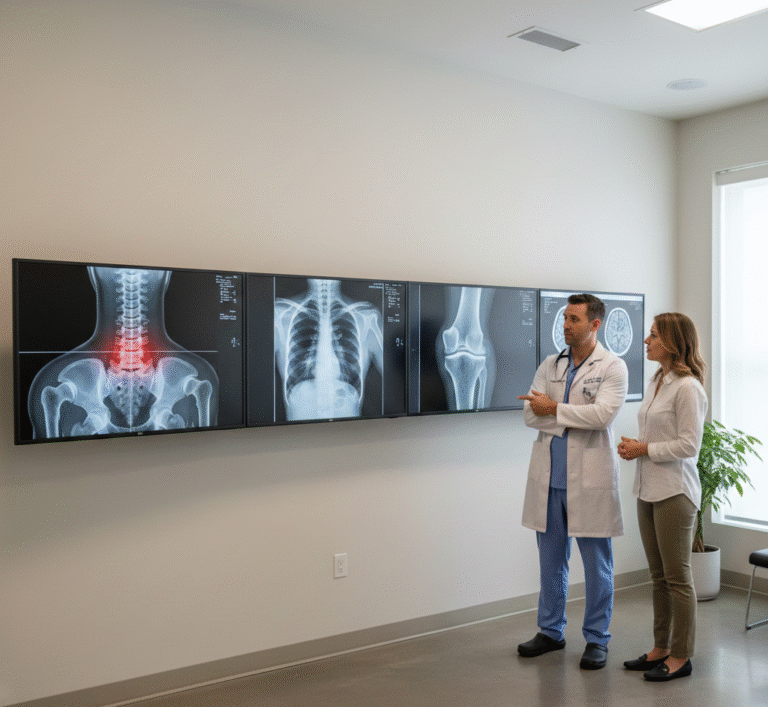
Understanding the Difference So You Can Get Real Answers
When you’re in pain after an accident or chronic spine problem, you may feel like you’ve already had “every test”:
- ER or urgent-care X-rays
- A CT scan to rule out fractures or bleeding
- An MRI of your neck or back
Yet you still don’t have a clear explanation for why your neck, mid-back, or low back hurts especially when you move. That’s when many patients end up at DMX Miami, asking a simple question: “How is Digital Motion X-Ray different?”
We see patients from Miami, Fort Lauderdale, Miami-Dade County, Broward County, the Florida Keys, and from across Florida, the USA, Central and South America (Colombia, Chile, Argentina, Mexico), and the Caribbean, who need a test that looks at the spine the way they actually use it in motion.
What Standard X-Ray Does Well (and Where It Stops)
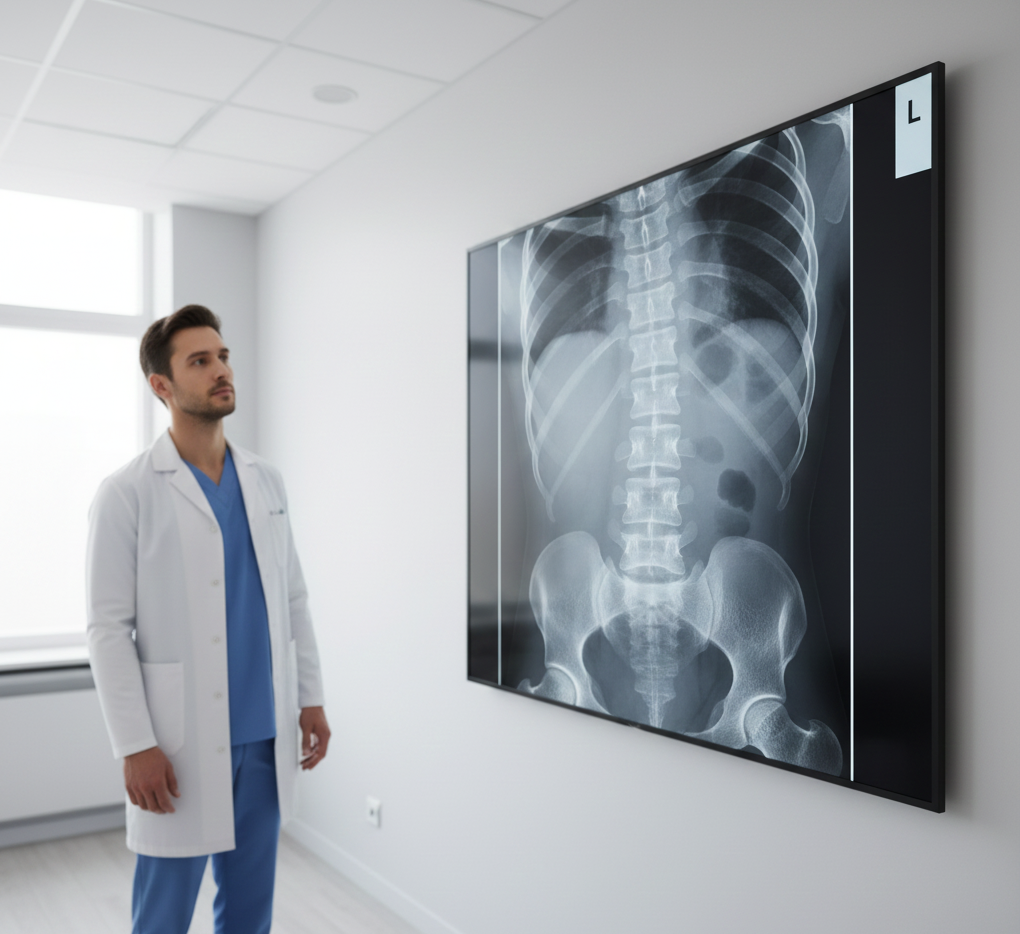
Conventional X-ray is great for a quick look at:
- Fractures and obvious dislocations
- Major alignment problems
- Severe degenerative changes
But standard X-rays are:
- Static – just a snapshot in one position
- Often taken lying or standing still
- Focused mostly on bones, not how those bones move
If your main issue is ligament damage and subtle instability, a static X-ray may look completely “normal.”
What CT Scans Are Good For
A CT scan uses many X-ray images combined by a computer to create detailed cross-sectional views. It’s excellent for:
- Complex fractures
- Some disc problems
- Certain trauma situations
But CT scans are:
- Still static, not real-time motion
- Less focused on subtle ligament laxity
- Usually done lying down, not in a functional, weight-bearing motion pattern
Again, useful but not the full story for many post-whiplash or chronic instability patients.
Where MRI Shines and Its Blind Spots
MRI is the best tool for:
- Evaluating discs, nerves, and soft tissues
- Ruling out tumors, infections, and serious internal pathology
However, MRI is typically:
- Done while you’re lying flat
- Capturing still images, not motion
- Optimized for soft tissue detail, not small changes in intersegmental movement
Many patients are told, “Your MRI looks pretty good,” while they continue to have pain that clearly changes with movement or position.
What Makes Digital Motion X-Ray Different
Digital Motion X-Ray (DMX) at DMX Miami is designed to answer a different question:
“What happens to your spine when it moves under real-world conditions?”
DMX:
- Uses fluoroscopy to record real-time video of your spine in motion
- Is typically done with you standing, to simulate daily life forces
- Measures translation (sliding) and angulation (tilting) between vertebrae
- Can reveal ligamentous instability that shows up only when you bend, extend, or rotate
DMX doesn’t replace MRI or CT it complements them by showing the functional side of your injury.
When DMX Adds the Most Value
DMX is especially helpful when:
- Pain clearly changes with movement or position
- You were in a car accident, whiplash, sports injury, or fall
- Static imaging is “normal” or “mild,” but your symptoms are significant
- There is suspicion of ligament damage or spinal instability
- Your case involves personal injury, workers’ comp, or long-term disability, where documentation matters
Many patients from South Florida, Latin America, and the Caribbean come to DMX Miami specifically because their existing imaging never explained their pain.
Do You Still Need MRI or CT?
Often, yes. You and your providers may still need:
- MRI to evaluate discs and nerve compression
- CT in certain trauma or surgical planning scenarios
Think of DMX as adding a fourth dimension (motion) to your imaging suite. Together, these tests provide a far more complete picture.
How DMX Results Are Used
DMX findings help:
- Chiropractors and physical therapists design safer, more precise rehab and stabilization plans
- Pain and regenerative specialists decide where and how to target injections or other procedures
- Attorneys and insurers see objective evidence of ligament injury and instability in med-legal cases
For patients, DMX can finally answer the nagging question: “Why do I still hurt when the tests say I’m fine?”
You Don’t Need “Every Test” You Need the Right One
If you’ve done X-ray, CT, and MRI and still don’t have a satisfying explanation for your pain especially if your pain clearly changes with movement it may be time for a motion-based look at your spine.
Learn more: Treatment
Schedule your appointment today: Appointments
Call 305-275-7475 or book your appointment online

Dr. Rodolfo Alfonso, D.C.
Dr. Mark N. Berry, D.C.
Sunset Chiropractic and Wellness
8585 Sunset Dr. STE 102
Miami, Florida 33143