
If you feel dizzy, off-balance, or “not steady” when you turn your head, you’re not alone. At DMX Miami, we see patients from Miami, Fort Lauderdale, Miami-Dade County, Broward County, the Florida Keys, across Florida, and visitors from the USA, Central & South America (Colombia, Chile, Argentina, Mexico) and the Caribbean who say:
- “I’m fine until I turn my head.”
- “Driving makes me feel off.”
- “I can’t tolerate busy environments like grocery stores or airports.”
Ear and brain testing can be essential but when symptoms are clearly triggered by neck movement, the cervical spine deserves a motion-based evaluation.
Why Neck Movement Can Trigger Dizziness
Balance is a 3-system team
Your brain integrates:
- Inner ear (vestibular).
- Eyes (visual).
- Neck joints/muscles (cervical proprioception).
When cervical joints or ligaments are injured especially after whiplash, falls, or sports impacts the neck’s position signals can become “noisy,” making the brain feel uncertain about orientation.
Whiplash often injures ligaments, not bones
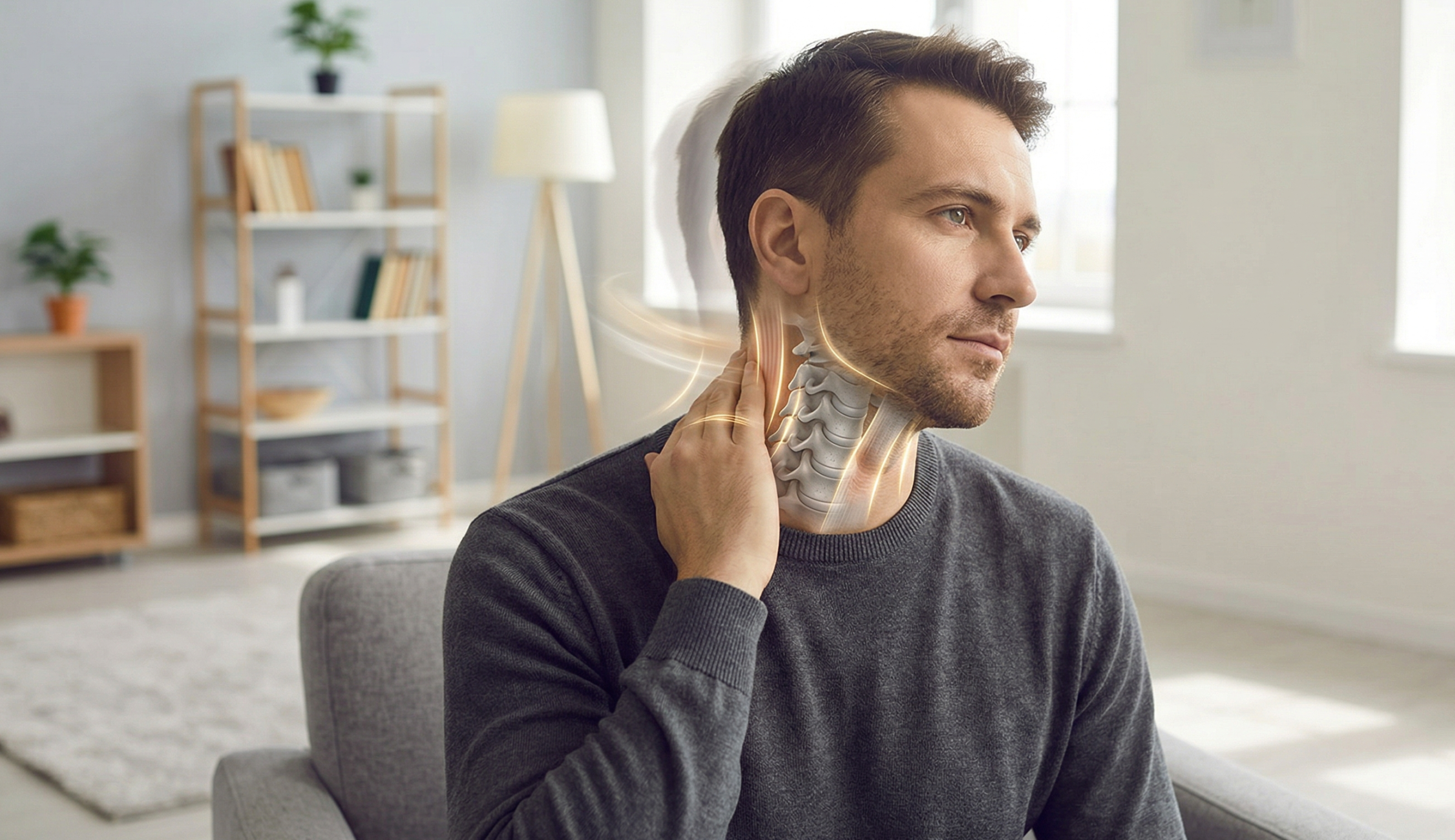
Many patients have normal ER imaging yet develop:
- neck stiffness.
- base-of-skull headaches.
- motion sensitivity.
- dizziness that flares with head turns.
Why Standard Imaging May Not Explain It
MRI and standard X-rays are typically:
- static.
- taken in a limited number of positions.
- not showing what happens during the exact motion that triggers symptoms.
If dizziness is motion-dependent, a still image can look “fine” while the problem is mechanical instability during movement.
How Digital Motion X-Ray Helps
Digital Motion X-Ray (DMX) is fluoroscopic video X-ray. It records the cervical spine during guided motion and helps providers evaluate:
- Translation (abnormal sliding).
- Angulation (abnormal tilting).
- asymmetry or “hinge points” that may correlate with symptom triggers.
How DMX Can Change the Plan
If motion abnormalities are found, your care team can:
- prioritize stabilization over stretching.
- adjust manual therapy techniques to protect unstable levels.
- coordinate vestibular rehab with cervical stabilization.
- better explain why symptoms persist even when static tests are reassuring.
When to Ask About Cervical DMX
Discuss DMX with your provider if:
- dizziness began after accident/fall/sports injury.
- symptoms worsen with head turning.
- ear/brain studies don’t match how you feel.
- headaches and neck pain travel with dizziness.
FAQs
Can neck problems cause dizziness?
Yes. Cervical joint and ligament dysfunction can disrupt proprioceptive signals, contributing to dizziness in some patients.
Why is dizziness worse when I turn my head?
Head turning stresses cervical segments; if motion is abnormal, symptoms can spike.
Will a normal MRI rule out a neck cause?
Not always. MRI is static and may miss motion-based instability.
What does DMX show that other tests don’t?
DMX shows spinal movement in real time and can measure abnormal translation and angulation.
Learn more: Treatment
Schedule your appointment today:Appointments
Call 305-275-7475 or book your appointment online

Dr. Rodolfo Alfonso, D.C.
Dr. Mark N. Berry, D.C.
Sunset Chiropractic and Wellness
8585 Sunset Dr. STE 102
Miami, Florida 33143