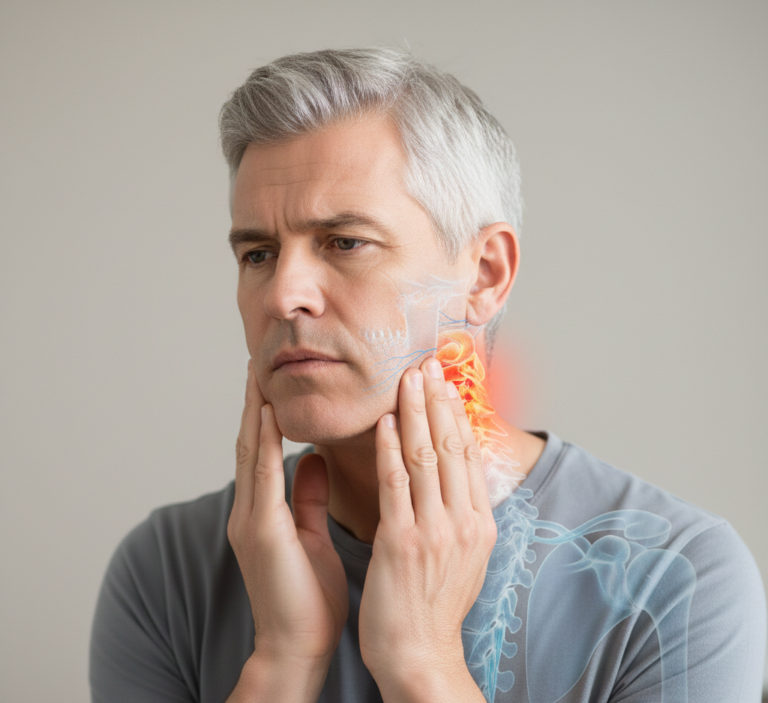
When Bite Issues and Neck Problems Show Up Together.
Patients with jaw or TMJ (temporomandibular joint) complaints often see:
- Dentists.
- Oral surgeons.
- TMJ specialists.
They may get:
- Splints or mouthguards.
- Bite adjustments.
- Muscle relaxers or injections.
But some patients in Miami, Fort Lauderdale, Miami-Dade, Broward, the Florida Keys, Florida and the USA, Central and South America (Colombia, Chile, Argentina, Mexico), and the Caribbean notice something important:
“My jaw pain and clicking started or worsened after my neck injury.”
At DMX Miami, we help explore whether upper cervical instability or abnormal motion is contributing to TMJ symptoms in certain cases.
How the Neck and Jaw Are Connected.
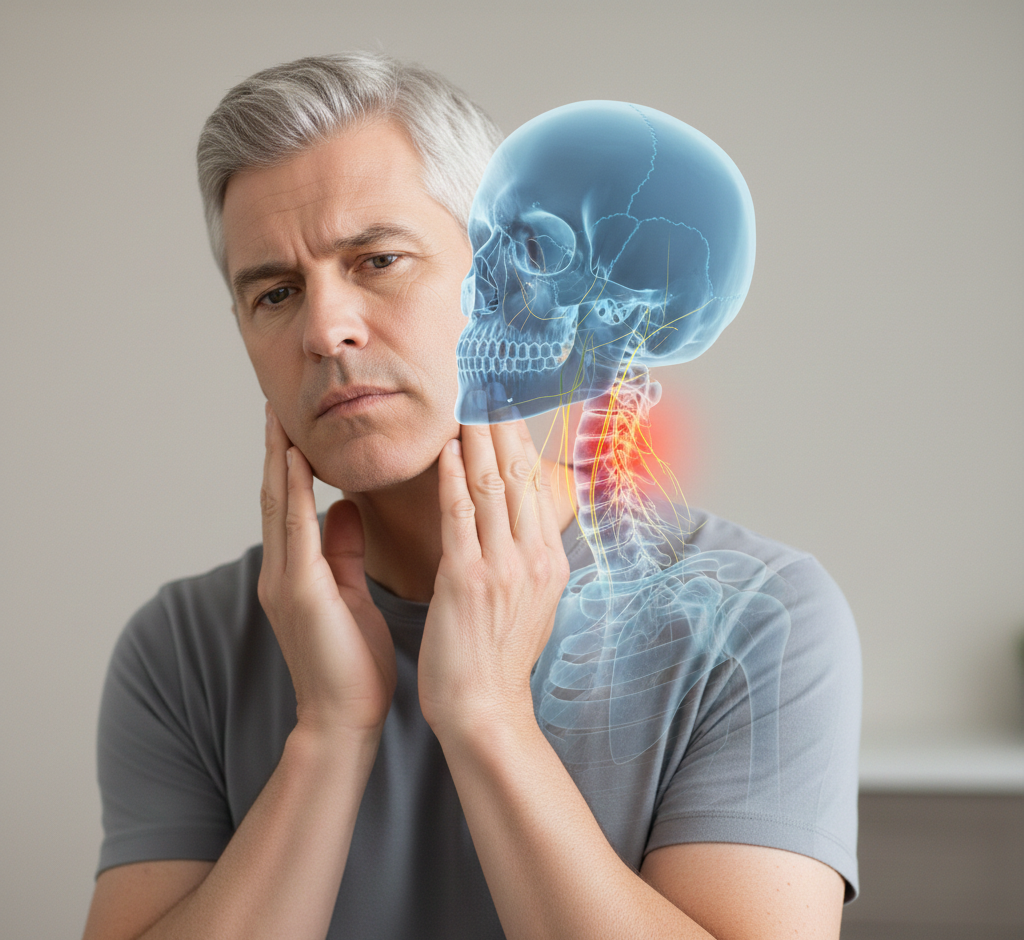
The head, neck, and jaw share:
- Muscles (like those attaching from the skull to the jaw and neck).
- Nerve pathways that process pain and position signals.
- Postural relationships (how you hold your head affects your jaw position).
When the upper cervical spine (the top of the neck) is unstable or moving abnormally, it can:
- Alter head and jaw posture.
- Increase muscle tension in the jaw and face.
- Change how forces are distributed when you bite, chew, or talk.
Over time, this can aggravate TMJ pain, clicking, or locking.
When TMJ Symptoms Have a Neck Story Behind Them.
We often hear patterns like:
- Jaw pain and neck pain started after a car accident or whiplash.
- Splints help a little, but symptoms never fully resolve.
- Certain head positions worsen both neck and jaw discomfort.
- Headaches, ear pressure, or facial pain travel together with TMJ flare-ups.
In these cases, treating the jaw alone may not be enough if the neck remains mechanically unstable.
How Digital Motion X-Ray Evaluates the Upper Cervical Spine.
At DMX Miami, Digital Motion X-Ray:
- Uses fluoroscopic video to record real-time movement of the cervical spine.
- Pays special attention to the upper cervical region, where head and neck interface.
- Measures abnormal sliding and tilting between vertebrae.
- Helps identify motion patterns that may:
- Strain upper cervical muscles.
- Alter head posture and jaw alignment.
- Contribute to combined neck and TMJ symptoms.
DMX doesn’t replace dental or TMJ-focused evaluation it adds a missing structural perspective from the neck.
How DMX Findings Can Support a More Complete TMJ Plan.
If upper cervical instability is identified, a coordinated team (dentist/TMJ specialist, chiropractor, physical therapist, etc.) can:
- Integrate neck stabilization and posture work with TMJ treatment.
- Modify manual techniques or exercises to avoid stressing unstable segments.
- Adjust splint or bite strategies to reflect what the neck is doing.
- Track symptom changes as both jaw and neck are addressed together.
This integrated approach is often more effective than treating the jaw in isolation.
Signs That Your Jaw Problem May Involve Your Neck.
Consider asking about cervical evaluation if:
- TMJ symptoms began after a neck injury or whiplash event.
- Neck pain and jaw pain almost always flare together.
- You experience headaches, facial pain, or ear symptoms along with TMJ issues.
- You have tried jaw-focused treatments with incomplete results.
Patients increasingly travel to DMX Miami to connect the dots between jaw symptoms and upper cervical mechanics.
The Jaw Doesn’t Work Alone Neither Should Its Evaluation.
If your TMJ problem has a neck history, it’s reasonable to check whether cervical instability is part of the picture. Digital Motion X-Ray can help providers see what your upper neck is doing while your jaw is trying to function.
👉 If your TMJ symptoms started after a neck injury, ask your providers whether cervical DMX might give a clearer mechanical picture, then contact our office.
Learn more: Treatment
Schedule your appointment today:Appointments
Call 305-275-7475 orbook your appointment online

Dr. Rodolfo Alfonso, D.C.
Dr. Mark N. Berry, D.C.
Sunset Chiropractic and Wellness
8585 Sunset Dr. STE 102
Miami, Florida 33143