
When the Real Problem Is in the Way Your Spine Moves
Many patients are told they have:
- “Sciatica.”
- “SI joint dysfunction.”
- “Lumbar strain.”
- “Mild disc bulging.”
They do physical therapy, chiropractic, medications, maybe injections and still, the low back, hip, or sacroiliac area continues to flare up with everyday activities.
At DMX Miami, we see patients from Miami, Fort Lauderdale, Miami-Dade, Broward, the Florida Keys, and from across Florida, the USA, Central and South America (Colombia, Chile, Argentina, Mexico), and the Caribbean whose low back and pelvic pain never fully resolved because underlying instability was never evaluated in motion.
Why Instability Matters in the Lower Back and Pelvis
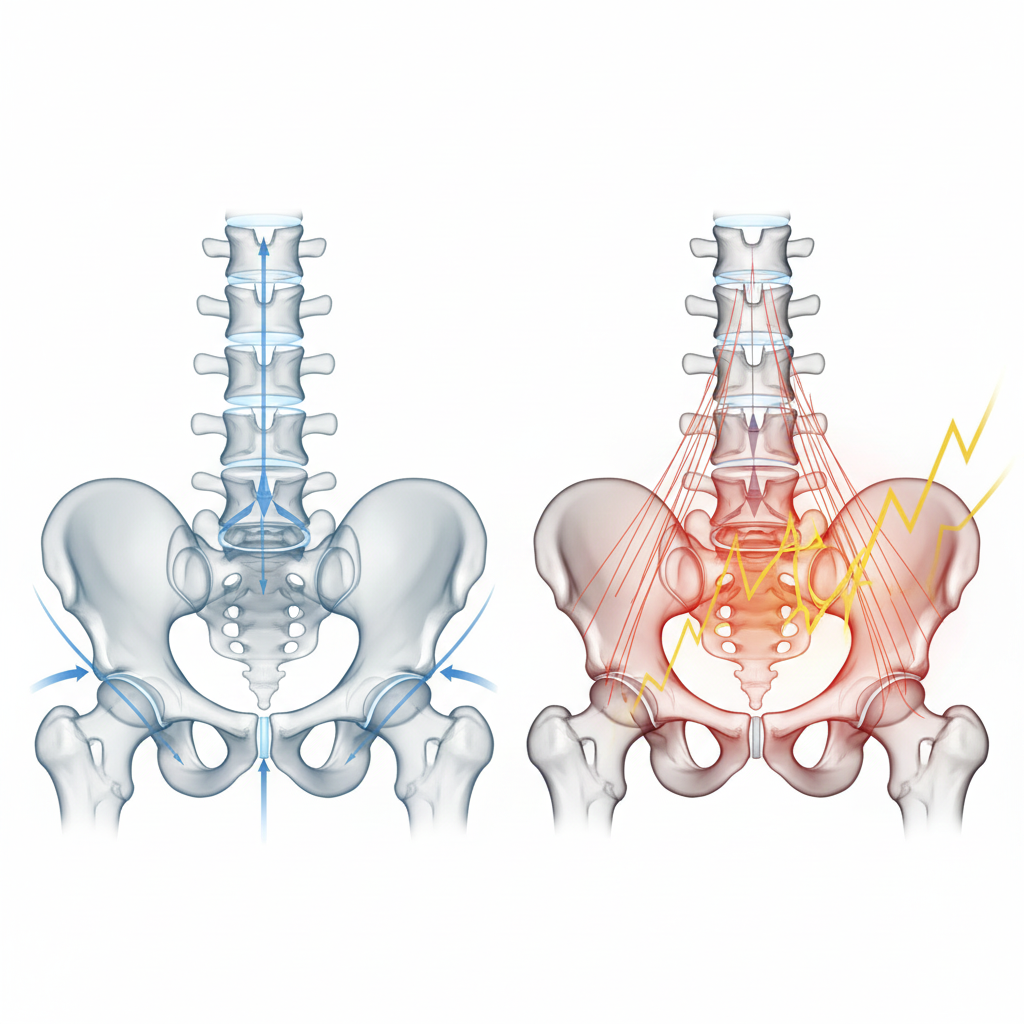
The lumbar spine and sacroiliac (SI) joints:
- Transfer force between the upper body and legs.
- Depend on strong ligaments to maintain controlled motion.
- Are stressed daily by sitting, lifting, twisting, and walking.
When ligaments are stretched, torn, or weakened by:
- Car crashes.
- Falls.
- Lifting injuries.
- Repetitive strain.
The result can be excessive motion between vertebrae or at the SI joints. Muscles then work overtime trying to “brace” the area, creating a cycle of spasms and pain.
Clues That Instability May Be Part of Your Problem
You might suspect hidden instability if:
- Pain gets worse with transitions (sitting to standing, rolling in bed, getting out of a car).
- You feel “good” lying down, but pain ramps up with standing or walking.
- Certain movements bending, twisting, lifting consistently trigger sharp pain.
- You feel like your low back or pelvis is “weak,” “wobbly,” or “about to go out”.
- You keep having recurring episodes, even after temporary improvement.
Static imaging may not explain this dynamic pattern well.
Limits of Standard Imaging for Low Back/SI Problems
Standard X-rays and MRIs can show:
- Disc bulges or herniations.
- Degenerative changes (arthritis).
- Gross alignment issues.
But they are usually:
- Done lying still (MRI) or standing still (X-ray).
- Focused on structure, not motion.
- Not sensitive to subtle ligamentous laxity and segmental instability.
Your report might say:
- “Mild disc bulge.”
- “Early degenerative changes.”
…even if your true problem is unstable movement that only shows during motion.
How Digital Motion X-Ray Evaluates the Lumbar Spine
At DMX Miami, Digital Motion X-Ray can:
- Record real-time fluoroscopic video of your lumbar spine while you perform gentle flexion and extension.
- Measure abnormal translation and angulation between vertebrae.
- Identify segments that move too much or too early.
- Help correlate mechanical findings with your painful motions.
While SI joints are harder to image directly in motion, DMX can still highlight lumbar patterns that contribute to pelvic and hip pain.
How DMX Findings Help Guide Treatment
DMX results help:
- Chiropractors and physical therapists plan stabilization-focused rehab instead of just stretching and adjustments.
- Pain and regenerative doctors choose whether target levels for injections, PRP, or other treatments are truly unstable.
- Surgeons understand the functional behavior of segments when considering surgical vs. non-surgical options.
- You understand why certain activities hurt more, which can guide daily-life modifications.
Treatment works better when it’s based on how your spine behaves, not only on how it looks lying still.
Who Should Consider DMX for Low Back or SI-Like Pain?
DMX may be worth discussing with your provider if:
- You’ve had persistent low back or SI-region pain after an accident, lifting injury, or fall.
- You’ve “tried everything” (PT, chiropractic, injections) without lasting progress.
- Imaging shows only mild degeneration or disc changes that don’t match your pain.
- Your symptoms clearly change with movement and position.
Patients from South Florida, Latin America, and the Caribbean sometimes schedule DMX as part of a broader low back recovery plan in Miami.
When Your Low Back Won’t Stabilize, Your Life Won’t Either
If your pain keeps returning with everyday movements, you may not just have “tight muscles” or “mild arthritis” you may have a motion problem.
Learn more: Treatment
Schedule your appointment today: Appointmen
Call 305-275-7475 or book your appointment online

Dr. Rodolfo Alfonso, D.C.
Dr. Mark N. Berry, D.C.
Sunset Chiropractic and Wellness
8585 Sunset Dr. STE 102
Miami, Florida 33143