
Why Digital Motion X-Ray Matters When Your Neck Doesn’t Feel Secure
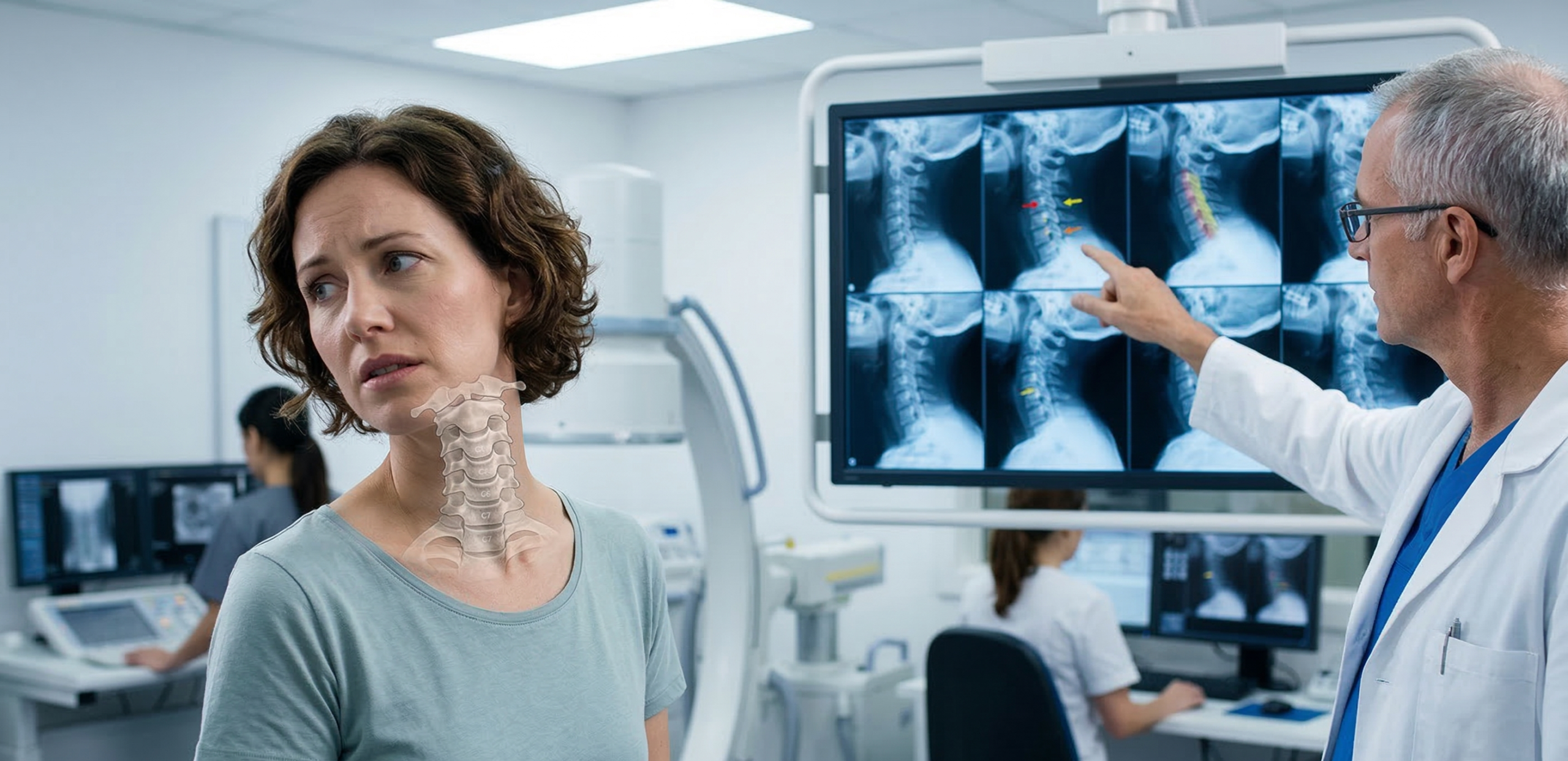
Patients often describe neck symptoms in two different ways:
- “My neck is tight and stiff.”
- “My neck feels unstable like it could slip, catch, or give out.”
Those are not the same problem.
Across Miami, Fort Lauderdale, Miami-Dade, Broward, the Florida Keys, and among patients traveling from Colombia, Chile, Argentina, Mexico, the Caribbean, and across the USA, we hear:
- “I feel like I need to support my head with my hand.”
- “My neck cracks and feels like it shifts.”
- “I don’t trust my neck in certain positions.”
When patients feel instability especially after trauma the question becomes: Is it true ligament-related instability, or muscular guarding and fear?
Stiffness vs. Instability: How They Feel
Stiffness often feels like:
- Restricted range of motion.
- Tight muscles.
- Soreness after posture strain or overuse.
- Temporary improvement with heat, massage, or stretching.
Instability often feels like:
- A sense of shifting, slipping, or “catching.”
- Symptoms triggered by specific movements (turning, looking up/down).
- A “heavy head” sensation or rapid fatigue.
- Headaches at the base of the skull.
- Dizziness or visual strain during head movement (in some cases).
Both can coexist because if the neck is unstable, muscles often tighten to protect it.
Why Static Imaging May Not Answer the Instability Question
MRI and standard X-rays are useful, but they usually show the neck:
- Still.
- In one or two positions.
- Often lying down or standing quietly.
If instability happens during motion which is common in ligament injuries static tests may appear “normal” or “mild.”
That’s why patients can feel unstable even when their MRI report sounds reassuring.
How Digital Motion X-Ray Evaluates “Do My Vertebrae Move Too Much?”
DMX records cervical motion as a video and allows providers to measure:
- Translation: abnormal sliding between vertebrae.
- Angulation: abnormal tilting between vertebrae.
- Motion sequencing: whether one segment moves too much while others barely move.
DMX helps answer:
- Is there true mechanical instability?
- If so, which levels are involved?
- Does the motion abnormality match what the patient feels?
Why This Changes Treatment
If the problem is mostly stiffness:
- Mobility work and posture correction may help.
If instability is present:
- Rehab should emphasize segmental stabilization and controlled motion.
- Certain aggressive stretching or manipulation may need modification.
- Providers can target care more precisely to vulnerable levels.
The plan becomes more specific, less trial-and-error.
Who Should Consider DMX for Suspected Instability?
Ask your provider about DMX if:
- Symptoms began after a car accident, fall, or sports injury.
- You feel shifting/catching or “heavy head” fatigue.
- Symptoms are highly movement-dependent.
- You’ve tried care but results don’t last.
Feeling Unstable Deserves a Motion-Based Evaluation
A neck that doesn’t feel secure can change how you work, drive, sleep, and live. Digital Motion X-Ray helps clarify whether your symptoms are coming from true mechanical instability and where.
👉 Ask your provider if cervical DMX is appropriate.
👉 Contact DMX Miami to coordinate a study if ordered.
Learn more: Treatment
Schedule your appointment today:Appointments
Call 305-275-7475 orbook your appointment online

Dr. Rodolfo Alfonso, D.C.
Dr. Mark N. Berry, D.C.
Sunset Chiropractic and Wellness
8585 Sunset Dr. STE 102
Miami, Florida 33143