
When “Looking Up” Causes Headaches, Dizziness, or Arm Tingling
A very specific complaint shows up in many cervical injury cases:
“I’m okay until I look up.”
Looking up (neck extension) can trigger:
- Headaches at the base of the skull.
- Dizziness or feeling off-balance.
- Pain behind the eyes.
- Tingling or heaviness into the arm.
- A sharp pinch or “catch” in the neck.
Patients in Miami, Fort Lauderdale, Miami-Dade, Broward, and the Florida Keys, and those traveling from the USA, Colombia, Chile, Argentina, Mexico, and the Caribbean, often notice this with real-life activities:
- Washing hair in the shower.
- Looking up at a screen or shelf.
- Painting, ceiling work, or gym movements.
- Checking traffic lights.
- Certain stretches or chiropractic positions.
When extension consistently triggers symptoms, the question becomes: What is your cervical spine doing during that movement?
Why Extension Can Be More Provocative Than Flexion
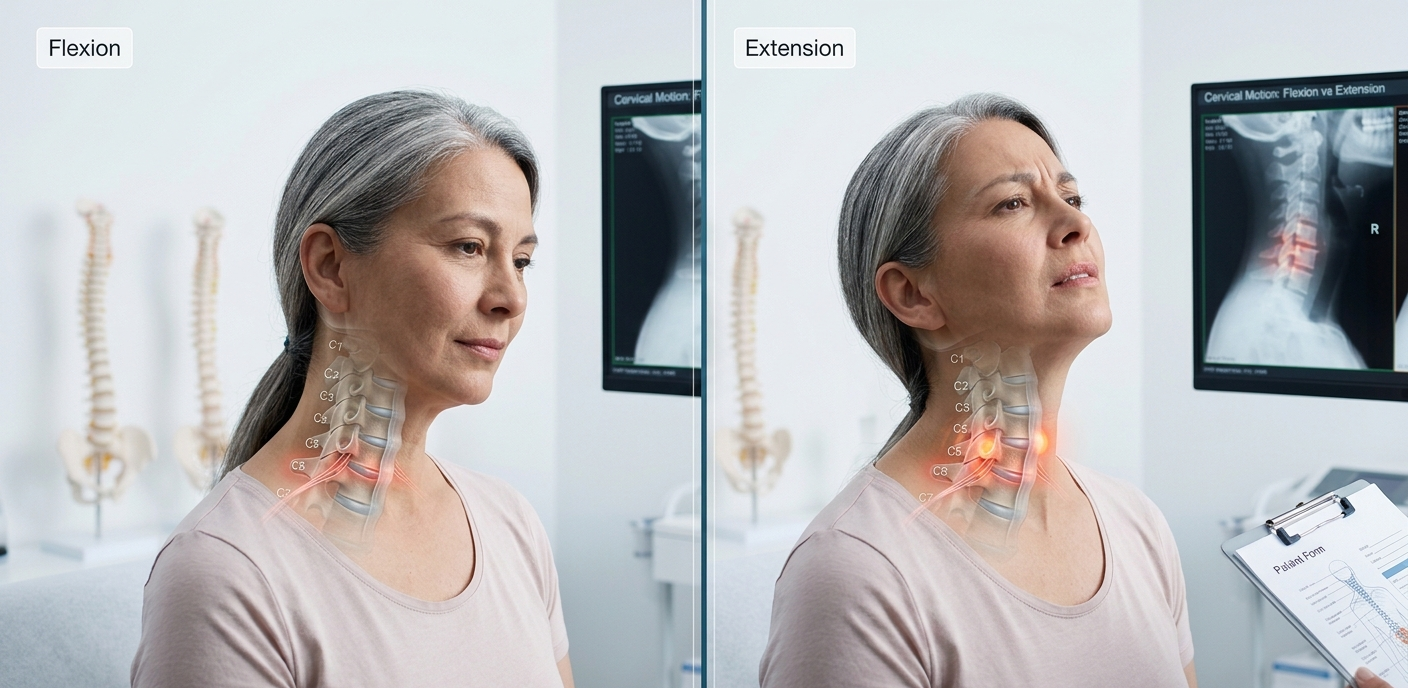
Neck extension compresses and loads certain structures more than neutral posture. In the presence of trauma history (like whiplash), extension can:
- Stress injured ligaments.
- Increase joint loading in the back of the neck (facet joints).
- Alter the space where nerves exit (foramina).
- Reveal instability patterns that aren’t obvious at rest.
That’s why some people feel fine on a normal MRI, but symptoms appear when the neck moves into extension.
Why Static Imaging Often Doesn’t Explain Extension-Triggered Symptoms
MRI and standard X-rays are typically:
- Static.
- Often performed lying down.
- Not capturing the exact motion arc that provokes symptoms.
A scan may show mild changes that “shouldn’t” cause big symptoms yet extension reliably triggers them.
That’s a sign the issue may be motion-related.
How Digital Motion X-Ray Helps
Digital Motion X-Ray (DMX) is fluoroscopic video X-ray that evaluates the cervical spine during guided motion. It allows providers to assess:
- Translation (sliding) between vertebrae during extension.
- Angulation (tilting) changes at specific segments.
- Motion asymmetries or “hinge points” that show up in extension.
This can help identify whether extension is provoking abnormal segment behavior that matches your symptom pattern.
How DMX Can Change the Plan
If DMX shows motion abnormalities, your care team can:
- Emphasize stabilization over stretching into extension.
- Modify manual techniques to avoid stressing unstable levels.
- Choose safer exercise progressions.
- Coordinate targeted interventions when appropriate.
Instead of “avoid looking up,” you get a plan based on why extension is provoking symptoms.
When to Ask About DMX
Talk to your provider about cervical DMX if:
- Extension reliably triggers headaches, dizziness, or arm symptoms.
- You have a whiplash, fall, or sports injury history.
- Standard imaging doesn’t match the severity of symptoms.
- You feel a “catch” or shift when looking up.
👉 Contact DMX Miami if your provider recommends a motion-based evaluation.
Learn more: Treatment
Schedule your appointment today:Appointments
Call 305-275-7475 orbook your appointment online

Dr. Rodolfo Alfonso, D.C.
Dr. Mark N. Berry, D.C.
Sunset Chiropractic and Wellness
8585 Sunset Dr. STE 102
Miami, Florida 33143