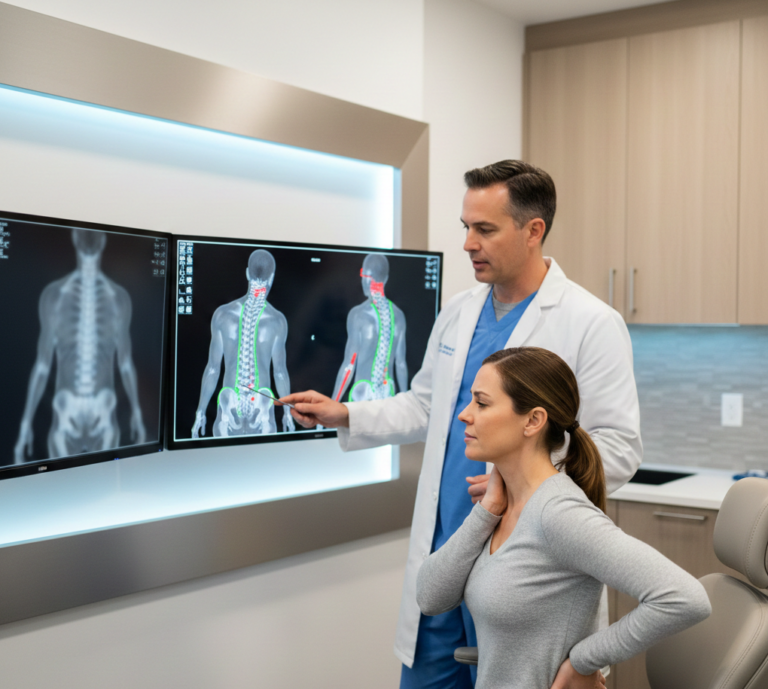
Why You Still Hurt Even When Your Imaging Looks “Fine”
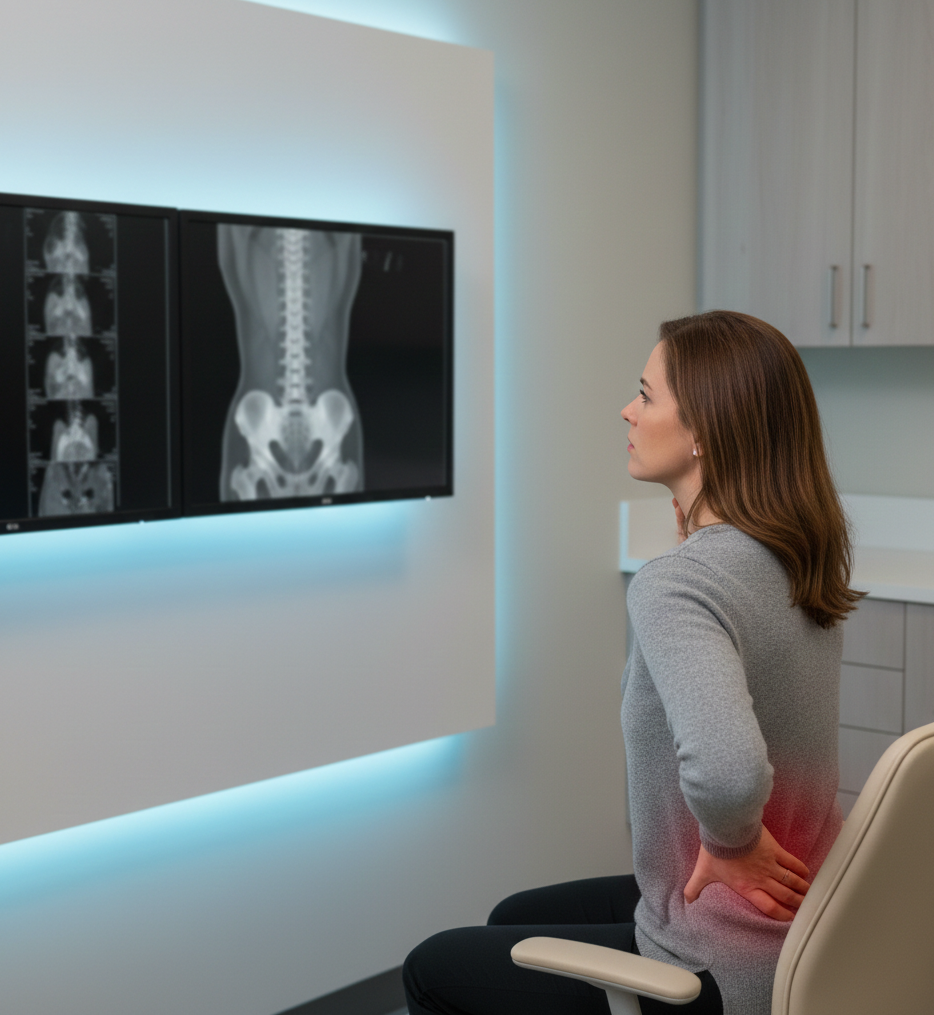
A lot of patients come to DMX Miami after hearing some version of:
- “Your MRI doesn’t show anything serious.”
- “Your X-rays look normal for your age.”
- “We don’t see a reason for this much pain.”
Yet they still live with:
- Daily neck or low back pain.
- Headaches, dizziness, or arm/leg symptoms.
- A feeling that something is being missed.
This happens to patients from Miami and Fort Lauderdale, across Florida and the rest of the United States, and from countries like Colombia, Chile, Argentina, Mexico and throughout the Caribbean all with the same frustration:
“If nothing is wrong, why do I still feel like this?”
Sometimes, the missing piece is that static imaging shows your spine at rest, but your pain shows up when it moves.
What Static Imaging Can (and Can’t) Tell You
Standard imaging is important:
- X-rays help show fractures, major alignment issues, and advanced degenerative changes.
- MRI shows discs, nerves, and the spinal cord in a still position.
- CT gives detailed cross-sections of bone and certain structural changes.
But all of these are usually done:
- Lying down or standing still.
- In one or two positions.
- Without real-world motion or loading.
They answer:
“What does your spine look like in this one position?”
They do not answer:
“What does your spine do when you actually move?”
Pain That Shows Up Only When You Move
If your pain is clearly connected to:
- Looking up or down.
- Turning your head while driving.
- Bending, twisting, or lifting.
- Being upright for a period of time.
…then your problem might be more about mechanics in motion than about what can be seen in a still snapshot.
This is where Digital Motion X-Ray (DMX) can help.
How Digital Motion X-Ray Sees What Static Tests Miss
Digital Motion X-Ray is a form of fluoroscopic video X-ray. At DMX Miami, that means:
- Your cervical or lumbar spine is recorded while you perform carefully guided movements.
- The system captures real-time images as you bend, extend, or rotate.
- Software and trained providers measure:
- Translation – abnormal sliding between vertebrae.
- Angulation – abnormal tilting between vertebrae.
The goal is to answer:
“Is there instability or abnormal motion that could explain your pain?”
What DMX Can Reveal
Digital Motion X-Ray may show:
- Ligament-related instability that doesn’t show up when you’re still.
- Excessive movement at one level with restricted motion above or below.
- Asymmetrical motion that matches your one-sided symptoms.
- Mechanical patterns that correlate with the exact motions that hurt.
This doesn’t replace MRI or CT it complements them with motion-based data.
How Your Doctors Use DMX Information
When a provider orders DMX and reviews the results, they can:
- Refine a diagnosis that was previously vague (“sprain/strain,” “non-specific pain.”)
- Shift treatment toward stabilization and protection of vulnerable segments.
- Decide which manual techniques or exercises should be modified or avoided.
- Have more objective documentation in complex or injury-related cases.
Having an explanation that matches your experience often changes both the treatment plan and your peace of mind.
Who Might Benefit from Digital Motion X-Ray
Talk to your provider about DMX if:
- Your MRI/X-rays are “normal” but your pain and limitations are clearly not.
- Your symptoms change dramatically with movement or position.
- You’ve tried multiple therapies with only partial or temporary results.
- You want a more complete mechanical picture before major decisions (like injections or surgery).
People travel to DMX Miami for that reason to see if motion-based imaging can finally connect the dots.
You’re Not Imagining It – Your Pain Just Might Be a Motion Problem
If you’ve been told “there’s nothing there” but your body tells a different story, you deserve imaging that looks at your spine the way you actually use it: in motion.
Digital Motion X-Ray doesn’t guarantee a simple answer, but it often provides the missing piece.
👉 If your pain is real but your scans look normal, ask your provider whether DMX could help clarify what’s going on, and contact our office to discuss next steps.
Learn more: Treatment
Schedule your appointment today:Appointments
Call 305-275-7475 orbook your appointment online

Dr. Rodolfo Alfonso, D.C.
Dr. Mark N. Berry, D.C.
Sunset Chiropractic and Wellness
8585 Sunset Dr. STE 102
Miami, Florida 33143