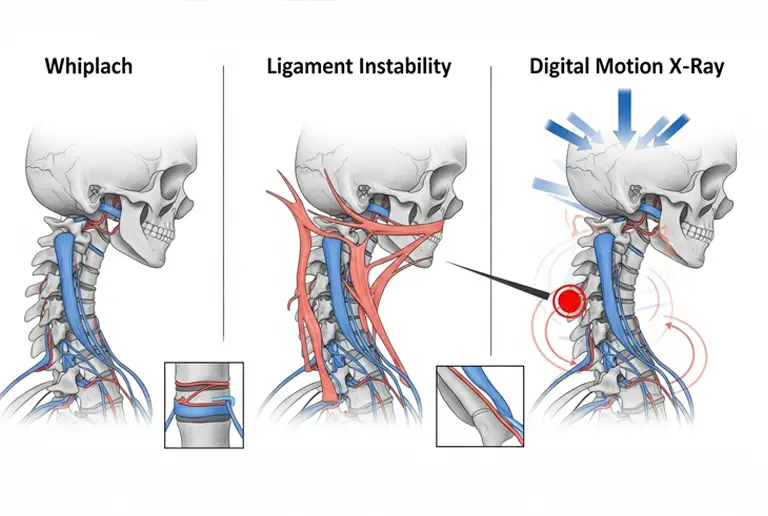
The Problem with Whiplash Injuries
Whiplash is one of the most common neck injuries, often caused by car accidents, sports trauma, or sudden falls. While the term “whiplash” sounds simple, the reality is more complicated: the violent back-and-forth motion can overstretch or tear the cervical ligaments. These ligaments normally keep the vertebrae stable, but when they’re damaged, patients develop ligament instability that can last for years.
Unfortunately, many people who suffer from whiplash are told their X-rays, CT scans, or MRIs look “normal.” The truth is, these traditional imaging methods are static they only take pictures of the spine while lying still. Ligament laxity, on the other hand, only reveals itself when the neck moves.
Why Standard Imaging Falls Short
When ligaments are damaged, the vertebrae shift abnormally during motion. This abnormal translation is what creates instability, pain, and neurological symptoms. Standard imaging does not capture movement, so the ligament damage remains invisible.
That’s why so many whiplash patients bounce from doctor to doctor without answers. Their pain is real, but the scans don’t validate it. Without proof of injury, insurance companies may even deny claims.
How Digital Motion X-Ray Reveals the Truth
Digital Motion X-Ray (DMX) solves this problem by recording the cervical spine in real time while the patient moves. Unlike MRI or CT, DMX produces a moving image that reveals:
- Abnormal gapping between vertebrae
- Shifting bones that signal ligament laxity
- Instability in flexion, extension, or rotation
This makes DMX the gold standard for diagnosing ligament damage from whiplash. It identifies the root cause of instability and provides objective proof for both patients and physicians.
Symptoms of Whiplash-Related Ligament Damage

Whiplash injuries with ligament instability can trigger symptoms far beyond neck pain, including:
- Migraines or chronic headaches
- Dizziness and vertigo
- Ringing in the ears (tinnitus)
- Tingling, numbness, or weakness in the arms
- Brain fog and difficulty concentrating
- Jaw pain (TMJ dysfunction)
These symptoms may persist for years if the underlying ligament damage is never diagnosed. By exposing the instability directly, DMX allows patients to finally receive appropriate treatment.
Why Patients Choose Digital Motion X-Ray in Miami
At our Miami clinic, we specialize in identifying hidden ligament injuries with DMX. Patients from Florida, across the U.S., and throughout Central and South American including Colombia, Argentina, Chile, and Mexico trust us because we provide the clarity they couldn’t find elsewhere.
Our bilingual staff ensures every patient, whether English- or Spanish-speaking, feels understood and supported. For many international patients, Miami is a convenient hub where they can access advanced imaging that is not yet available in their home countries.
Taking the Next Step
If you’ve suffered whiplash and still struggle with symptoms despite being told your scans are normal, Digital Motion X-Ray in Miami may finally give you answers. DMX pinpoints ligament instability, validates your condition, and helps guide treatment designed to restore stability and function.
Don’t let your pain be dismissed discover the power of DMX and take the first step toward real recovery.
Call 305-275-7475 or book your appointment online

Dr. Rodolfo Alfonso, D.C.
Dr. Mark N. Berry, D.C.
Sunset Chiropractic and Wellness
8585 Sunset Dr. STE 102
Miami, Florida 33143
305-275-7475
Schedule Your DMX Today
You’ve been searching for answers. Now you can see the cause of your symptoms in motion.
Visit us in Miami
Call 305-275-7475
Request an appointment online
Follow us on Instagram, Facebook, and YouTube for updates, patient success stories, and expert insights on neuropathy treatment!