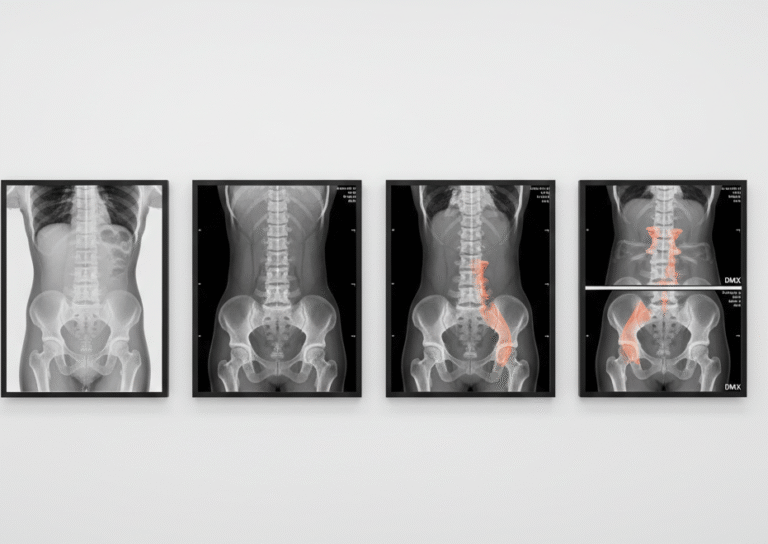
Which Spine Test Does What In Plain Language
If you’ve had a spinal injury or chronic neck and back pain, you’ve probably heard a confusing list of imaging options:
- X-ray.
- MRI.
- CT scan.
- “Maybe Digital Motion X-Ray…”
It’s easy to feel overwhelmed trying to figure out which test is right for you. At DMX Miami, we specialize in Digital Motion X-Ray (DMX), but we also respect the role of standard X-ray, MRI, and CT. Each has strengths and limitations.
Here’s a clear, patient-friendly breakdown for people in Miami, Fort Lauderdale, Miami-Dade, Broward, the Florida Keys, Florida and the USA, Central and South America, and the Caribbean.
Standard X-Ray: The Basic Starting Point

What it does well:
- Shows bones clearly.
- Detects fractures, major dislocations, gross alignment problems.
- Quick, widely available, low cost compared to MRI or CT.
Limitations:
- Mostly static usually taken standing still.
- Does not show discs, nerves, or soft tissues clearly.
- May miss subtle ligament injuries or instability, especially in the neck and low back.
MRI: Great for Discs and Nerves
What it does well:
- Shows discs, nerves, spinal cord, and soft tissues in detail.
- Detects herniated discs, nerve compression, inflammation, some tumors and infections.
- Essential for evaluating serious neurologic symptoms.
Limitations:
- Usually done lying down and still.
- Not ideal for seeing motion-related instability.
- May show age-related changes that aren’t the main source of pain.
- Sometimes normal even in patients with clear whiplash or ligamentous injury.
CT Scan: Detailed Bone Imaging
What it does well:
- Excellent for bone detail complex fractures, bone spurs, some post-surgical evaluations.
- Helpful when standard X-ray doesn’t give enough information.
- Can be combined with contrast in some special studies.
Limitations:
- Still mostly static.
- Not as good as MRI for soft tissue, discs, or nerves.
- Like X-ray, doesn’t directly show how vertebrae move.
Digital Motion X-Ray: Seeing the Spine in Action
What DMX does differently at DMX Miami:
- Uses fluoroscopic video X-ray to record the spine during movement.
- Evaluates the cervical, thoracic, or lumbar spine while you perform gentle, guided motions.
- Measures abnormal translation and angulation between vertebrae.
- Helps reveal ligament injuries and instability that only appear when the spine is moving.
DMX doesn’t replace MRI or CT. Instead, it complements them by answering a different question:
“What happens when my spine actually moves?”
A Simple Way to Think About It
- X-ray:
- “What do my bones look like at rest?.”
- MRI:
- “What do my discs, nerves, and soft tissues look like at rest?.”
- CT:
- “What do my bones and complex structural details look like at rest?.”
- Digital Motion X-Ray:
- “How do my vertebrae actually move and do they move too much or in the wrong way?”
When Providers Consider Adding DMX
At DMX Miami, Digital Motion X-Ray is often considered when:
- You’ve had a car accident, sports injury, fall, or work injury.
- Standard X-ray and MRI are normal or only mildly abnormal, but you still hurt.
- Symptoms clearly change with movement and position.
- There’s concern for ligamentous injury or instability, especially in the neck.
Providers may use DMX to:
- Guide chiropractic, rehab, or pain management plans.
- Support regenerative medicine targeting specific ligaments.
- Clarify med-legal questions about permanent spinal injury.
You Don’t Have to Choose Alone
You shouldn’t have to guess which test you need. The decision should be made with your:
- Primary doctor.
- Chiropractor or therapist.
- Specialist (orthopedic, neurosurgical, pain, or regenerative).
At DMX Miami, our role is to provide high-quality motion-based imaging when your health team believes it’s appropriate not to replace the rest of your care.
The Right Tool for the Right Question
Think of imaging like tools in a toolbox. MRI, CT, X-ray, and DMX each answer different questions:
- “Is something broken?.”
- “Is a disc pressing on a nerve?.”
- “How do these vertebrae behave when I move?.”
When the question is about motion and stability, that’s when Digital Motion X-Ray shines.
Learn more: Treatment
Schedule your appointment today: Appointments
Call 305-275-7475 or book your appointment online

Dr. Rodolfo Alfonso, D.C.
Dr. Mark N. Berry, D.C.
Sunset Chiropractic and Wellness
8585 Sunset Dr. STE 102
Miami, Florida 33143