Choosing the Right Imaging Tool for Your Neck or Back Problem.
When you’re dealing with ongoing neck or back pain, the list of imaging options can be confusing:
- Regular X-ray.
- MRI.
- CT scan.
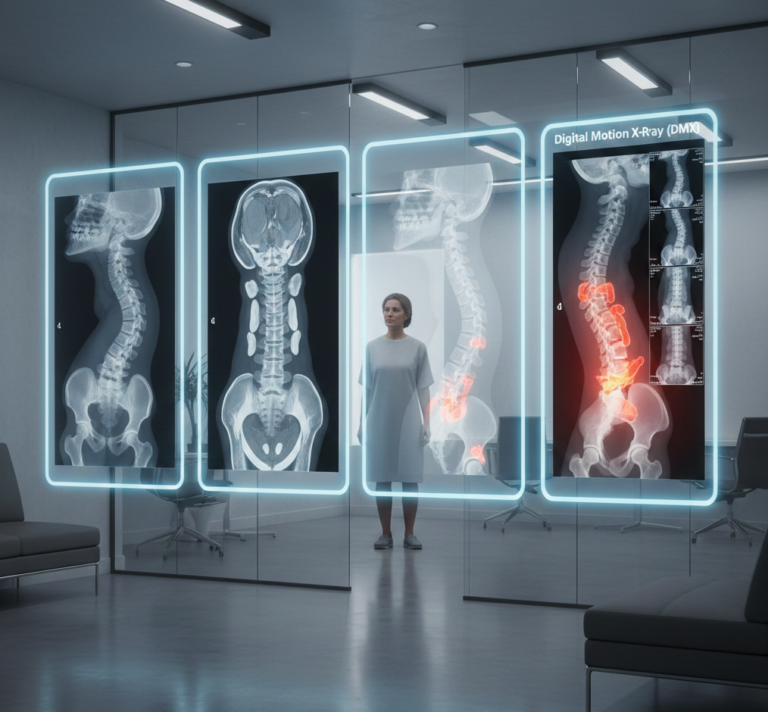
- Digital Motion X-Ray (DMX).
Patients from Miami, Fort Lauderdale, Miami-Dade County, Broward County, the Florida Keys, and across Florida, as well as from the USA, Central and South America (Colombia, Chile, Argentina, Mexico), and the Caribbean, often ask us at DMX Miami:
“What makes Digital Motion X-Ray different from what I’ve already done?”
Let’s break it down in simple, practical terms.
What Standard X-Rays Are Good At.

Conventional X-rays are:
- Fast.
- Widely available.
- Useful for seeing bones in a still position.
They’re great at:
- Detecting fractures and dislocations.
- Showing major alignment issues.
- Revealing advanced arthritis or severe disc space loss.
But they are usually taken in one or two static positions. They don’t show what your spine does when you bend, turn, or look up and down.
What MRI Is Good At.
MRI focuses on soft tissues:
- Discs.
- Nerves.
- Spinal cord.
- Ligaments and muscles (to a degree.)
MRI is excellent for:
- Disc herniations or bulges.
- Spinal cord compression.
- Infections, tumors, or major inflammatory processes.
However, MRI is almost always done:
- Lying down.
- Completely still.
So MRI answers:
“What does your spine look like in one position?”
It doesn’t show whether certain vertebrae slide or tilt abnormally when you move.
What CT Scans Are Good At.
CT scans are advanced, cross-sectional images that are especially helpful for:
- Complex fractures.
- Detailed bone structure.
- Certain forms of spinal stenosis.
CT is powerful for structural detail, but just like static X-ray and MRI, it’s typically done with no motion.
Where Digital Motion X-Ray Fits In.
Digital Motion X-Ray (DMX) at DMX Miami is different because it:
- Uses fluoroscopic video X-ray.
- Records your spine while you perform gentle, guided movements.
- Shows how each segment behaves under real-world motion.
- Measures abnormal translation (sliding) and angulation (tilting) between vertebrae.
So DMX answers:
“What happens to your spine when you actually use it?”
This is especially important after:
- Car accidents.
- Whiplash.
- Falls.
- Sports injuries.
…when ligament injuries and instability may not appear on still images.
Conditions Where DMX Can Add Value.
Digital Motion X-Ray may be helpful (when ordered by an appropriate provider) in cases like:
- Ongoing neck pain and headaches after a “minor” car crash.
- Persistent low back pain that flares with bending or twisting.
- Post-concussion symptoms where the neck was also injured.
- Suspected cervical or lumbar ligament instability.
- Complex personal-injury or med-legal cases where objective motion data is important.
DMX doesn’t replace MRI, CT, or standard X-ray it complements them by looking at motion.
How Your Care Team Uses DMX Results.
The doctors who order and interpret DMX studies can use the findings to:
- Focus rehab on stability at the exact segments that need it.
- Modify or avoid certain manual techniques or adjustments at unstable levels.
- Target injections or regenerative procedures more precisely.
- Clarify why you still hurt even when static imaging looks “okay.”
Attorneys and insurers (when appropriate) can also use DMX evidence to understand mechanical injuries that aren’t visible on standard scans.
Do You Need Digital Motion X-Ray?
You might ask your provider about DMX if:
- You’ve had trauma and still have pain, stiffness, or headaches that don’t match your “normal” imaging.
- Your symptoms clearly change with movement, posture, or time of day.
- You’re considering major treatments and want the clearest possible mechanical picture.
Patients often travel to DMX Miami from elsewhere in Florida, the USA, Central and South America, and the Caribbean for this specific type of evaluation.
The Bottom Line: Right Tool, Right Question.
Each imaging test answers a different question:
- X-ray / CT – Is there a fracture or obvious structural damage?
- MRI – Are discs, nerves, or the spinal cord compromised in a static position?
- Digital Motion X-Ray – Is the spine stable or unstable when it moves?
When you combine the right tools, you and your doctors get a much clearer view of what’s really going on.
Learn more: Treatment
Schedule your appointment today:Appointments
Call 305-275-7475 orbook your appointment online

Dr. Rodolfo Alfonso, D.C.
Dr. Mark N. Berry, D.C.
Sunset Chiropractic and Wellness
8585 Sunset Dr. STE 102
Miami, Florida 33143