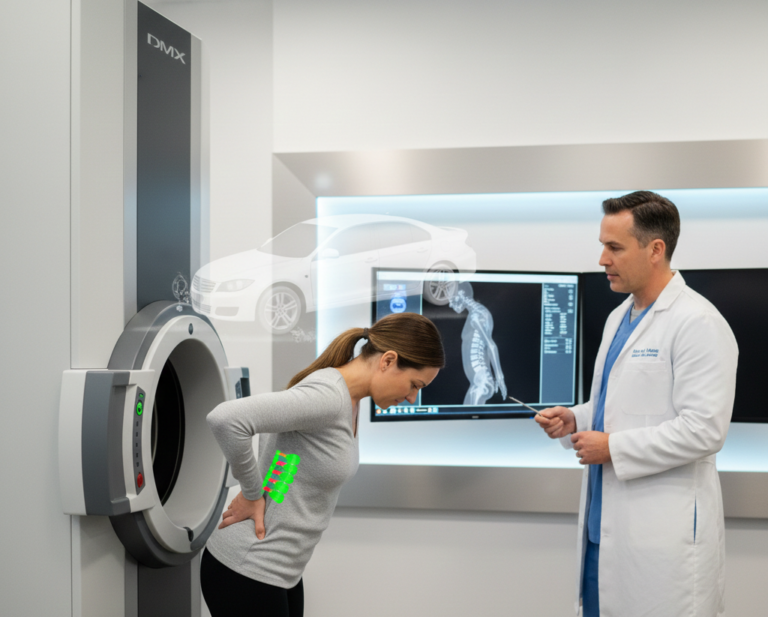
When Your “Sprain/Strain” Never Really Healed
After a car accident, most attention goes to the neck. But many patients develop low back pain that:
- Starts soon after the crash, or..
- Appears gradually over weeks or months.
They may be told:
- “It’s just a lumbar sprain/strain.”
- “Your X-rays and MRI don’t show anything surgical.”
- “Give it time and keep taking these medications.”
Yet months or years later, they still have:
- Pain with bending, twisting, or lifting.
- Discomfort after standing or sitting too long.
- Episodes where their back “locks up” or spasms.
Sometimes, the issue is lumbar instability and Digital Motion X-Ray can help detect it.
What Happens to the Low Back in a Collision

Even in “low-speed” accidents, the lumbar spine can experience:
- Sudden forward and backward forces.
- Compression and shear across discs and facet joints.
- Strain or partial tearing of lumbar ligaments.
These ligaments help keep vertebrae from sliding or tilting excessively when you move. If they’re compromised, certain spinal segments may become:
- Too mobile in some directions.
- Irritated and inflamed.
- Sources of ongoing pain with normal activities.
Why Static Imaging Often Looks Better Than You Feel
Standard lumbar imaging focuses on:
- Fractures.
- Disc herniations or major bulges.
- Severe arthritis or stenosis.
Many patients are told they have:
- “Mild degenerative changes.”
- “Age-appropriate findings.”
- “Nothing to explain this degree of pain.”
But those images are taken lying down or standing still. They don’t show what happens when you:
- Bend forward.
- Extend backward.
- Rotate or side-bend.
That’s exactly when many accident patients hurt.
How Digital Motion X-Ray Evaluates the Lumbar Spine in Motion
With Digital Motion X-Ray:
- The lumbar spine is observed using fluoroscopic video while you perform controlled movements.
- Vertebral motion is measured for:
- Abnormal forward/backward translation.
- Abnormal angulation between levels.
The goal is to see:
- Whether certain segments move excessively compared to normal.
- Whether instability matches your pain patterns and motion triggers.
How DMX Lumbar Findings Guide Treatment
If DMX reveals instability or abnormal motion, your providers can:
- Put more emphasis on core and segmental stabilization rather than only stretching.
- Protect unstable segments from certain manual techniques or exercises.
- Target specific levels for interventional or regenerative procedures if appropriate.
- Provide clearer documentation in injury-related or med-legal cases.
Instead of a generic “low back strain,” you get a more precise mechanical explanation.
Who Should Consider Lumbar Digital Motion X-Ray?
You might discuss lumbar DMX with your provider if:
- Your low back pain started after a car accident or significant fall.
- Pain clearly worsens with specific motions or positions.
- Standard imaging doesn’t match the severity or chronicity of your symptoms.
- Physical therapy, chiropractic, or injections haven’t given lasting relief.
Patients frequently travel to DMX Miami when they suspect their ongoing low back issues are more than just muscle soreness.
Your Low Back Pain Has a History DMX Helps Clarify the Story
If your low back never felt the same after a crash, and “normal” scans haven’t led to real answers, it’s reasonable to ask whether lumbar instability is part of the problem.
Digital Motion X-Ray provides a motion-based look at how your lumbar spine behaves under load information you can’t get from static imaging alone.
👉 If your low back pain started after an accident and never truly resolved, ask your provider whether lumbar DMX could help, and contact our office to discuss scheduling
Learn more: Treatment
Schedule your appointment today:Appointments
Call 305-275-7475 orbook your appointment online

Dr. Rodolfo Alfonso, D.C.
Dr. Mark N. Berry, D.C.
Sunset Chiropractic and Wellness
8585 Sunset Dr. STE 102
Miami, Florida 33143