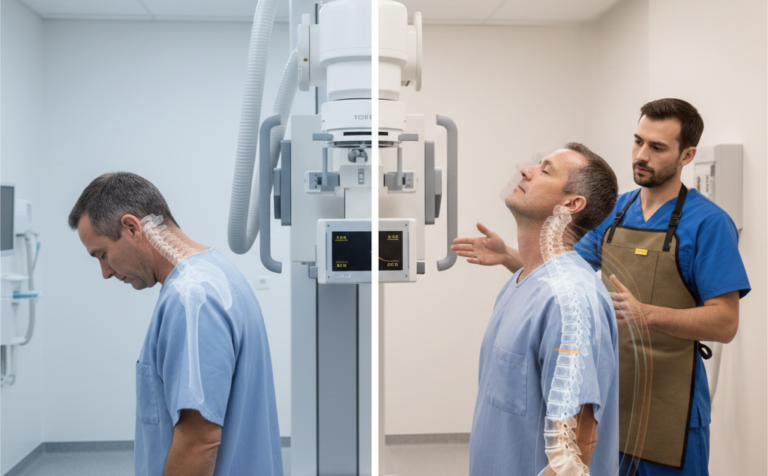
Understanding Two Very Different Ways to Look at Spinal Motion
If you’ve had a neck or low back injury, your doctor may order:
- Standard X-rays.
- MRI.
- CT scans.
- Flexion extension X-rays.
You might also hear about Digital Motion X-Ray (DMX) and wonder:
- “Isn’t that just another kind of X-ray?”
- “What’s the difference between flexion–extension films and DMX?”
- “Why would I need both?”
At DMX Miami, we help patients and providers understand how these tools are similar and how they’re very different.
What Are Standard Flexion – Extension X-Rays?

Flexion – extension X-rays are:
- A pair of static images taken at the extremes of bending forward (flexion) and bending backward (extension)
- Used to look for:
- Gross instability.
- Large changes in alignment between positions.
- Obvious ligament failure at end ranges.
They provide two snapshots of motion: one at forward bend, one at backward bend.
These are widely available and often part of a basic instability workup.
What Is Digital Motion X-Ray?
Digital Motion X-Ray is different:
- It’s a fluoroscopic video X-ray a continuous sequence of images.
- It records the spine through the entire range of guided motion, not just the endpoints.
- It allows providers to:
- Watch how each vertebra moves frame by frame.
- Measure subtle translation and angulation at many points in the movement.
- Correlate specific motion segments with pain or symptom triggers.
Instead of two pictures, you get a movie of spinal motion.
Why DMX Can Show More Than Flexion – Extension Films
Flexion – extension films:
- Capture only the start and end of the movement.
- Can miss:
- Instability that occurs mid-range.
- Asymmetrical or jerky motion patterns.
- Levels that move abnormally only in certain arcs.
Digital Motion X-Ray:
- Shows what happens throughout the movement.
- Can reveal:
- Segments that “catch” or slide at specific points.
- Levels that share motion poorly (one hypermobile, one hypomobile).
- Mechanical behaviors that line up with the exact motion that causes your pain.
For some patients, flexion – extension X-rays and DMX both show instability. For others, flexion – extension studies appear normal, but DMX reveals subtler motion problems.
Do You Always Need DMX If You’ve Had Flexion–Extension Films?
Not necessarily. In some cases:
- Flexion – extension X-rays are enough to show major problems.
- DMX might not change the treatment plan.
In other cases especially when symptoms are severe, long lasting, or clearly motion-driven despite “normal” basic imaging DMX can provide additional mechanical detail that influences:
- Rehab strategies.
- Manual therapy choices.
- Decisions about injections or regenerative procedures.
- Documentation in injury-related cases.
The key question is:
“Would DMX findings change what we do?”
How Doctors Use Both in Practice
A provider might:
- Start with standard imaging (X-ray, MRI, CT).
- Add flexion–extension films to screen for gross instability.
- Recommend DMX if:
- Symptoms are not explained by those studies.
- Motion triggers are very specific.
- More precise mechanical information is needed.
In this way, DMX builds on standard imaging rather than replacing it.
Asking Your Provider the Right Questions
If you’ve had flexion – extension X-rays but still don’t have clear answers, you can ask:
- “Do my symptoms match what you see on my current imaging?”
- “Are there motion questions that flexion – extension films can’t fully answer?”
- “Could Digital Motion X-Ray provide more detail that might change our plan?”
This keeps the focus on whether DMX would meaningfully add to your case.
Two Tools, Two Levels of Motion Detail
Flexion – extension X-rays and Digital Motion X-Ray are both ways of looking at spinal motion, but they provide very different levels of information:
- Flexion – extension = snapshots at the endpoints.
- DMX = a continuous movie throughout the motion.
For the right patient, that extra motion detail can make a real difference.
👉 If you’ve had flexion – extension films but still don’t have a mechanical explanation for your pain, ask your provider whether DMX might provide the missing details, and contact our office to learn more.
Learn more: Treatment
Schedule your appointment today:Appointments
Call 305-275-7475 orbook your appointment online

Dr. Rodolfo Alfonso, D.C.
Dr. Mark N. Berry, D.C.
Sunset Chiropractic and Wellness
8585 Sunset Dr. STE 102
Miami, Florida 33143