
A Plain-English Guide to Your Digital Motion X-Ray Results
After you complete Digital Motion X-Ray, you may receive a report that includes:
- Technical terms.
- Measurements.
- Segment names (C1–C7, L1–L5, etc.)
- Findings such as abnormal motion patterns.
Patients often ask:
- “What does this mean?”
- “Is this serious?”
- “How does this change my treatment plan?”
This blog explains the DMX report in plain language so you can be an informed patient.
What a DMX Report Is Trying to Answer
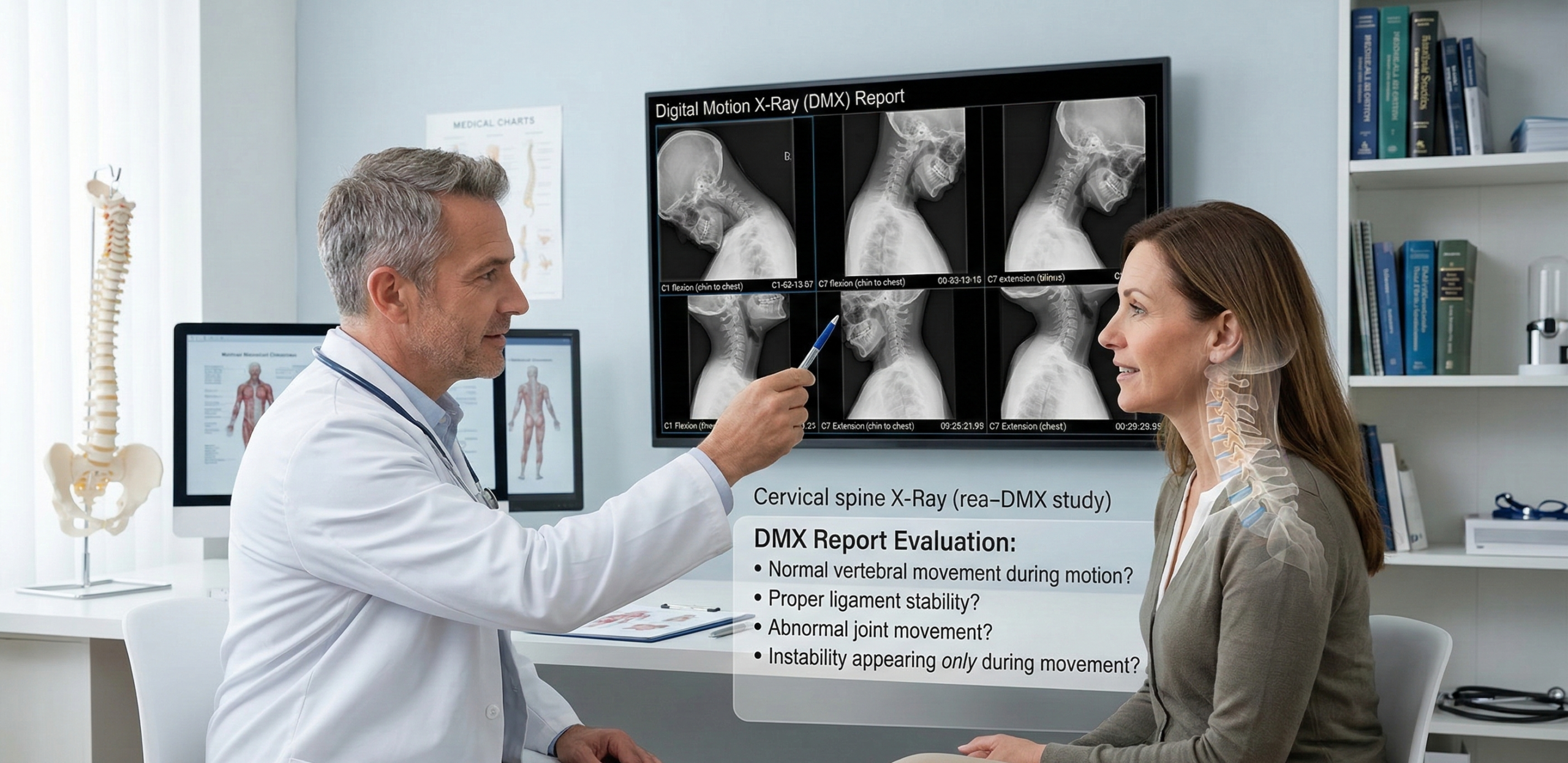
A DMX report primarily evaluates:
- How the spine moves during guided motion.
- Whether motion is smooth and normal.
- Whether certain segments show abnormal translation or angulation.
In simple terms, it asks:
“Are any spinal segments moving too much, too little, or in an abnormal pattern?”
Terms You May See (Plain English)
- Translation: sliding between vertebrae.
- Angulation: tilting between vertebrae.
- Instability: motion beyond expected limits for a segment.
- Segmental dysfunction: a level not moving normally (too stiff or too loose.)
- Asymmetry: motion differs on one side vs the other.
Your provider uses these findings to connect mechanical behavior to symptoms.
Why “Where” Matters More Than “How Many Findings”
A report may note one or multiple abnormal segments. What matters is:
- Do findings match your symptom map?
- Do they match what movements reproduce your pain?
- Are they clinically meaningful for your plan?
A good provider integrates DMX with:
- Your history.
- Physical exam.
- Other imaging.
- Response to previous care.
How DMX Results Typically Influence Treatment
Depending on findings, providers may:
- Emphasize stabilization over stretching.
- Modify manual therapy to protect unstable levels.
- Choose safer exercise progressions.
- Consider targeted procedures at documented unstable segments.
- Improve documentation in injury-related cases when relevant.
The real value of DMX is often that it turns a vague complaint into a mechanically specific plan.
What Patients Should Ask After Reading Their DMX Report
Ask your provider:
- Which segments were abnormal, and how do they relate to my symptoms?
- Which movements should I avoid for now?
- What does a stability-focused rehab plan look like for me?
- How will we track improvement (symptoms, function, follow-up exams)?
- Does this change whether injections, regenerative care, or surgery should be considered?
These questions help you translate the report into action.
The DMX Report Isn’t the End It’s the Map
DMX provides motion-based information. Your provider uses it to build the right plan. The report doesn’t “treat” you but it can help ensure your treatment matches what your spine is actually doing.
👉 If you’ve had DMX and want to understand the report better, ask your provider to review it with you line-by-line.
👉 Contact DMX Miami for information about Digital Motion X-Ray studies and reporting.
Learn more: Treatment
Schedule your appointment today:Appointments
Call 305-275-7475 orbook your appointment online

Dr. Rodolfo Alfonso, D.C.
Dr. Mark N. Berry, D.C.
Sunset Chiropractic and Wellness
8585 Sunset Dr. STE 102
Miami, Florida 33143