
After a rear-end accident, it’s common to be told “no fracture” and still have lingering neck pain, headaches, or dizziness. DMX evaluates cervical motion in real time and can help your provider determine whether motion-based ligament instability is part of the picture.
- Whiplash is often a ligament/mechanics injury, not a bone injury.
- Static imaging can miss motion-based instability patterns.
- DMX findings can improve treatment targeting and documentation clarity.
Last updated: March 31, 2026
Reviewed by: DMX Miami clinical team
Many rear-end collision patients hear:
“No fracture.”
“Your MRI is okay.”
“It’s just soft tissue.”
Yet months later they still have:
- headaches at the base of the skull.
- neck fatigue and tightness.
- pain turning the head while driving.
- dizziness or visual strain in busy environments.
In South Florida Miami, Fort Lauderdale, Miami-Dade, Broward, the Florida Keys rear-end accidents are common, and we also see visitors from the USA, Colombia, Chile, Argentina, Mexico, and the Caribbean with the same frustration:
“If everything is normal, why do I still feel this way?”
Why Rear-End Impacts Often Create Ligament Injuries
Whiplash forces can:
- stretch cervical ligaments.
- disrupt normal segment control.
- create subtle instability that doesn’t show on still images.
Ligaments don’t always show up clearly on standard imaging, but their function is expressed through motion.
Why Static Imaging Can Look Reassuring
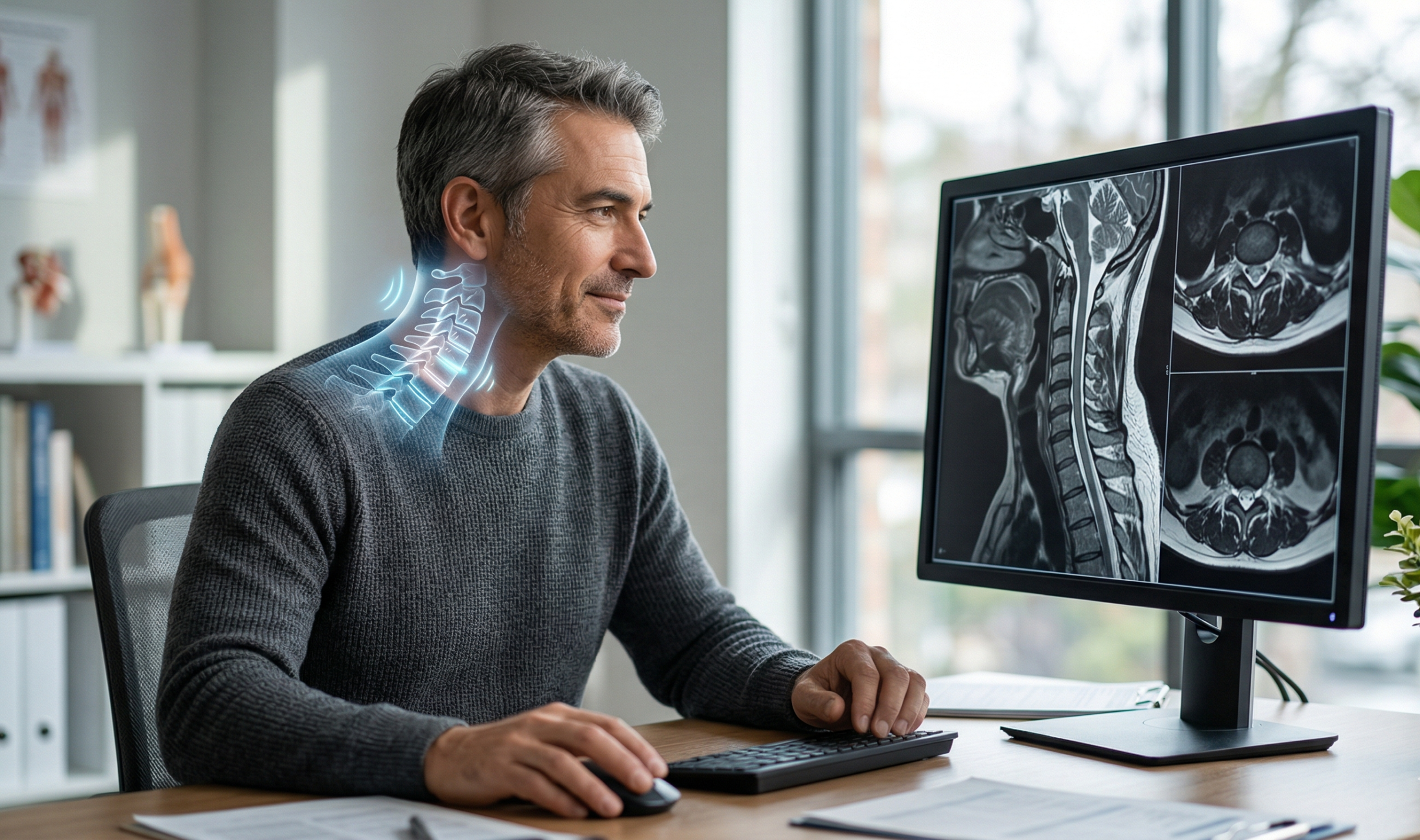
MRI and standard X-rays are essential, but they often show:
- structure at rest.
- limited positional snapshots.
- not the real-time “sliding/tilting” behavior that can trigger symptoms.
That’s why symptoms can be real even with a “normal” report.
How Digital Motion X-Ray Helps After Whiplash
DMX records the cervical spine as a video through guided motion, helping providers evaluate:
- abnormal translation (sliding).
- abnormal angulation (tilting).
- segmental instability patterns that align with movement-triggered symptoms.
How DMX Findings Can Guide Next Steps
If motion abnormalities are present, providers can:
- focus rehab on stability and motor control.
- avoid techniques that stress unstable segments.
- communicate clearer expectations for recovery.
- provide objective motion documentation when needed in complex cases.
Quick Self-Check: Common Post-Whiplash Patterns
Many patients with persistent symptoms after rear-end collisions report:
- Pain turning the head to check blind spots.
- Headaches that start at the base of the skull.
- Neck fatigue that builds through the day (“heavy head” feeling).
- Symptoms that spike with looking up/down or sustained posture.
What DMX Adds When MRI/X-Ray Don’t Match Symptoms
Static imaging is excellent for many problems, but whiplash can be mechanics-first. DMX can help your provider evaluate whether a segment is moving too much or too irregularly information that may influence stabilization, exercise selection, and manual technique choices.
Next Steps Checklist
- Document your top 3 triggers (driving, desk work, turning, sleeping positions).
- Track which motions reproduce symptoms most reliably.
- Ask your provider: “Would motion findings change my treatment plan?”
- If DMX is ordered, make sure results are shared with your treating team so the report leads to an action plan.
What to Bring to Your Follow-Up Visit
To turn imaging into action, bring:
- A written list of your top triggers and daily limitations.
- The timeline of symptoms since the collision (what improved vs what didn’t).
- Any prior MRI/X-ray reports so your provider can compare structure vs motion.
FAQs
Can whiplash cause instability even without a fracture?
Yes. Ligament injury can create instability without bone damage.
Why can MRI look normal after a rear-end accident?
Because MRI is static and may not show motion-based instability.
What does DMX add in whiplash cases?
DMX documents real-time motion and can measure abnormal translation and angulation.
Does DMX replace other imaging?
No. It complements MRI/CT/X-ray by evaluating motion and stability.
References
- Peer-reviewed research on whiplash-associated disorders and clinical evaluation limitations with static imaging.
- Peer-reviewed discussions of videofluoroscopy/dynamic imaging concepts for assessing motion-related instability.
Learn more: Treatment
Schedule your appointment today:Appointments
Call 305-275-7475 orbook your appointment online

Dr. Rodolfo Alfonso, D.C.
Dr. Mark N. Berry, D.C.
Sunset Chiropractic and Wellness
8585 Sunset Dr. STE 102
Miami, Florida 33143