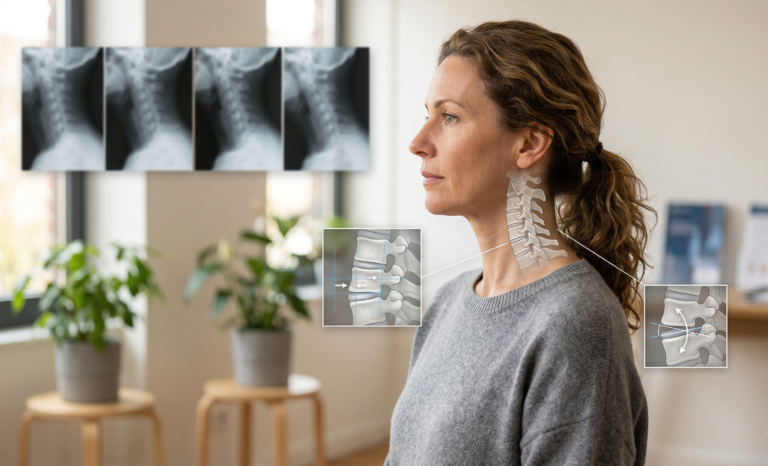
Translation means “sliding” between vertebrae; angulation means “tilting.” DMX evaluates these motion behaviors in real time, helping your provider understand whether your spine moves smoothly and within expected limits—information static imaging typically can’t show.
Translation = sliding; angulation = tilting during motion.
- DMX can document motion behavior that explains movement-triggered symptoms.
- Findings are interpreted with symptoms + exam not in isolation.
Last updated: March 31, 2026
Reviewed by: DMX Miami clinical team
After a Digital Motion X-Ray study, patients often see words like translation and angulation and wonder what they actually mean.
At DMX Miami, we work with patients from Miami, Fort Lauderdale, Miami-Dade, Broward, the Florida Keys, and travelers from the USA, Colombia, Chile, Argentina, Mexico, and the Caribbean who want a clear answer:
“What did my DMX show and how does it change my plan?”
This guide explains the most common DMX motion terms in plain English.
What DMX Is Evaluating
DMX is a fluoroscopic video X-ray that shows how spinal segments move during guided motion. It focuses on whether motion is:
- stable.
- symmetrical.
- smooth.
- within expected limits.
Translation: Sliding Between Vertebrae

Translation means sliding. In the neck or low back, it describes how much one vertebra shifts forward/backward relative to the next during motion.
Why it matters:
- excessive sliding can suggest reduced ligament control.
- instability can cause muscles to overwork and joints to irritate.
Angulation: Tilting Between Vertebrae
Angulation means tilting. It describes how much one vertebra tips relative to the next during motion.
Why it matters:
- excessive tilt can overload facet joints and discs.
- abnormal tilt patterns can correlate with pain during specific movements.
Why These Findings Can Be Missed on MRI
MRI is static. It may show discs, nerves, and structure at rest, but it does not show:
- how much segments slide/tilt during motion.
- whether instability appears mid-range.
- asymmetry during rotation or extension.
How Providers Use Translation/Angulation Findings
When motion abnormalities are documented, providers can:
- target stabilization to specific segments.
- modify manual care to avoid stressing unstable levels.
- tailor rehab progressions (what to do first, what to avoid).
- communicate clearer expectations and objective findings.
Quick Self-Check: When Motion Metrics Matter Most
Translation and angulation findings are most clinically useful when your symptoms are clearly motion-triggered, such as:
- Pain that spikes with turning, looking up/down, or transitioning positions.
- Symptoms that feel “fine” at rest but flare with specific arcs of movement.
- Complaints of catching, shifting, clunking, or heavy fatigue.
How to Use Your DMX Report in Real Life
After you receive your report, ask your provider to connect the findings to decisions:
- Which segment(s) are most relevant to my symptom triggers?
- Which movements should I limit temporarily while stabilizing?
- What are the first 2–3 rehab priorities based on the motion findings?
- How will we measure progress (function, tolerance, symptom pattern)?
Next Steps Checklist
- Bring your report to the clinician who is managing your rehab plan.
- Confirm whether findings change exercise selection, manual techniques, or activity limits.
- Use the report as a roadmap, not a verdict motion findings must match the clinical picture.
Common Mistake: Treating the Numbers Without the Pattern
Translation/angulation values matter most when they line up with your symptom pattern. A small finding can be important if it consistently matches your triggers, while a larger-looking number may be less meaningful if it doesn’t correlate clinically. The goal is a report-to-plan conversation, not a report-to-fear spiral.
FAQs
What is translation on a DMX report?
Translation is the amount of sliding between vertebrae during motion.
What is angulation on a DMX report?
Angulation is the amount of tilting between vertebrae during motion.
Does abnormal translation always mean severe injury?
Not always. Your provider interprets findings alongside symptoms and exam.
Why can’t MRI show translation and angulation?
MRI is typically taken while still and does not evaluate segment behavior through motion.
References
- Peer-reviewed spine biomechanics literature describing intervertebral translation and angulation as motion metrics.
- Clinical education resources explaining how dynamic imaging complements static imaging for motion-dependent symptoms.
Learn more: Treatment
Schedule your appointment today:Appointments
Call 305-275-7475 orbook your appointment online

Dr. Rodolfo Alfonso, D.C.
Dr. Mark N. Berry, D.C.
Sunset Chiropractic and Wellness
8585 Sunset Dr. STE 102
Miami, Florida 33143