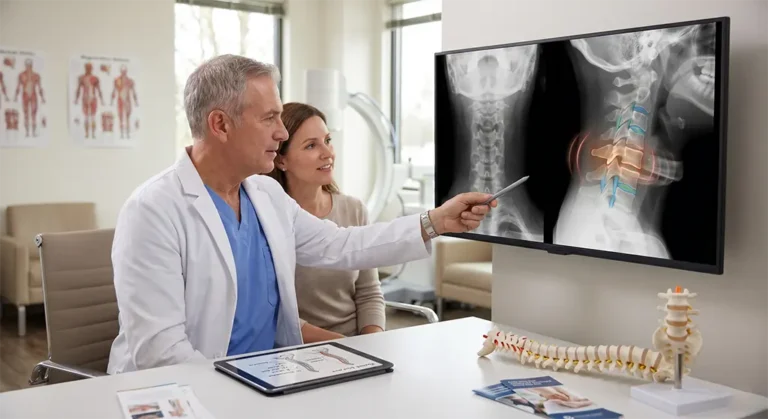
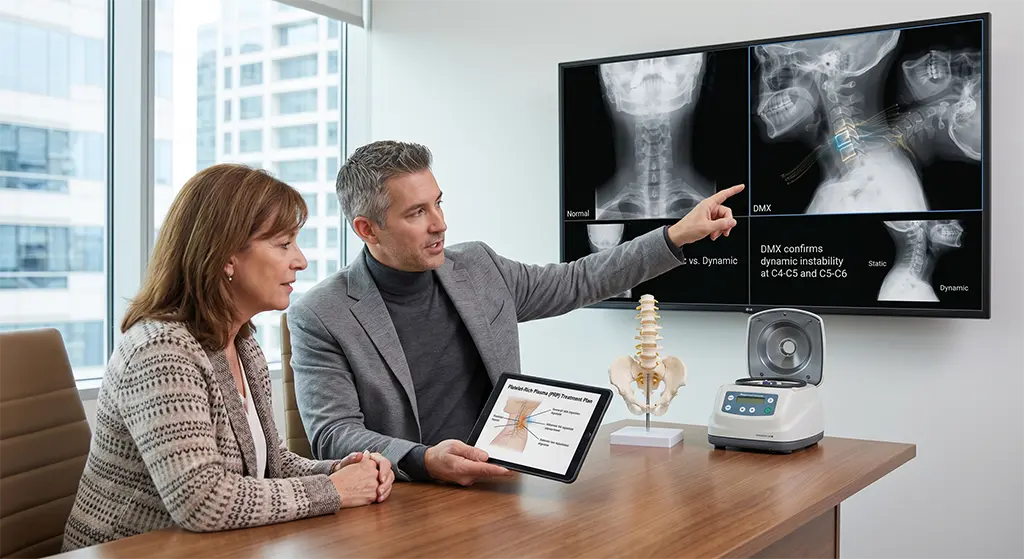
Regenerative injections (PRP, prolotherapy, “stem cell” products) can be expensive and outcomes vary. One major reason for failure is treating symptoms instead of the true mechanical driver especially when instability is motion dependent. DMX evaluates spinal motion in real time (translation and angulation) to help identify hinge segments, asymmetry, and instability patterns that static MRI/CT may miss. When the plan is to inject or stabilize, motion clarity can reduce guesswork and improve decision-making.
- Instability is often a motion problem; static imaging may not show the driver segment.
- DMX helps identify hinge patterns and asymmetry, improving targeting and rehab planning.
- DMX does not replace MRI/CT; it complements them when symptoms are movement triggered and treatment decisions depend on stability.
Last updated: April 14, 2026
Reviewed by: DMX Miami clinical team
In Miami and Fort Lauderdale, we routinely see patients who have already spent significant money on regenerative procedures for neck or back pain PRP, prolotherapy, and other injection-based approaches yet they still have the same triggers: headaches/dizziness with turning, pain spikes with looking up or bending, catching during transitions, and short-lived relief followed by relapse. We also see visitors from the USA, Colombia, Chile, Argentina, Mexico, and the Caribbean seeking clearer answers.
Why regenerative procedures can fail even when the product is “good”
- The wrong segment was treated
- The driver is motion sequencing, not tissue irritation alone.
- The rehab plan didn’t protect the unstable arc.
Why static imaging often doesn’t solve the targeting problem
Static imaging may not show translation/angulation that appears only during movement arcs, left-right asymmetry, mid-range instability, or hinge segments that dump motion early.
What DMX evaluates
DMX is fluoroscopic video X-ray performed with guided motion. It can help evaluate translation, angulation, symmetry, hinge patterns, and sequencing through the arc. It complements MRI/CT when stability is the question.
The expensive mistake: treating compensation
A structural MRI finding doesn’t automatically identify the movement driver. DMX adds motion behavior so decisions are less guess-based.
When DMX is especially useful before injections (general guidance)
- reproducible arc triggers (turning, looking up/down, bending-returning-upright)
- trauma history
- quick relapse after prior procedures
- catching/shifting sensations
- consistent left vs right differences
- plan depends on identifying the stabilizing level
How DMX findings can change the plan
- Targeting becomes more defensible.
- Rehab becomes stability-first and arc-specific
- Manual techniques and stretching can be modified
- Expectations become clearer (milestones tied to function)
Questions to ask before spending more money
Which arcs trigger? Which segments behave abnormally during those arcs? What changes in rehab immediately after treatment? Which arcs are protected temporarily? What milestones define success?
FAQs
Is DMX necessary before PRP or prolotherapy?
Not always, but it can add value when symptoms are motion-triggered and targeting depends on stability.
Why do injections fail?
Wrong level, unchanged motion behavior, and returning to provocative arcs too soon are common reasons.
What does DMX add vs MRI?
Real-time motion behavior translation/angulation, asymmetry, hinge patterns through guided arcs.
Does DMX replace medical imaging?
No. It complements MRI/CT/X-rays when motion and stability are the key questions.
References
- AAOS OrthoInfo: Neck and low back pain education.
- PubMed-indexed literature on spinal instability, biomechanics, and dynamic fluoroscopic imaging.
Learn more: Treatment
Schedule your appointment today:Appointments
Call 305-275-7475 orbook your appointment online
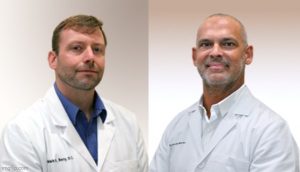
Dr. Rodolfo Alfonso, D.C.
Dr. Mark N. Berry, D.C.
Sunset Chiropractic and Wellness
8585 Sunset Dr. STE 102
Miami, Florida 33143