
Target Word Count: 1,000+ expanded
TL;DR:
Car headrests are designed for safety, but certain headrest positions can push the head forward, alter neck posture, or trigger symptoms in patients with cervical instability. If driving or sitting against a headrest causes neck pain, headaches, dizziness, shoulder-blade burning, or heavy-head fatigue, the issue may involve cervical motion sensitivity. Digital Motion X-Ray (DMX) evaluates cervical motion in real time and can help identify translation, angulation, asymmetry, hinge behavior, or instability patterns.
Key Takeaways:
- Headrests can change cervical posture, especially if they push the head forward.
- Driving symptoms may involve posture load, vibration, rotation, and cervical instability.
- DMX can help guide stabilization-focused care and safer driving-position strategies.
Last updated: April 14, 2026
Reviewed by: DMX Miami clinical team
Many patients notice their neck pain is worse in certain cars. Sometimes the issue is the seat angle. Sometimes it is the steering wheel position. Sometimes it is the headrest.
At DMX Miami, we see patients from Miami, Fort Lauderdale, Miami-Dade County, Broward County, and the Florida Keys, along with visitors from the USA, Colombia, Chile, Argentina, Mexico, and the Caribbean, who report neck symptoms during driving.
Patients often say:
- “The headrest pushes my head forward.”
- “Driving makes my neck feel compressed.”
- “My headache starts after 20 minutes in the car.”
- “My shoulder blade burns after commuting.”
- “Rental cars flare my neck.”
- “My neck feels better when I change the seat position.”
This matters because driving is a real-world cervical endurance test.
Why headrest position affects the neck
A headrest is designed to reduce excessive head movement during a crash. But depending on the vehicle, seat angle, body size, and posture, the headrest may push the head into a forward position.
That can increase demand on:
- cervical stabilizers
- upper traps
- suboccipital muscles
- cervicothoracic junction
- shoulder-blade stabilizers
- upper cervical joints
If the neck is stable, this may only feel uncomfortable. If the cervical spine is motion-sensitive, it can trigger symptoms.
Forward head posture and driving
Driving already encourages forward-head posture because the patient is looking ahead, reaching for the wheel, checking mirrors, and responding to traffic. A headrest that pushes the head forward can exaggerate the problem.
Symptoms may include:
- neck tightness
- base-of-skull headache
- dizziness
- eye pressure
- shoulder-blade burning
- arm tingling
- heavy-head fatigue
- symptoms after long commutes
Why post-whiplash patients are more sensitive
After whiplash, cervical ligaments, joints, and stabilizing muscles may become irritated. The body may guard against certain positions. A headrest pressing the head forward can feel threatening because the neck is already struggling with stability.
Patients may feel worse during:
- stop-and-go traffic
- long drives
- checking blind spots
- backing out of parking spaces
- road vibration
- sudden braking
- rental car driving
Driving is rarely just one trigger. It is a stack of posture, vibration, stress, and motion.
Why static imaging may not explain headrest symptoms
MRI, CT, and X-rays are usually performed outside the driving environment. They may not show what happens when the patient sits with a specific headrest position for 30–60 minutes.
Static imaging may not show:
- abnormal cervical translation during motion
- abnormal angulation
- hinge behavior
- upper cervical asymmetry
- instability that appears during guided movement
- posture-sensitive motion patterns
This is why dynamic evaluation may be helpful when symptoms are position- and motion-triggered.
How Digital Motion X-Ray helps
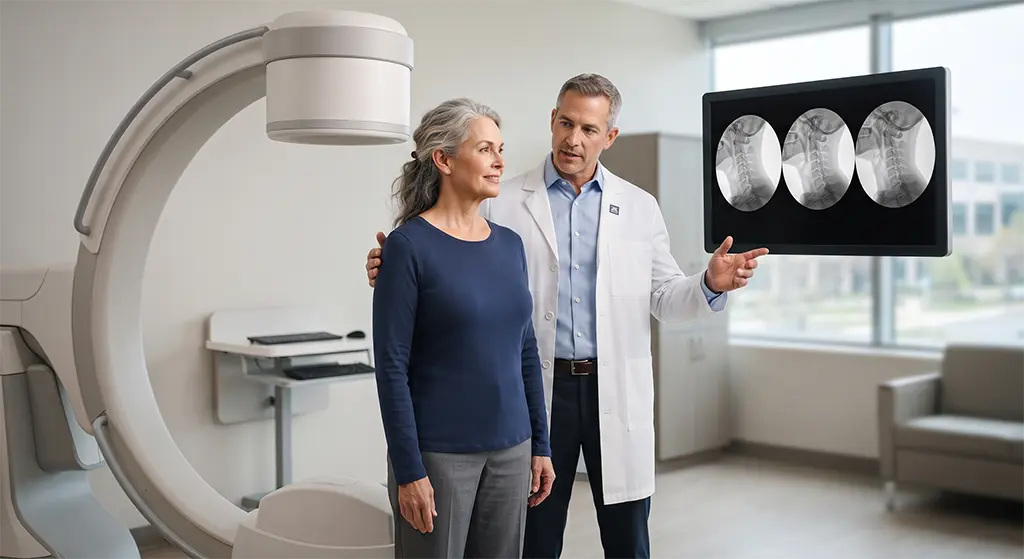
Digital Motion X-Ray is fluoroscopic video X-ray performed during guided cervical motion. It helps evaluate how cervical segments move in real time.
DMX may assess:
- Translation: abnormal sliding between vertebrae
- Angulation: abnormal tilting between vertebrae
- Asymmetry: left-right differences
- Hinge behavior: one segment moving too much
- Sequencing: smooth vs irregular movement
DMX does not replace MRI, CT, emergency evaluation, neurological care, or vehicle safety guidance. It complements them when symptoms are motion-based.
Internal link prompt: Link “Digital Motion X-Ray in Miami” to your main DMX page.
Internal link prompt: Link “neck pain while driving after whiplash” to a supporting DMX blog.
How DMX findings can change care
If abnormal motion is found, care may include:
- cervical stabilization
- posture endurance training
- driving-position modification
- safer mirror use
- reduced end-range rotation during flare periods
- manual therapy modifications
- gradual driving tolerance progression
The goal is better driving comfort and safer neck control.
Practical steps while awaiting evaluation
- Adjust seatback angle
- Avoid reaching too far for the wheel
- Keep the head and torso aligned
- Adjust mirrors to reduce excessive neck motion
- Take breaks on longer drives
- Avoid prolonged chin-forward posture
- Track which vehicles trigger symptoms most
- Bring symptom details to your evaluation
Safety note
Seek medical evaluation if driving triggers severe dizziness, fainting, neurological symptoms, severe headache, progressive weakness, vision changes, or unsafe driving control.
FAQs (For Schema)
Can a car headrest cause neck pain?
It can contribute if it pushes the head forward or forces an uncomfortable cervical position.
Why is driving worse after whiplash?
Driving combines posture load, vibration, head turns, stress, and visual scanning, which can irritate a motion-sensitive neck.
What does DMX show?
DMX evaluates real-time cervical translation, angulation, asymmetry, hinge behavior, and motion sequencing.
Does DMX replace MRI?
No. DMX complements MRI/CT/X-ray when symptoms are posture- or motion-triggered.
References
- Cleveland Clinic: Whiplash and neck pain education
- PubMed-indexed literature on cervical biomechanics, whiplash-associated disorders, and dynamic motion assessment
Footer: DMX Miami serves patients in Miami, Fort Lauderdale, Miami-Dade, Broward, the Florida Keys, Florida, the USA, and visitors from Colombia, Chile, Argentina, Mexico, and the Caribbean.