
Making a bed combines several movements that commonly aggravate mechanical low-back pain: bending forward, reaching across a wide surface, twisting, lifting mattress corners and repeatedly moving from one side of the bed to the other. A patient may tolerate ordinary walking yet experience a sharp catch while tucking sheets or reaching toward the opposite corner. This does not automatically indicate lumbar instability, but the specific movement pattern can help identify whether hip-spine coordination, muscular endurance or segmental motion deserves further evaluation.
- Making a bed combines flexion, reaching and rotation.
- Reaching across a wide mattress increases leverage on the trunk.
- Lifting mattress corners adds load.
- Turning the feet instead of twisting only the lumbar spine may reduce stress.
- DMX may add information when the clinical examination raises concern for abnormal lumbar segmental movement.
Last updated: September 29, 2026
Reviewed by: DMX Miami clinical team
Some low-back pain triggers sound surprisingly ordinary.
One of them is:
making the bed.
Patients tell us:
- “Tucking in sheets hurts my back.”
- “Reaching across the mattress makes it catch.”
- “Changing the fitted sheet kills my back.”
- “Lifting the mattress corner triggers pain.”
- “The twisting is worse than the lifting.”
- “I can walk for an hour but making the bed hurts.”
That contrast matters.
Walking and bed-making place very different demands on the lumbar spine.
Why Making a Bed Is Mechanically Difficult
Think through the task.
You may repeatedly:
- bend
- reach
- twist
- pull
- lift
- straighten
- walk around the bed
- bend again
The movement is repetitive and often asymmetrical.
Reaching Across the Mattress
The farther the arms move away from the body, the greater the leverage placed on the trunk.
A king-size bed creates a longer reach than a narrow surface.
The patient may compensate by:
- rounding the low back
- twisting
- leaning on one leg
- reaching farther instead of walking around
The final few inches of reach can become the provocative part.
The Fitted-Sheet Problem
Fitted sheets can be particularly demanding.
You may need to:
- Bend toward the corner.
- Lift part of the mattress.
- Pull the sheet.
- Rotate.
- Hold the mattress while adjusting the fabric.
This combines load with an awkward trunk position.
Why Twisting While Bent Can Be Provocative
Bending and rotation together may aggravate several forms of mechanical low-back pain.
Possible contributors include:
- muscle strain
- joint irritation
- disc-related pain
- poor hip mobility
- reduced trunk control
- segmental motion problems
The symptom does not identify the cause by itself.
But knowing the exact movement helps guide the examination.
The “Catch” When Standing Back Up
Some patients have little pain while bending.
The problem occurs when they straighten.
They describe:
- catching
- grabbing
- locking
- sharp one-sided pain
That transition is worth noting.
Tell your provider whether pain occurs:
- bending down
- while reaching
- while twisted
- while lifting
- while straightening
Those are different mechanical clues.
A Better Bed-Making Strategy
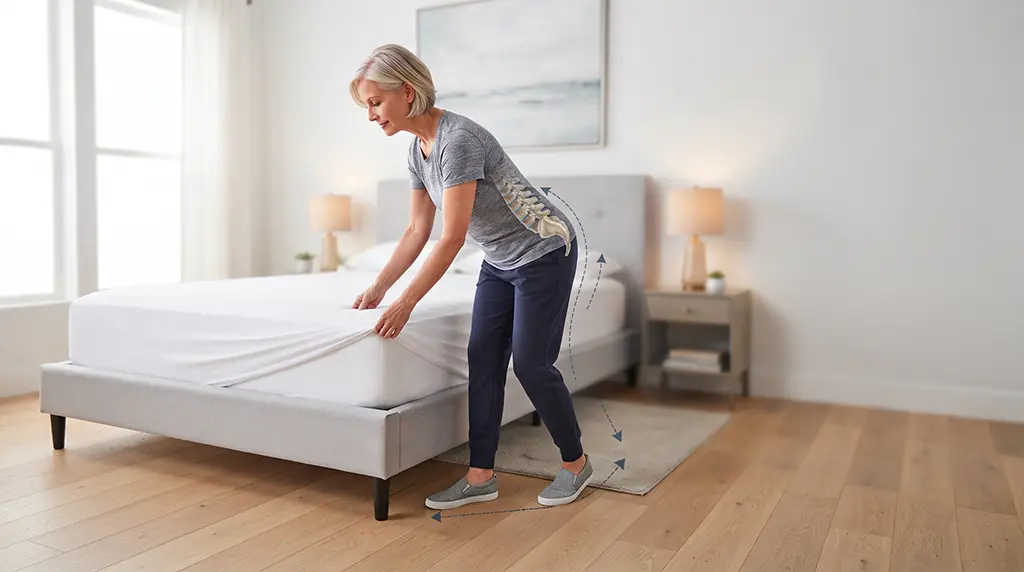
Instead of reaching across the mattress:
- walk around the bed
- keep the work closer to your body
- bend through the hips and knees
- turn the feet before changing direction
- avoid twisting while holding a mattress corner
- divide the task into smaller movements
An elevated mattress may also be easier than a very low bed.
When Dynamic Evaluation May Be Relevant
Suppose bed-making is one of many triggers.
The patient also experiences:
- pain rolling over in bed
- pain standing from a chair
- pain lifting groceries
- pain during rotation
- repeated lumbar catching
That broader movement pattern may justify evaluation for a lumbar control or segmental motion problem.
How Digital Motion X- Ray May Help
Lumbar DMX may provide information about:
- translation
- angulation
- asymmetry
- hinge behavior
- segmental sequencing
The findings need to be interpreted together with:
- examination
- symptoms
- neurological status
- previous imaging
- functional limitations
DMX should not be ordered merely because someone experiences occasional pain while making a bed.
How Findings May Change Rehabilitation
If movement control appears to be contributing, rehabilitation may include:
- hip hinge training
- lumbar stabilization
- glute strength
- rotational control
- bending tolerance
- loaded reaching
- functional household-task training
The ultimate test is not simply:
“Does your back hurt on the treatment table?”
It is:
“Can you perform your normal life without repeatedly triggering the problem?”
Safety Note
Seek prompt medical evaluation for progressive leg weakness, major numbness, bowel or bladder changes, saddle-region numbness, fever with significant back pain, substantial trauma or rapidly worsening neurological symptoms.
FAQs
Why does making the bed hurt my low back?
The task combines repetitive bending, reaching, lifting and twisting.
Why is a fitted sheet especially difficult?
It often requires lifting a mattress while bending and reaching at an awkward angle.
Does this mean I have lumbar instability?
No. Many mechanical conditions can cause this pattern. Instability requires a broader evaluation.
Can DMX help?
If symptoms and examination suggest abnormal segmental motion, dynamic imaging may provide additional information about lumbar movement.
References
- Cleveland Clinic: Lower Back Pain
- Mayo Clinic: Back Pain
- Published literature on dynamic lumbar radiography and lumbar segmental instability
Footer: DMX Miami serves patients in Miami, Fort Lauderdale, Miami-Dade, Broward, the Florida Keys, Florida, the USA, and visitors from Colombia, Chile, Argentina, Mexico, and the Caribbean.
Learn more: Treatment
Schedule your appointment today:Appointments
Call 305-275-7475 orbook your appointment online

Dr. Rodolfo Alfonso, D.C.
Dr. Mark N. Berry, D.C.
Sunset Chiropractic and Wellness
8585 Sunset Dr. STE 102
Miami, Florida 33143