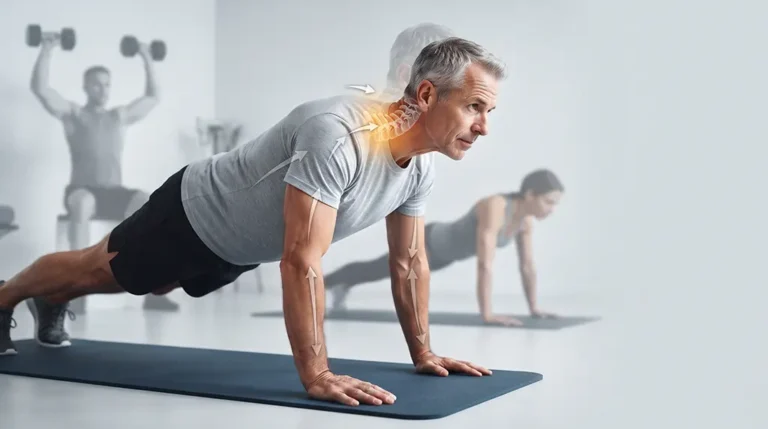
Push-ups, planks and overhead lifting may look like shoulder or arm exercises, but the cervical spine must remain controlled while the rest of the body produces force. Neck pain during these exercises can result from posture, muscular fatigue, shoulder mechanics, excessive load, technique problems or cervical disorders. Previous whiplash or motion sensitivity may make loaded stabilization more difficult. Persistent symptoms do not automatically mean cervical instability, but exercise can expose problems that are less obvious at rest.
- The neck continues working during upper-body exercise even when it is not visibly moving.
- Planks and push-ups require cervical endurance and postural control.
- Overhead lifting adds shoulder, upper-back and cervical stabilization demand.
- Technique problems are common and should be addressed before assuming instability.
- DMX may be useful when trauma history and examination suggest abnormal cervical motion.
Last updated: September 29, 2026
Reviewed by: DMX Miami clinical team
A patient may say:
“I can turn my head fine. Push-ups make my neck hurt.”
Another says:
“My neck shakes during planks.”
Another:
“Overhead presses trigger the pain at the base of my skull.”
These complaints tell us something important.
The neck’s job is not only to create movement.
It also has to prevent unwanted movement.
The Neck Works During a Plank
During a plank, the body attempts to maintain alignment from:
- ankles
- knees
- pelvis
- trunk
- shoulders
- neck
- head
If cervical endurance fails, the patient may:
- drop the head
- extend the chin
- shrug the shoulders
- tense the upper traps
- clench the jaw
This may produce neck pain even though the exercise is usually considered a “core” exercise.
Push-Ups Add Movement
Push-ups add:
- shoulder motion
- scapular motion
- changing body load
- stabilization demands
As fatigue increases, the patient may begin leading with the chin or allowing the head to sag.
That can increase cervical strain.
Overhead Lifting Is More Complex
Pressing weight overhead requires coordination among:
- shoulders
- shoulder blades
- thoracic spine
- trunk
- cervical spine
If shoulder mobility is limited, the body may compensate by:
- arching the low back
- elevating the shoulders
- extending the neck
- pushing the head forward
The cervical spine then absorbs movement that should be shared elsewhere.
Why Previous Whiplash May Matter
Whiplash can affect the cervical muscles, joints, ligaments and nerves.
Some patients return to normal daily activities but notice that exercise exposes a remaining deficit.
Why?
Exercise increases:
- load
- repetitions
- endurance demand
- speed
- stabilization requirements
A problem that is invisible during light activity may become obvious under load.
But Do Not Jump Straight to “Instability”
The most common explanation may still be something simpler:
- too much weight
- poor technique
- deconditioning
- shoulder limitation
- muscular fatigue
- training error
Those possibilities should be addressed.
DMX should not become a substitute for a good functional examination.
When the Pattern Deserves More Investigation
Further cervical evaluation becomes more relevant when exercise pain accompanies:
- previous whiplash
- painful cervical clicking
- headaches
- dizziness with head movement
- arm tingling
- repeated pain during ordinary activities
- abnormal motion on examination
- symptoms that do not improve with technique correction
How Digital Motion X-Ray May Help
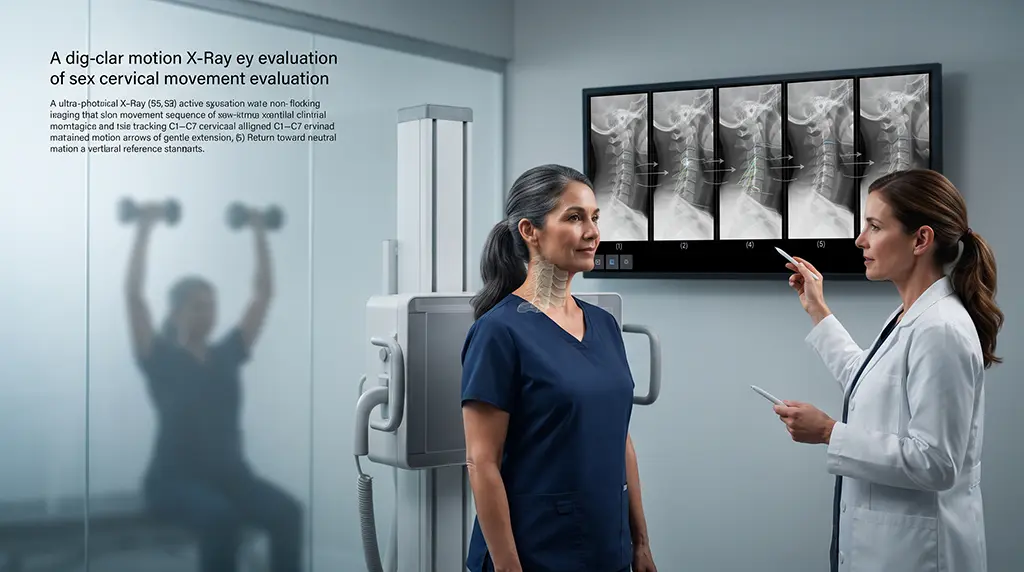
When clinically appropriate, DMX evaluates cervical movement using fluoroscopic imaging.
Assessment may include:
- translation
- angulation
- left-right asymmetry
- hinge behavior
- motion sequencing
DMX does not reproduce a heavy overhead press during imaging.
Rather, it helps determine whether the underlying cervical motion pattern shows abnormalities that may affect rehabilitation decisions.
How Findings May Change Exercise Rehabilitation
Rehabilitation may include:
- deep neck stabilization
- cervical endurance
- scapular control
- thoracic mobility
- shoulder mobility
- progressive loading
- improved head position during exercise
The patient might begin with:
- wall push-ups
- elevated push-ups
- short-duration planks
- lighter overhead loads
and progress gradually.
Training Principle: Control Before Load
Adding more weight to an uncontrolled movement generally does not improve control.
A better sequence is:
- Establish pain-free positioning.
- Improve endurance.
- Improve movement quality.
- Add load.
- Add speed or complexity.
Safety Note
Stop exercise and seek medical evaluation for new progressive weakness, significant arm numbness, severe headache, fainting, significant dizziness, vision changes, loss of coordination or other neurological symptoms.
FAQs
Why does my neck hurt during push-ups?
Head position, muscle fatigue, shoulder mechanics and cervical stabilization demands can all contribute.
Why does a plank make my neck tired?
Your cervical muscles must maintain head position throughout the exercise.
Does neck pain with lifting mean instability?
No. Technique problems and muscular fatigue are common. Instability requires appropriate clinical evaluation.
Can DMX help athletes?
DMX may provide additional motion information when symptoms, trauma history and examination suggest a cervical movement disorder.
References
- Cleveland Clinic: Neck Pain
- Cleveland Clinic: Whiplash
- Published literature on cervical biomechanics and dynamic spinal assessment
Footer: DMX Miami serves patients in Miami, Fort Lauderdale, Miami-Dade, Broward, the Florida Keys, Florida, the USA, and visitors from Colombia, Chile, Argentina, Mexico, and the Caribbean.
Learn more: Treatment
Schedule your appointment today:Appointments
Call 305-275-7475 orbook your appointment online

Dr. Rodolfo Alfonso, D.C.
Dr. Mark N. Berry, D.C.
Sunset Chiropractic and Wellness
8585 Sunset Dr. STE 102
Miami, Florida 33143