
Coughing and sneezing create a rapid increase in pressure and muscular force through the trunk. For some people with low-back problems, that brief event can trigger a sharp pain, muscle spasm or pain radiating into the buttock or leg. Causes can include muscle strain, disc-related problems, nerve irritation and other spinal conditions. Pain with coughing or sneezing does not by itself prove lumbar instability, but when it occurs with repeatable movement-related back pain, the overall pattern may help determine whether further mechanical or dynamic evaluation is appropriate.
- Coughing and sneezing rapidly increase trunk pressure and muscular demand.
- Low-back strains can be aggravated by sneezing or coughing.
- Radiating leg symptoms can suggest nerve involvement and deserve evaluation.
- Cough-triggered pain does not automatically mean lumbar instability.
- DMX may provide additional information when segmental movement abnormalities are clinically suspected.
Last updated: September 29, 2026
Reviewed by: DMX Miami clinical team
You feel a sneeze coming.
You brace.
Then:
sharp low-back pain.
Patients often describe:
- “My back grabs when I sneeze.”
- “Coughing sends pain down my leg.”
- “I brace my stomach before coughing.”
- “Every sneeze feels like something moves in my back.”
- “I am fine until I cough hard.”
This can be concerning.
But there are several possible explanations.
What Happens During a Cough or Sneeze?
A forceful cough or sneeze requires rapid coordinated contraction of muscles involving the:
- abdomen
- diaphragm
- trunk
- chest
- spinal stabilizers
Pressure inside the trunk rises rapidly.
The spine must remain controlled during that sudden event.
For an irritated back, that can be enough to reproduce symptoms.
Cleveland Clinic notes that strains and sprains are common causes of low-back pain and that some people strain the back through coughing or sneezing as well as bending and twisting.
Muscle Strain
A relatively straightforward explanation is muscular or ligamentous strain.
An already irritated muscle can react painfully when the trunk suddenly contracts.
The patient may experience:
- localized back pain
- brief spasm
- soreness afterward
This does not necessarily indicate deeper instability.
Disc and Nerve Symptoms
Pain that shoots into:
- buttock
- thigh
- calf
- foot
may suggest irritation involving a spinal nerve.
Disc problems are one possible cause, although imaging findings must be interpreted carefully because disc abnormalities can also exist in people without symptoms.
This is why symptom pattern and neurological examination matter.
Why Patients Describe a “Shift”
Some patients say:
“It feels like something moves when I sneeze.”
That description is clinically interesting but should not be interpreted literally without evaluation.
A sudden sensation may originate from:
- muscle spasm
- joint irritation
- disc-related symptoms
- nerve pain
- mechanical instability
- several other causes
The sensation alone cannot identify the structure.
When Dynamic Evaluation Becomes Relevant
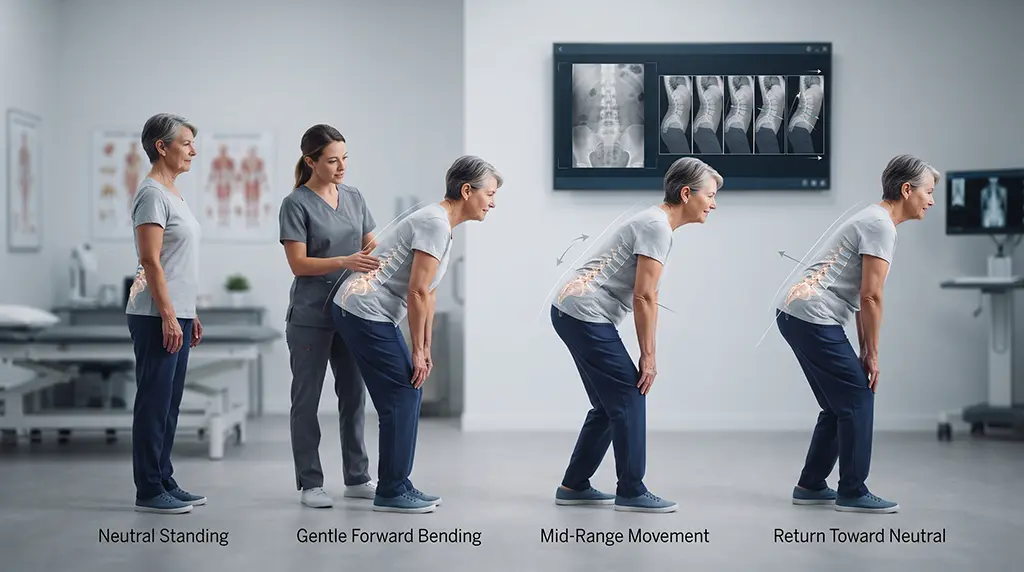
Suppose coughing is only one trigger.
The patient also reports:
- catching while bending
- pain turning in bed
- pain standing from a chair
- pain twisting
- difficulty lifting
- a repeated hinge-like sensation
Now there is a broader pattern of movement-dependent symptoms.
If the examination raises concern for segmental motion abnormality, dynamic imaging may be considered.
How Digital Motion X-Ray May Help
Lumbar DMX may provide information about movement characteristics including:
- vertebral translation
- angulation
- asymmetry
- hinge behavior
- motion sequencing
It is not a test specifically designed to reproduce coughing.
It evaluates whether abnormal segmental motion is present during controlled spinal movement.
DMX should complement not replace MRI, neurological examination or other appropriate diagnostic testing.
What You Can Track
Tell your provider:
- whether coughing or sneezing causes localized or radiating pain
- which side hurts
- whether numbness occurs
- whether weakness occurs
- whether bending is also painful
- whether sitting changes symptoms
- whether the symptom began after an accident or lifting injury
These details may be more valuable than simply saying:
“My back hurts.”
When to Seek Evaluation
Schedule an evaluation if:
- coughing repeatedly causes significant pain
- pain radiates into a leg
- numbness develops
- weakness occurs
- symptoms are progressively worsening
- normal movement is becoming difficult
Safety Note
Seek urgent medical evaluation for bowel or bladder dysfunction, saddle-region numbness, progressive leg weakness, severe trauma, fever associated with significant back pain, or other major neurological symptoms.
FAQs
Why does sneezing hurt my low back?
Sneezing creates a sudden increase in trunk pressure and muscular force, which can aggravate an already irritated spinal structure.
Does coughing pain mean I have a herniated disc?
Not necessarily. Disc and nerve problems are possibilities, but muscle strain and other spinal conditions can also produce symptoms.
Does it mean my spine is unstable?
No. Cough-triggered pain by itself does not diagnose lumbar instability.
Can DMX help?
When a broader evaluation suggests segmental movement problems, dynamic imaging can provide additional information about lumbar motion.
References
- Cleveland Clinic: Lower Back Pain
- Mayo Clinic: Back Pain
- Published literature on lumbar segmental motion and instability
Footer: DMX Miami serves patients in Miami, Fort Lauderdale, Miami-Dade, Broward, the Florida Keys, Florida, the USA, and visitors from Colombia, Chile, Argentina, Mexico, and the Caribbean.
Learn more: Treatment
Schedule your appointment today:Appointments
Call 305-275-7475 orbook your appointment online

Dr. Rodolfo Alfonso, D.C.
Dr. Mark N. Berry, D.C.
Sunset Chiropractic and Wellness
8585 Sunset Dr. STE 102
Miami, Florida 33143