
Roller coasters, amusement rides, water rides, and sudden amusement-park movements can trigger neck pain, headaches, dizziness, visual strain, or shoulder-blade burning because they expose the cervical spine to acceleration, deceleration, vibration, and rapid direction changes. If symptoms persist after a ride, especially in someone with prior whiplash or neck injury, Digital Motion X-Ray (DMX) may help evaluate cervical motion patterns such as translation, angulation, asymmetry, hinge behavior, and instability.
- Amusement rides can stress the cervical spine through rapid acceleration, deceleration, and directional changes.
- Persistent symptoms after rides may reveal cervical motion sensitivity or instability.
- DMX can help evaluate real-time cervical motion when static imaging does not explain symptoms.
Last updated: April 14, 2026
Reviewed by: DMX Miami clinical team
Florida is a major destination for amusement parks, water parks, cruises, and family travel. Many patients from Miami, Fort Lauderdale, Miami-Dade County, Broward County, and the Florida Keys travel to Orlando or other parks. Visitors from the USA, Colombia, Chile, Argentina, Mexico, and the Caribbean often include amusement rides as part of their Florida trip.
Most people think of roller coasters as harmless fun. But for patients with cervical instability, prior whiplash, or motion sensitivity, a ride can trigger a significant flare.
Patients often say:
- “My neck hurt after a roller coaster.”
- “I had a headache after the ride.”
- “My dizziness started later that day.”
- “The ride jerked my head side to side.”
- “My shoulder blade burned after the park.”
- “I had an old whiplash injury, and the ride brought symptoms back.”
This pattern should not be ignored, especially when symptoms persist.
Why amusement rides stress the neck
Amusement rides can involve:
- rapid acceleration
- sudden braking
- quick turns
- side-to-side jolts
- vibration
- head whipping
- unexpected drops
- bracing
- awkward restraint positions
The cervical spine must stabilize the head through all of this. If the neck is already injured, the stabilizing system may not tolerate the ride well.
Why prior whiplash matters
Whiplash is an acceleration-deceleration injury. Roller coasters and amusement rides also involve acceleration and deceleration, though in a different context. A patient with prior whiplash may have ligaments, joints, and muscles that are already sensitive to sudden motion.
This does not mean every person with past whiplash must avoid every ride. But it does mean ride tolerance should be taken seriously.
Delayed symptoms after rides
Some patients feel fine during the ride because adrenaline and excitement mask symptoms. Later, they develop:
- neck stiffness
- base-of-skull headache
- dizziness
- nausea
- eye pressure
- shoulder-blade burning
- heavy-head fatigue
- arm tingling
Delayed symptoms may appear later the same day or the next morning.
When ride symptoms are more concerning
A short-lived mild soreness may not be unusual after a rough ride. But evaluation is more important when symptoms:
- last more than a few days
- include dizziness or neurological signs
- trigger headaches
- radiate into the arm
- worsen with turning or looking down
- return after temporary relief
- occur in someone with prior whiplash or known instability
Why static imaging may not explain ride-related symptoms
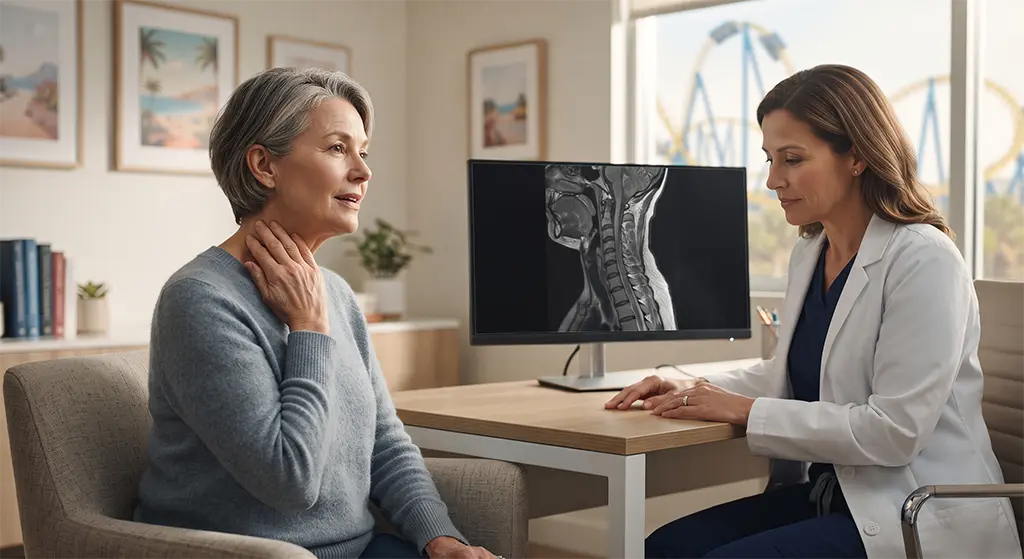
MRI, CT, and standard X-rays are important when medical evaluation is needed. But amusement-ride symptoms are motion-based. They happen during acceleration, deceleration, jolts, and bracing.
Static imaging may not show:
- abnormal translation during motion
- abnormal angulation
- upper cervical asymmetry
- hinge behavior
- instability that appears only during movement
- sequencing problems that trigger symptoms
This is why motion-based evaluation may be useful when symptoms persist.
How Digital Motion X-Ray helps
Digital Motion X-Ray uses fluoroscopic video imaging during guided cervical motion. Providers may evaluate:
- Translation: abnormal sliding between vertebrae
- Angulation: abnormal tilting between vertebrae
- Asymmetry: left-right motion differences
- Hinge behavior: one segment moving excessively
- Sequencing: whether motion is smooth or irregular
DMX does not replace emergency evaluation, MRI, CT, neurological care, or concussion evaluation. It complements those tools when the question is cervical motion and stability.
How DMX findings can change care
Stabilization-focused rehab
If abnormal motion is identified, care may focus on stabilizing the cervical spine and improving motion control.
Safer activity decisions
Patients may need guidance on rides, boating, jet skis, contact sports, or high-velocity activities.
Better manual therapy choices
If instability is present, providers may avoid aggressive end-range techniques and focus on safer stabilization strategies.
Functional progress tracking
Progress can be tracked by:
- fewer headaches after motion exposure
- better driving tolerance
- less dizziness with turning
- improved neck endurance
- reduced shoulder-blade burning
Practical steps after a ride-related flare
- Avoid repeating high-force rides during symptoms
- Track headache, dizziness, neck pain, and arm symptoms
- Avoid aggressive self-manipulation
- Use gentle motion only within tolerance
- Seek evaluation if symptoms persist or worsen
- Bring prior imaging and accident history to your appointment
Safety note
Seek urgent medical evaluation if symptoms include severe headache, loss of consciousness, confusion, vomiting, neurological changes, weakness, severe dizziness, vision changes, or symptoms after head impact.
FAQs
Can roller coasters cause neck pain?
Yes. Rapid acceleration, deceleration, jolts, and bracing can stress the cervical spine.
Are amusement rides risky after whiplash?
They can be for some patients, especially if neck instability or motion sensitivity remains.
What does DMX show?
DMX evaluates real-time cervical translation, angulation, asymmetry, hinge behavior, and motion sequencing.
Does DMX replace MRI or concussion evaluation?
No. DMX complements other evaluations when cervical motion instability is suspected.
References
- Cleveland Clinic: Whiplash and neck pain education
- PubMed-indexed literature on cervical instability and videofluoroscopy after whiplash
Footer: DMX Miami serves patients in Miami, Fort Lauderdale, Miami-Dade, Broward, the Florida Keys, Florida, the USA, and visitors from Colombia, Chile, Argentina, Mexico, and the Caribbean.
Learn more: Treatment
Schedule your appointment today:Appointments
Call 305-275-7475 orbook your appointment online

Dr. Rodolfo Alfonso, D.C.
Dr. Mark N. Berry, D.C.
Sunset Chiropractic and Wellness
8585 Sunset Dr. STE 102
Miami, Florida 33143