
Side-impact collisions can create rotational whiplash forces that stress the cervical ligaments, joints, muscles, and upper cervical spine differently than a simple rear-end crash. If turning the head, checking blind spots, looking down, driving, or sleeping triggers neck pain, dizziness, headaches, or arm symptoms after a side-impact crash, Digital Motion X-Ray (DMX) may help evaluate real-time cervical translation, angulation, asymmetry, hinge behavior, and instability patterns.
- Side-impact crashes can create rotational and lateral forces through the cervical spine.
- Symptoms may be worse turning one direction because the injury pattern is asymmetric.
- DMX can help evaluate real-time cervical motion when static imaging does not explain persistent symptoms.
Last updated: April 14, 2026
Reviewed by: DMX Miami clinical team
Not all car accidents stress the neck the same way. Rear-end crashes are commonly discussed, but side-impact collisions can create a different motion pattern. The head and neck may move sideways, rotate, rebound, or combine multiple directions in a split second.
At DMX Miami, we see patients from Miami, Fort Lauderdale, Miami-Dade County, Broward County, and the Florida Keys, as well as visitors from the USA, Colombia, Chile, Argentina, Mexico, and the Caribbean, who continue to have symptoms after side-impact crashes.
Patients often say:
- “I was hit from the side, and my neck never felt right.”
- “Turning one direction hurts more.”
- “My headaches started after the accident.”
- “Driving and checking blind spots flare me.”
- “My neck feels twisted or off-center.”
- “My MRI was mild, but my symptoms are very real.”
Side-impact mechanisms deserve careful motion-based thinking.
Why side-impact crashes are different
A side-impact crash may force the head and neck into:
- lateral bending
- rotation
- extension
- flexion
- rebound motion
- shoulder impact
- seatbelt restraint
- window or door-side bracing
This combination can stress the cervical spine asymmetrically.
That asymmetry matters because patients may have more symptoms turning one direction than the other.
Rotational whiplash patterns
Whiplash is not always straight forward and backward. Rotational whiplash can occur when the head turns or the body is hit from an angle.
This can irritate:
- upper cervical joints
- alar and capsular ligament regions
- facet joints
- lower cervical segments
- cervicothoracic junction
- muscles controlling rotation
- proprioceptive sensors in the neck
Symptoms may include neck pain, headaches, dizziness, nausea, shoulder-blade burning, arm tingling, or heavy-head fatigue.
The one-direction clue
After side-impact trauma, patients often report that one direction feels worse.
Examples:
- turning left hurts more than right
- looking over one shoulder triggers dizziness
- sleeping on one side flares symptoms
- one side of the skull base is more painful
- one shoulder blade burns more
- one arm tingles more often
This is clinically useful because it suggests an asymmetric motion pattern.
Why static imaging may not explain rotational symptoms
MRI, CT, and standard X-rays are important. But rotational symptoms happen during movement. A neutral static image may not show how the spine behaves when the patient turns or moves through a painful arc.
Static imaging may not show:
- abnormal rotational coupling
- abnormal translation during motion
- abnormal angulation
- left-right asymmetry
- hinge behavior
- instability that appears only during movement
This is where DMX can add important functional information.
How Digital Motion X-Ray helps
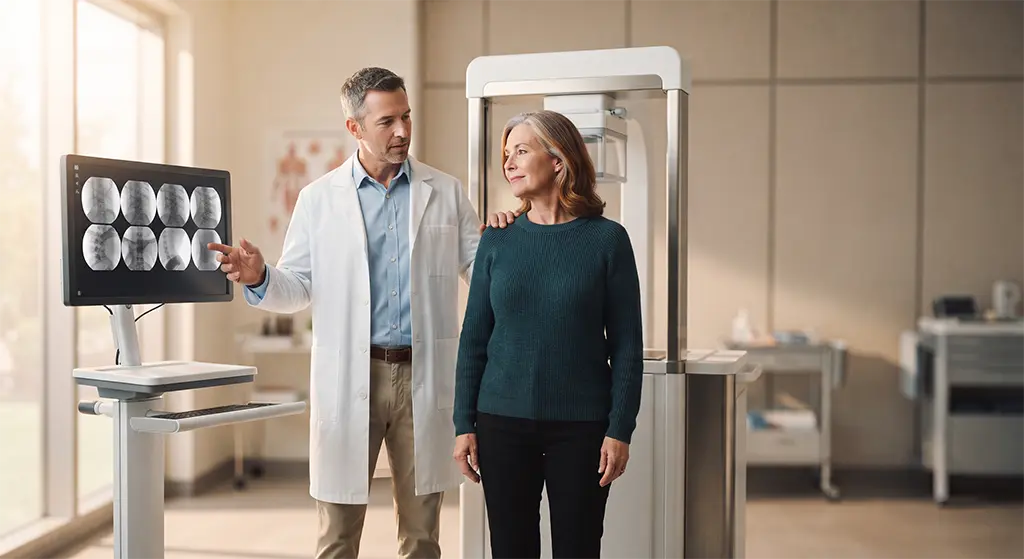
Digital Motion X-Ray is fluoroscopic video X-ray performed during guided cervical motion. DMX can help assess how the cervical spine moves in real time.
DMX may evaluate:
- Translation: abnormal sliding between vertebrae
- Angulation: abnormal tilting between vertebrae
- Asymmetry: left-right differences
- Hinge behavior: one segment moving too much
- Sequencing: whether movement is smooth or irregular
DMX does not replace MRI, CT, neurological evaluation, vestibular testing, or emergency care. It complements them when symptoms are motion-triggered.
How DMX findings can change care
If abnormal motion is identified, the care plan may become more specific.
Stabilization-focused rehab
Instead of only stretching the painful side, the plan may train controlled rotation and deep cervical stabilizer endurance.
Safer manual therapy
If instability is present, providers may avoid stressing vulnerable segments and focus on motion control.
Driving and activity modification
Patients may use mirror adjustments, trunk rotation, backup cameras, and safer blind-spot strategies while improving neck tolerance.
Better documentation
Motion findings can help explain why symptoms persist despite mild static imaging.
Practical steps while awaiting evaluation
- Track which direction triggers symptoms
- Avoid repeatedly forcing painful rotation
- Turn the shoulders and trunk when checking blind spots
- Avoid sleeping in positions that rotate the neck sharply
- Note whether dizziness, headache, or arm symptoms appear
- Bring accident details and prior imaging to your evaluation
Safety note
Seek urgent care after a crash if symptoms include severe headache, neurological changes, progressive weakness, severe dizziness, fainting, vision changes, confusion, or severe trauma symptoms.
FAQs
Can a side-impact crash cause whiplash?
Yes. Side-impact collisions can create rotational and lateral whiplash forces.
Why does my neck hurt more turning one direction?
Asymmetric motion or injury patterns may make one direction more provocative.
What does DMX show?
DMX evaluates real-time cervical translation, angulation, asymmetry, hinge behavior, and motion sequencing.
Does DMX replace MRI or CT?
No. DMX complements MRI/CT/X-ray when symptoms are motion-triggered.
References
- Cleveland Clinic: Whiplash and neck pain education
- PubMed-indexed literature on cervical videofluoroscopy and whiplash-associated instability
Footer: DMX Miami serves patients in Miami, Fort Lauderdale, Miami-Dade, Broward, the Florida Keys, Florida, the USA, and visitors from Colombia, Chile, Argentina, Mexico, and the Caribbean.
Learn more: Treatment
Schedule your appointment today:Appointments
Call 305-275-7475 orbook your appointment online

Dr. Rodolfo Alfonso, D.C.
Dr. Mark N. Berry, D.C.
Sunset Chiropractic and Wellness
8585 Sunset Dr. STE 102
Miami, Florida 33143