
A “heavy head” feeling that builds through the day can be more than posture fatigue. It may suggest that the cervical spine is struggling to stabilize the head during real-life activity. Digital Motion X-Ray (DMX) evaluates cervical motion in real time and can help identify abnormal translation, angulation, asymmetry, or hinge behavior that may contribute to late-day neck fatigue, headaches, dizziness, or shoulder-blade pain.
- Late-day neck fatigue can reflect endurance failure in cervical stabilizers.
- Symptoms that worsen with driving, screens, or carrying loads may be motion-based.
- DMX can help guide stabilization-focused rehab when static imaging does not explain functional symptoms.
Last updated: April 14, 2026
Reviewed by: DMX Miami clinical team
Many patients do not describe their main symptom as sharp pain. Instead, they say their head feels too heavy for their neck by the end of the day.
They may say:
- “My head feels heavy after work.”
- “By 4 p.m., my neck can’t hold my head up.”
- “Screen time gives me a heavy-head headache.”
- “Driving makes my neck exhausted.”
- “I feel better in the morning, then fade as the day goes on.”
At DMX Miami, we see this pattern in patients from Miami, Fort Lauderdale, Miami-Dade County, Broward County, and the Florida Keys, and in visitors from the USA, Colombia, Chile, Argentina, Mexico, and the Caribbean. Many have a history of whiplash, falls, repetitive posture strain, or symptoms that temporarily improve with rest or traction.
Why the head feels heavy
The head weighs enough that the cervical spine must constantly stabilize it. When cervical mechanics are healthy, that work is distributed across joints, muscles, ligaments, and posture systems. When the neck is injured or unstable, the stabilizing demand becomes harder.
Late-day heavy-head symptoms may reflect:
- muscle endurance failure
- ligament irritation
- poor motor control
- upper cervical sensitivity
- abnormal segment motion
- sustained forward head posture
- guarding after whiplash
Why symptoms build through the day
A morning-to-evening pattern is an endurance clue. The neck may tolerate activity early, but as stabilizers fatigue, symptoms appear.
Common late-day symptoms include:
- neck tightness
- base-of-skull headaches
- shoulder-blade burning
- dizziness or fogginess
- eye pressure
- upper trap tension
- need to lie down
- relief with neck support
This pattern suggests the cervical spine may not be handling cumulative load well.
Why driving and screens are common triggers
Driving
Driving requires sustained head position, vibration tolerance, visual scanning, and rotation for blind spots. It also adds stress and limited movement.
Screens
Phones and laptops encourage sustained flexion and forward head posture. The neck must work continuously to support the head.
Carrying loads
Backpacks, groceries, and luggage increase demand on the neck and shoulders, often worsening heavy-head symptoms.
Why static imaging may not explain heavy-head fatigue
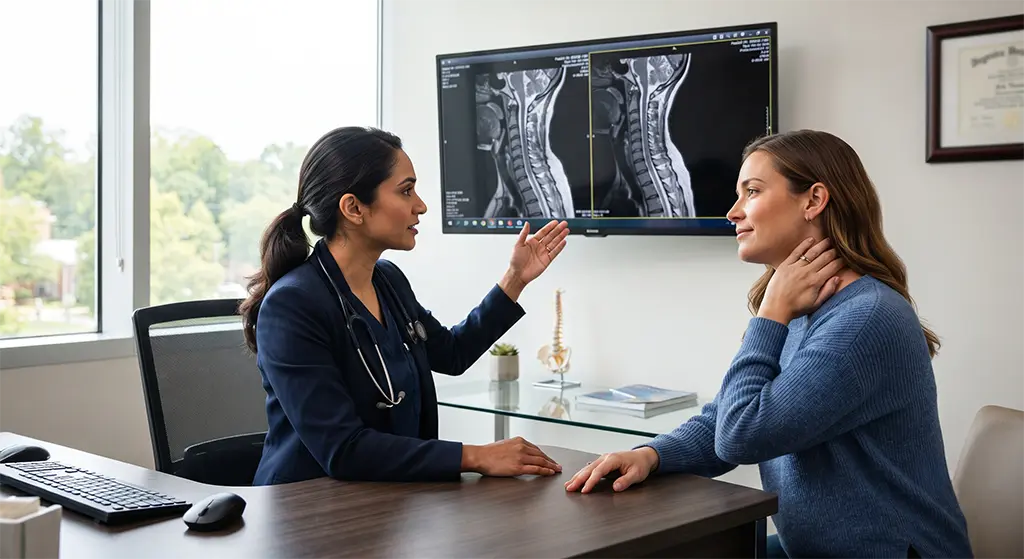
MRI and X-rays can look mild because heavy-head symptoms are often functional. The issue may not be one dramatic structural abnormality. It may be how the cervical spine moves and stabilizes over time.
Static imaging may not show:
- abnormal translation
- abnormal angulation
- motion asymmetry
- hinge behavior
- instability during flexion/extension
- movement patterns that worsen with fatigue
How Digital Motion X-Ray helps
Digital Motion X-Ray evaluates cervical motion with fluoroscopic video imaging during guided movement.
DMX may help assess:
- Translation: sliding between vertebrae
- Angulation: tilting between vertebrae
- Asymmetry: left/right motion differences
- Hinge behavior: one segment moving too much
- Sequencing: whether the neck shares motion smoothly
DMX does not measure endurance directly, but it can reveal motion patterns that may force muscles to work harder all day.
How DMX findings can change care
Stabilization-first rehab
If abnormal motion is present, rehab may prioritize deep neck stabilizer endurance, motor control, and posture tolerance.
Better workday strategy
Instead of generic posture advice, the plan can include specific break timing, screen height changes, and load management.
Safer exercise selection
Some exercises may overload the neck if the patient compensates with upper traps. Rehab can be modified to build endurance without feeding symptoms.
Tracking functional progress
Progress can be measured by:
- longer screen tolerance
- fewer late-day headaches
- improved driving tolerance
- less need for neck support
- reduced shoulder-blade burning
- faster recovery after workdays
Practical steps while awaiting evaluation
- Use screen breaks before symptoms peak
- Raise devices closer to eye level
- Avoid long phone-flexion sessions
- Support arms during desk work
- Reduce one-sided carrying
- Track when heavy-head symptoms start
- Note whether traction or lying down helps
Safety note
Seek medical evaluation for progressive weakness, severe headache, neurological symptoms, fainting, vision changes, or rapidly worsening dizziness.
FAQs
Why does my head feel heavy by the end of the day?
The cervical stabilizers may be fatiguing from posture load, motion sensitivity, or instability patterns.
Can whiplash cause heavy-head symptoms?
Yes. Whiplash can disrupt cervical motion control and increase muscle guarding and fatigue.
What does DMX show?
DMX evaluates real-time cervical translation, angulation, asymmetry, hinge behavior, and motion sequencing.
Does DMX replace MRI?
No. DMX complements MRI/CT/X-ray when symptoms are motion- or fatigue-triggered.
References
- Cleveland Clinic: Neck pain and whiplash education
- PubMed-indexed literature on cervical instability, proprioception, and whiplash-associated disorders
Learn more: Treatment
Schedule your appointment today:Appointments
Call 305-275-7475 orbook your appointment online

Dr. Rodolfo Alfonso, D.C.
Dr. Mark N. Berry, D.C.
Sunset Chiropractic and Wellness
8585 Sunset Dr. STE 102
Miami, Florida 33143