
Some patients feel almost normal when their head is still. Then they move. They turn their head, look upward, look downward, or return to neutral and suddenly the symptoms appear.
Those symptoms may include neck pain, headaches, dizziness, arm tingling, shoulder-blade pain, visual discomfort, clicking, catching, or a feeling that the neck is unstable.
This raises an important question:
“Why do my symptoms happen only when my neck moves?”
Movement places different mechanical demands on the cervical spine than resting does. When you are upright and moving, your cervical spine must support the weight of your head while the joints, muscles, and ligaments continuously control vertebral movement.
That is very different from evaluating the neck while lying still.
At DMX Miami, we evaluate patients from Miami, Fort Lauderdale, Miami-Dade County, Broward County, and the Florida Keys, as well as patients traveling to South Florida from across the United States and internationally, including Colombia, Chile, Argentina, Mexico, and the Caribbean.
What Are Motion-Dependent Neck Symptoms?
A motion-dependent symptom repeatedly changes with a particular movement or position. Examples include:
- “I only get tingling when I turn left.”
- “I feel okay looking straight ahead, but looking up makes me dizzy.”
- “My headache starts when I bring my head back up.”
- “My neck catches halfway through rotation.”
The important feature is repeatability. The same movement repeatedly changes the patient’s symptoms.
A good example is arm tingling that appears only when looking up or turning the head.
What Changes Inside the Neck When You Move?
Joints Change Position
Cervical facet joints change their position and loading as the neck moves.
Muscles Activate
Cervical muscles move the head while also helping stabilize it.
Nerve Relationships Change
Neck position can change the mechanical environment surrounding cervical nerve roots.
Ligaments Change Tension
Ligaments tighten and relax through different portions of the movement.
Vertebrae Translate and Angulate
Individual vertebrae must move relative to one another in a coordinated pattern.
The Spine Remains Weight-Bearing
While all of this occurs, the cervical spine continues supporting the weight of the head. That combination makes motion a functional test of the cervical stabilizing system.
Why Are Ligaments So Important?
Ligaments provide passive mechanical stability. Their functions include guiding joint motion, limiting excessive translation, controlling angulation, restricting excessive rotation, and maintaining appropriate relationships between adjacent vertebrae.
A ligament’s mechanical function is directly related to the movement it controls. A static examination can provide information about ligament anatomy. But the functional question is:
“Is the ligament adequately restraining the joint during movement?”
How Can Whiplash Affect Ligament Function?
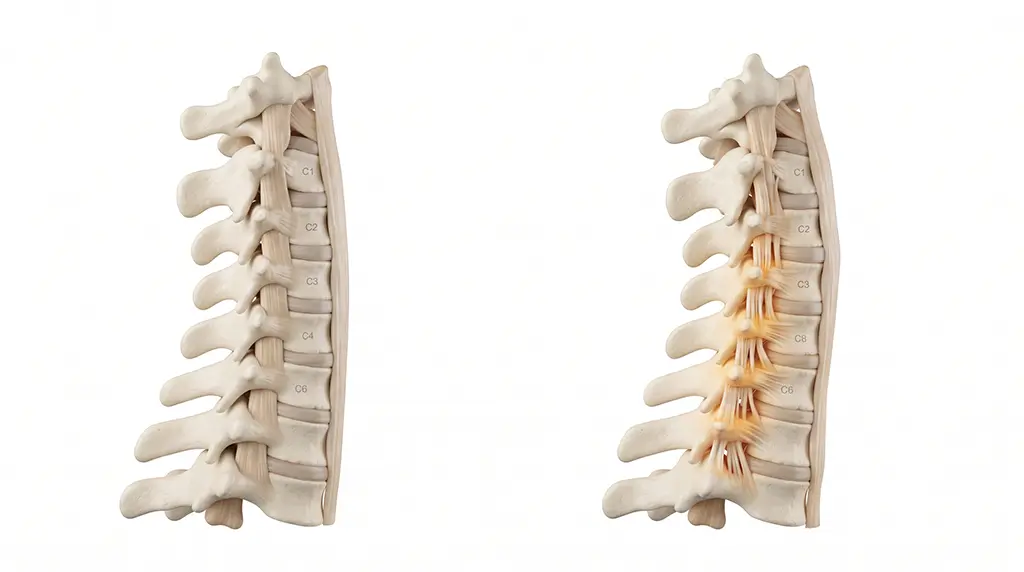
Whiplash creates rapid acceleration and deceleration. The cervical ligaments can be stressed as the head and vertebral segments move rapidly. If ligamentous restraint becomes compromised, the motion segment may no longer behave normally.
Possible biomechanical changes include:
- excessive translation
- increased angulation
- abnormal coupled motion
- asymmetric movement
- altered motion sequencing
- excessive movement at one level relative to another
The body’s muscles may then work harder to compensate. This may contribute to the heavy-head feeling and late-day neck fatigue some patients report after cervical injury.
For more on the broader injury mechanism, see Whiplash Injuries and Cervical Instability.
Why Can MRI or CT Look Reassuring?
Conventional MRI and CT are primarily static studies. The patient is generally lying down, not supporting the head in the same way as when upright, and not moving through a functional range.
These studies provide valuable anatomical information. But when symptoms occur while the patient is upright and moving, the mechanical conditions that provoke the symptoms are different. That creates another clinical question.
For a patient-specific example, read Why Does My Neck Hurt When I Turn My Head but My MRI Is Normal?.
What Is the Functional Question?
“How does the cervical spine behave while it is upright, weight-bearing, and moving?”
That is the question Digital Motion X-Ray is designed to evaluate.
What Does DMX Evaluate?
DMX uses fluoroscopy to record real-time cervical movement while the patient is upright. It allows evaluation of vertebral translation, segmental angulation, left-right asymmetry, intersegmental motion, motion sequencing, and abnormal movement patterns.
Why Can DMX Be Useful When Ligamentous Instability Is Suspected?
Ligaments are mechanical restraints. When the ligamentous system is functioning properly, cervical movement should remain mechanically controlled. If that restraint has been compromised, excessive or abnormal movement may become apparent when the joint is placed under functional demand.
DMX evaluates the cervical spine under those conditions: upright + weight-bearing + motion.
This allows evaluation of the functional consequence of ligamentous insufficiency.
What About Dizziness, Brain Fog, or Post-Concussion Symptoms?
Neck symptoms after trauma can overlap with neurological and vestibular complaints. Patients may experience dizziness, difficulty concentrating, visual strain, headaches, or intolerance of head movement. These symptoms deserve appropriate medical evaluation because they can have several causes.
When these symptoms occur together with neck pain and are repeatedly provoked by cervical motion, the cervical component may also deserve evaluation. Read more about post-concussion symptoms with neck pain and cervical motion and brain fog after whiplash.
Does Every Movement-Triggered Symptom Mean Instability?
No. Other potential causes include muscle strain, facet-joint irritation, disc-related pain, radiculopathy, arthritis, vestibular disorders, migraine, shoulder dysfunction, and neurological disorders. The purpose of evaluation is to determine which explanation best fits the patient.
When Might Dynamic Evaluation Make Sense?
- symptoms occur repeatedly with movement
- symptoms started after trauma
- one direction consistently causes symptoms
- static imaging has not explained the functional problem
- treatment has plateaued
- cervical instability is suspected
- understanding cervical motion could change treatment decisions
Digital Motion X-Ray in Miami for Local and International Patients
DMX Miami sees patients from Miami, Miami Beach, Fort Lauderdale, Miami-Dade County, Broward County, and the Florida Keys, as well as people traveling from elsewhere in Florida and across the United States. International patients also travel to South Florida from Colombia, Chile, Argentina, Mexico, and the Caribbean for motion-based cervical evaluation.
If the symptom occurs during movement, it is reasonable to ask how the joint functions during movement. Contact DMX Miami or call 305-275-7474 to discuss whether a dynamic cervical study is appropriate.
Patients researching post-whiplash imaging can also read Whiplash Imaging in Miami: What to Consider When MRI or CT Doesn’t Explain Persistent Neck Symptoms.
Frequently Asked Questions
Why does my neck hurt only when I move?
Movement changes joint loading, muscle activity, nerve relationships, ligament tension, and intervertebral mechanics.
Can cervical instability cause symptoms mainly during movement?
It can. A mechanically unstable motion segment may become symptomatic when the stabilizing structures are required to control movement.
Why is weight bearing important?
The cervical spine normally supports the weight of the head. Upright weight bearing places the spine and stabilizing structures under functional demand.
Can ligament function be evaluated while the joint is not moving?
Static imaging can provide information about ligament anatomy, but assessing mechanical ligament restraint requires evaluating how the joint behaves during motion.
What does DMX evaluate?
DMX evaluates translation, angulation, symmetry, intersegmental motion, and movement sequencing.
Why consider DMX if I already had an MRI?
MRI primarily evaluates anatomy. DMX evaluates functional movement under upright, weight-bearing conditions.
References
- Cleveland Clinic – Whiplash
- Wang et al. – The Quantitative Measurements of the Intervertebral Angulation and Translation During Cervical Flexion and Extension
- Published cervical biomechanics and videofluoroscopy literature
DMX Miami serves patients in Miami, Fort Lauderdale, Miami-Dade, Broward, the Florida Keys, Florida, the USA, and visitors fromColombia, Chile, Argentina, Mexico, and the Caribbean.
Learn more: Treatment
Schedule your appointment today:Appointments
Call 305-275-7475 orbook your appointment online

Dr. Rodolfo Alfonso, D.C.
Dr. Mark N. Berry, D.C.
Sunset Chiropractic and Wellness
8585 Sunset Dr. STE 102
Miami, Florida 33143