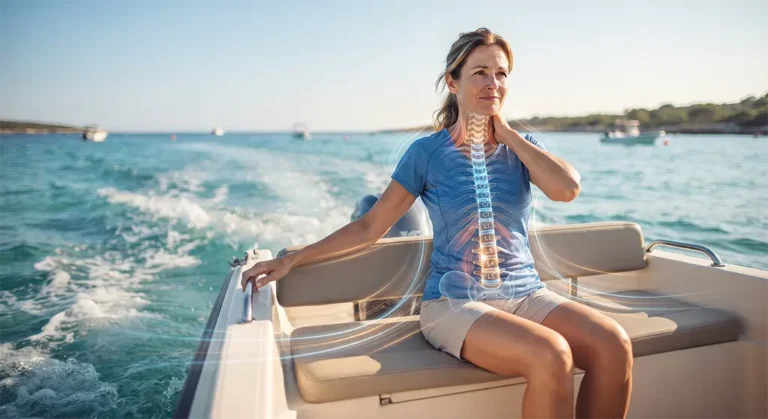
Boat rides can trigger neck pain, low back pain, headaches, dizziness, or shoulder-blade burning because waves, vibration, bracing, and sudden impacts challenge spinal stability. Patients with whiplash history, fall injuries, or lumbar/cervical instability may flare after choppy water even when static imaging looks mild. Digital Motion X-Ray (DMX) evaluates spinal motion in real time and can help identify translation, angulation, asymmetry, hinge behavior, or instability patterns.
- Boat rides combine vibration, impact, bracing, and unpredictable motion.
- Pain after boating may reflect cervical or lumbar instability rather than simple soreness.
- DMX can help guide stabilization-focused care and safer return to boating, fishing, and water activities.
Last updated: April 14, 2026
Reviewed by: DMX Miami clinical team
Boating is part of life in South Florida. From Miami, Biscayne Bay, Fort Lauderdale, the Florida Keys, Miami-Dade, and Broward, many people spend time fishing, diving, cruising, or traveling by boat. But for patients with spinal instability or motion sensitivity, a boat ride can cause a major flare.
Patients often say:
- “My back hurt after a choppy boat ride.”
- “My neck flared from the waves.”
- “I felt fine on the boat, then had headaches later.”
- “Standing on the boat made my low back tighten.”
- “After fishing all day, my neck and shoulder blades burned.”
- “My MRI didn’t explain why vibration affects me so much.”
At DMX Miami, we also see visitors from the USA, Colombia, Chile, Argentina, Mexico, and the Caribbean who flare during vacation boating, fishing trips, or water sports.
Why boat rides stress the spine
Boat rides are not passive. Even when sitting, the body is constantly adjusting to motion, waves, vibration, acceleration, deceleration, and impact.
The spine must respond to:
- vertical bouncing
- rotational movement
- sudden wave impact
- vibration
- bracing
- twisting
- prolonged sitting or standing
- unstable footing
If a cervical or lumbar segment is motion-sensitive, boating can expose it.
Why symptoms may appear after the ride
Many patients feel okay during the activity because adrenaline, excitement, or distraction masks symptoms. Later, symptoms appear as the body calms down.
A typical pattern:
- Boat ride creates repeated vibration and impact
- Neck and low back brace to stabilize
- A motion-sensitive segment becomes irritated
- Muscles guard
- Pain, headache, or dizziness appears later
- Symptoms worsen after sitting, driving home, or sleeping
Delayed flare patterns are common after repetitive motion exposure.
Neck symptoms after boating
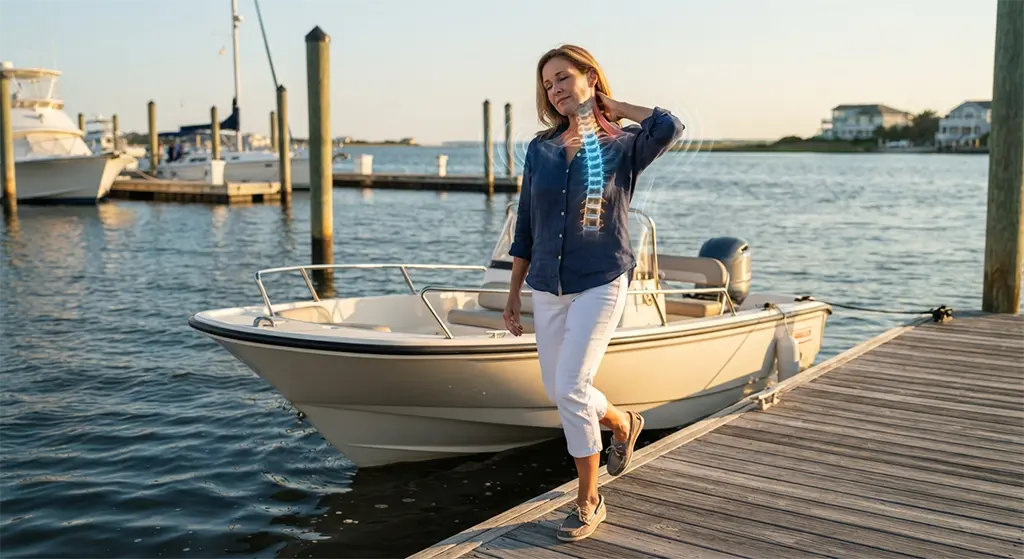
The cervical spine must stabilize the head during waves and vibration. This can trigger:
- neck pain
- base-of-skull headaches
- dizziness
- visual strain
- shoulder-blade burning
- heavy-head fatigue
- arm tingling
Patients with prior whiplash may be especially sensitive because their neck may already struggle with acceleration-deceleration forces.
Low back symptoms after boating
The lumbar spine absorbs repeated sitting, standing, bracing, and impact. This can trigger:
- low back ache
- sharp catches
- buttock pain
- hip tightness
- pain when standing after the ride
- stiffness the next morning
- flare after carrying coolers or gear
Fishing adds additional triggers: twisting, bending, lifting, and standing on uneven surfaces.
Why static imaging may not explain boat-related symptoms
MRI and standard X-rays are useful but static. Boat pain is dynamic. It occurs during vibration, impact, bracing, and unpredictable motion.
Static imaging may not show:
- cervical or lumbar translation
- abnormal angulation
- hinge behavior
- asymmetry
- instability under motion
- sequencing problems
- compensation across spine and pelvis
How Digital Motion X-Ray helps
Digital Motion X-Ray is fluoroscopic video imaging performed during guided motion. It helps evaluate how spinal segments behave in real time.
Depending on the region studied, DMX may assess:
- Translation: sliding between vertebrae
- Angulation: tilting between vertebrae
- Asymmetry: left vs right motion differences
- Hinge behavior: one segment moving too much
- Sequencing: smooth vs irregular motion
DMX does not recreate a boat ride, but it can identify motion patterns that may explain why vibration and unpredictable movement trigger symptoms.
How DMX findings can change care
Stabilization-first rehab
If instability is present, rehab may prioritize cervical or lumbar stabilization before returning to long boat days.
Activity-specific planning
Patients may modify:
- seating position
- trip duration
- standing time
- gear lifting
- fishing posture
- driving after boating
- recovery routine after the trip
Safer return to water activities
Instead of avoiding boating forever, patients can build tolerance gradually and track symptom response.
Better documentation
Motion findings can connect symptoms to functional limitations, especially when static imaging is mild but the patient cannot tolerate vibration and impact.
Practical steps while awaiting evaluation
- Avoid long choppy rides during active flare periods
- Sit where impact is minimized
- Use support when standing
- Avoid twisting while lifting gear
- Take breaks after boating before long drives
- Track whether symptoms are neck, low back, headache, or dizziness dominant
- Note whether symptoms appear during or after the ride
Safety note
Seek medical evaluation after boating if you have severe headache, neurological symptoms, fall injury, chest pain, fainting, progressive weakness, severe numbness, or inability to walk.
FAQs
Why does boating make my back hurt?
Boat rides create vibration, impact, bracing, and unpredictable motion that can stress motion-sensitive spinal segments.
Can choppy water trigger neck pain after whiplash?
Yes. Waves and acceleration-deceleration forces can irritate a neck that is already motion-sensitive.
What does DMX show?
DMX evaluates real-time translation, angulation, asymmetry, hinge behavior, and motion sequencing.
Does DMX replace MRI?
No. DMX complements MRI/CT/X-ray when symptoms are motion- or vibration-triggered.
References
- Cleveland Clinic: Whiplash and neck pain education
- AAOS OrthoInfo: Low back pain and mechanical triggers
- PubMed-indexed literature on spinal instability, vibration exposure, and dynamic biomechanics
Footer: DMX Miami serves patients in Miami, Fort Lauderdale, Miami-Dade, Broward, the Florida Keys, Florida, the USA, and visitors from Colombia, Chile, Argentina, Mexico, and the Caribbean.
Learn more: Treatment
Schedule your appointment today:Appointments
Call 305-275-7475 orbook your appointment online

Dr. Rodolfo Alfonso, D.C.
Dr. Mark N. Berry, D.C.
Sunset Chiropractic and Wellness
8585 Sunset Dr. STE 102
Miami, Florida 33143