
Holding a phone between the shoulder and ear places the neck into side-bending, rotation, compression, and sustained muscle guarding. If this position triggers neck pain, headaches, dizziness, shoulder-blade burning, jaw tension, or arm tingling, the problem may involve cervical instability or motion sensitivity not just tight muscles. Digital Motion X-Ray (DMX) evaluates cervical motion in real time and can help identify translation, angulation, asymmetry, hinge behavior, and instability patterns that static imaging may miss.
● Phone-to-shoulder posture compresses one side of the neck while stretching the other.
● Symptoms triggered by side-bending may suggest cervical instability, upper cervical
involvement, or cervicothoracic stress.
● DMX can help evaluate real-time motion when symptoms occur during daily activities.
Last updated: April 14, 2026
Reviewed by: DMX Miami clinical team
Many patients do not think twice about holding a phone between the shoulder and ear. It feels convenient while typing, cooking, driving, working, or moving around the house. But for patients with cervical instability or prior whiplash, this posture can trigger a major symptom flare.
At DMX Miami, we see patients from Miami, Fort Lauderdale, Miami-Dade County, Broward County, and the Florida Keys, as well as patients traveling from the USA, Colombia, Chile, Argentina, Mexico, and the Caribbean, who report symptoms with ordinary phone posture.
Patients often say:
● “My neck hurts when I hold the phone with my shoulder.”
● “One side of my neck locks up after phone calls.”
● “I get headaches after long calls.”
● “My shoulder blade burns when I multitask on the phone.”
● “My jaw and ear feel tight after calls.”
● “My MRI was mild, but this position always triggers symptoms.”
This symptom pattern matters because it reveals how the neck handles side-bending and sustained load.
Why phone-to-shoulder posture stresses the neck
When you hold the phone between the ear and shoulder, the neck is usually placed into:
● side-bending
● slight rotation
● compression on one side
● stretch on the opposite side
● shoulder elevation
● jaw tension
● upper trap activation
● sustained cervical bracing
This is not a neutral posture. It is a loaded position held over time.
Why symptoms may be one-sided
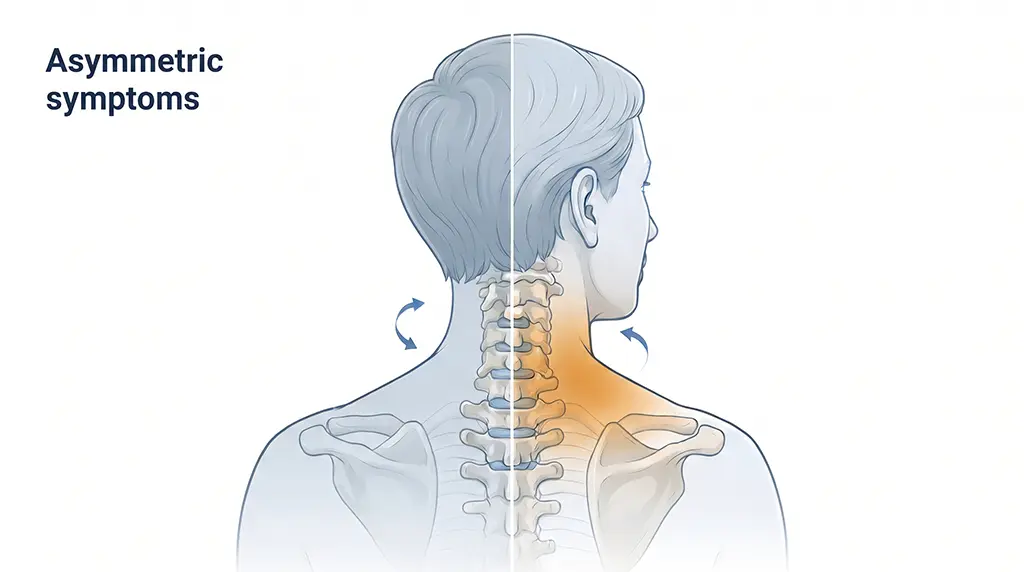
Phone posture often stresses one side more than the other. If a patient always holds the phone on the same side, the same cervical segments and muscles are repeatedly irritated.
Symptoms may include:
● one-sided neck pain
● base-of-skull headache
● jaw tightness
● ear pressure
● shoulder-blade burning
● arm tingling
● dizziness
● heavy-head fatigue
One-sided symptoms after a repeatable posture can suggest an asymmetric motion problem.
Why prior whiplash matters
After whiplash, the cervical ligaments, joints, and stabilizing muscles may become more sensitive to end-range posture. A position that was once harmless can become provocative.
Phone-to-shoulder posture may be especially irritating because it combines side-bending, rotation, and sustained compression.
Why static imaging may not explain it
MRI, CT, and standard X-rays are useful, but phone-related symptoms happen during posture and motion. Static imaging may not show what happens when the neck is side-bent for several minutes.
Static imaging may not show:
● abnormal translation
● abnormal angulation
● asymmetry
● hinge behavior
● instability during motion
● poor sequencing
● posture-triggered symptom patterns
How Digital Motion X-Ray helps
Digital Motion X-Ray uses fluoroscopic video imaging during guided cervical motion. It allows providers to evaluate how the cervical spine moves in real time.
DMX may assess:
● Translation: abnormal sliding between vertebrae
● Angulation: abnormal tilting between vertebrae
● Asymmetry: left-right motion differences
● Hinge behavior: one segment moving too much
● Sequencing: smooth vs irregular movement
DMX does not replace MRI, CT, neurological evaluation, TMJ evaluation, or medical care. It complements them when symptoms are motion- or posture-triggered.
How DMX findings can change care
If abnormal motion is present, care may include:
● cervical stabilization
● upper cervical control
● posture endurance training
● safer phone ergonomics
● manual therapy modifications
● jaw-neck coordination
● gradual tolerance training
The goal is to reduce repeated irritation from everyday positions.
Practical steps while awaiting evaluation
● Use speakerphone or earbuds
● Avoid pinching the phone between shoulder and ear
● Keep the neck neutral during calls
● Switch sides if needed, but do not force painful positions
● Take breaks during long calls
● Track whether symptoms are neck, headache, jaw, ear, or arm dominant ● Avoid multitasking in provocative neck positions
Safety note
Seek medical evaluation if symptoms include progressive weakness, severe dizziness, fainting, neurological changes, severe headache, vision changes, or worsening arm symptoms.
FAQs
Why does holding the phone with my shoulder hurt my neck?
This posture places the neck into side-bending, rotation, and compression, which can irritate motion-sensitive cervical segments.
Can phone posture trigger headaches?
Yes. Sustained cervical side-bending and muscle guarding can contribute to headache patterns.
What does DMX show?
DMX evaluates real-time cervical translation, angulation, asymmetry, hinge behavior, and motion sequencing.
Does DMX replace MRI?
No. DMX complements MRI/CT/X-ray when symptoms are posture- or motion-triggered.
References
● Cleveland Clinic: Neck pain and whiplash education
● PubMed-indexed literature on cervical biomechanics, whiplash-associated disorders, and dynamic spinal motion assessment
Footer: DMX Miami serves patients in Miami, Fort Lauderdale, Miami-Dade, Broward, the Florida Keys, Florida, the USA, and visitors from Colombia, Chile, Argentina, Mexico, and the Caribbean.
Learn more: Treatment
Schedule your appointment today:Appointments
Call 305-275-7475 orbook your appointment online

Dr. Rodolfo Alfonso, D.C.
Dr. Mark N. Berry, D.C.
Sunset Chiropractic and Wellness
8585 Sunset Dr. STE 102
Miami, Florida 33143