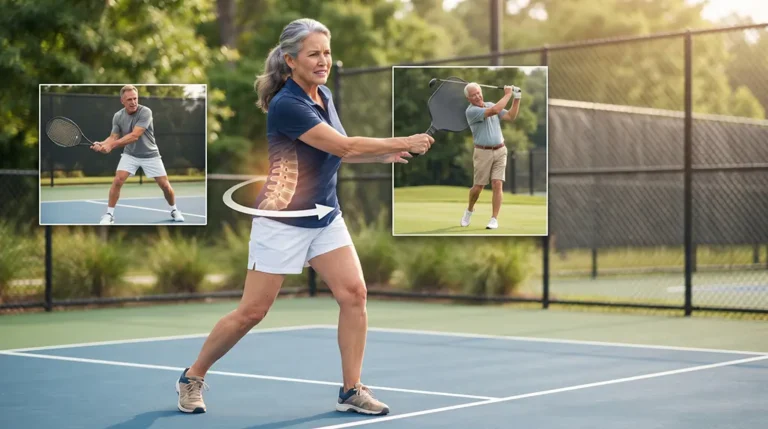
Pickleball, tennis, golf, and racquet sports can trigger low back pain because they combine rotation, side-bending, quick starts and stops, reaching, twisting, and repeated loading. If your back catches during a swing, serve, return, or follow-through, the issue may involve lumbar instability or poor hip-spine load sharing. Digital Motion X-Ray (DMX) evaluates lumbar motion in real time and can help identify translation, angulation, hinge behavior, asymmetry, and instability patterns.
● Rotational sports are a common trigger for lumbar motion sensitivity.
● Pain during swings, serves, or quick direction changes may reveal hinge behavior or instability.
● DMX can help guide stabilization-focused rehab and safer return to sport.
Last updated: April 14, 2026
Reviewed by: DMX Miami clinical team
Pickleball, tennis, golf, and racquet sports are popular throughout South Florida. They are social, competitive, and active. But for patients with lumbar instability, rotational sports can create repeated low back flares.
At DMX Miami, we see patients from Miami, Fort Lauderdale, Miami-Dade County, Broward County, and the Florida Keys, as well as visitors from the USA, Colombia, Chile, Argentina, Mexico, and the Caribbean, who develop symptoms during or after rotational sports.
Patients often say:
● “My back catches during my golf swing.”
● “Pickleball twisting makes my low back flare.”
● “Serving in tennis hurts one side.”
● “I feel fine warming up, then my back locks later.”
● “My hip feels tight and my back takes over.”
● “My imaging does not explain why rotation triggers pain.”
This pattern matters because rotational sports repeatedly test lumbar stability.
Why rotational sports stress the low back
These activities combine:
● trunk rotation
● hip rotation
● side-bending
● quick direction changes
● acceleration and deceleration
● reaching
● pivoting
● swinging
● fatigue
The hips, pelvis, and lumbar spine must share motion. If the hips are stiff or the lumbar spine is unstable, the low back may absorb too much rotational stress.
The swing-and-follow-through problem
Many patients feel pain during the follow-through, not the start of the swing. This is when the body decelerates and controls rotation.
Pain may occur during:
● golf follow-through
● tennis serve
● pickleball reach
● backhand rotation
● sudden lunge
● returning to upright
● pivoting after a shot
This suggests the spine may struggle with rotation control.
The hinge segment problem
A hinge segment is a spinal level that moves too much while nearby areas move too little. Rotational sports can irritate a hinge segment because the motion is repeated and often high speed.
Signs may include:
● one-sided low back pain
● sharp catch with rotation
● buttock tightness
● pain after play
● stiffness the next morning
● recurring flare after the same sport
● relief with rest but recurrence after return to play
Why static imaging may not explain sport pain
MRI and standard X-rays are helpful, but sport pain occurs during motion, load, rotation, and fatigue.
Static imaging may not show:
● lumbar translation during movement
● abnormal angulation
● hinge behavior
● asymmetry
● instability during flexion-extension
● poor sequencing
● hip-spine compensation during rotation
This is where motion-based evaluation can add value.
How Digital Motion X-Ray helps
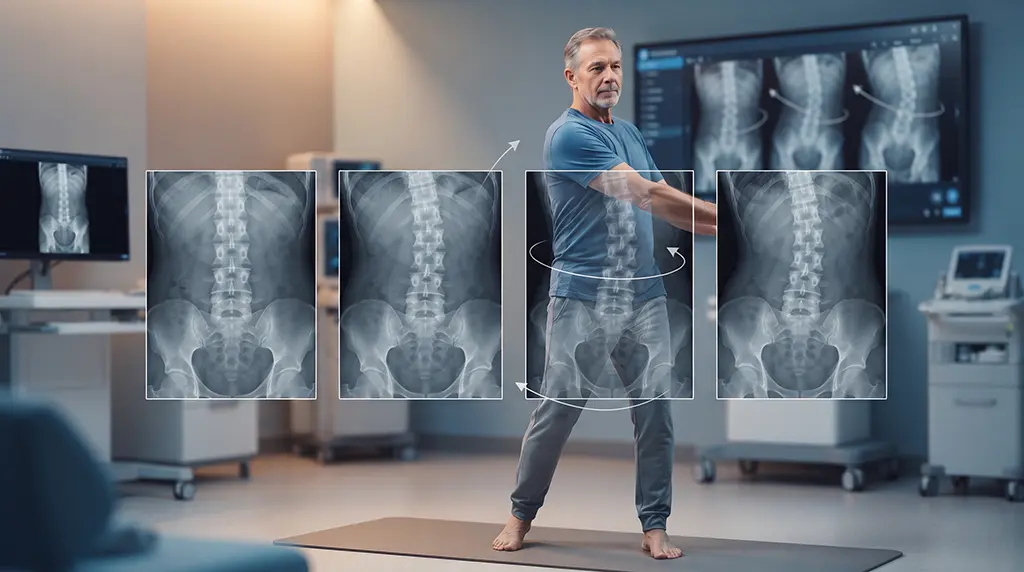
Digital Motion X-Ray is fluoroscopic video imaging performed during guided motion. In lumbar cases, DMX may assess:
● Translation: abnormal sliding between vertebrae
● Angulation: abnormal tilting between vertebrae
● Hinge behavior: one segment moving excessively
● Sequencing: whether movement is smooth or irregular
● Asymmetry: differences between movement directions
DMX does not replace MRI, CT, orthopedic evaluation, sports medicine evaluation, or physical examination. It complements them when symptoms are motion-triggered.
How DMX findings can change care
A motion-based plan may include:
● lumbar stabilization
● hip mobility and control
● glute strengthening
● rotational control
● sport-specific progression
● swing modification
● safer warm-up strategy
● gradual return to play
The goal is not just to stop pain temporarily. The goal is to improve load tolerance so the patient can stay active.
Practical steps while awaiting evaluation
● Avoid playing through sharp catching pain
● Warm up hips and trunk gradually
● Reduce intensity during flare periods
● Avoid repeated end-range twisting
● Track which movement triggers pain
● Use shorter sessions while rebuilding tolerance
● Do not jump back into full play after rest-only recovery
● Bring sport-specific symptom history to evaluation
Safety note
Seek medical evaluation if low back pain includes progressive weakness, numbness, bowel/bladder changes, severe trauma, fever, unexplained weight loss, or inability to walk.
FAQs
Why does pickleball hurt my low back?
Pickleball involves quick starts, stops, reaching, pivoting, and rotation, which can stress motion-sensitive lumbar segments.
Can golf reveal lumbar instability?
Yes. A golf swing requires coordinated hip and spine rotation, and instability may appear during the swing or follow-through.
What does DMX show?
DMX evaluates real-time lumbar translation, angulation, hinge behavior, asymmetry, and motion sequencing.
Does DMX replace MRI?
No. DMX complements MRI/CT/X-ray when symptoms are motion- or sport-triggered.
References
● AAOS OrthoInfo: Low back pain and sports-related mechanical triggers
● PubMed-indexed literature on lumbar instability, rotational biomechanics, and dynamic
spinal motion
Footer: DMX Miami serves patients in Miami, Fort Lauderdale, Miami-Dade, Broward, the Florida Keys, Florida, the USA, and visitors from Colombia, Chile, Argentina, Mexico, and the Caribbean.
Learn more: Treatment
Schedule your appointment today:Appointments
Call 305-275-7475 orbook your appointment online

Dr. Rodolfo Alfonso, D.C.
Dr. Mark N. Berry, D.C.
Sunset Chiropractic and Wellness
8585 Sunset Dr. STE 102
Miami, Florida 33143