
You can sit still without much pain. Then you turn your head to check a blind spot, look over your shoulder, or speak to someone beside you and your neck hurts.
Maybe the neck catches. Maybe you feel pressure at the base of your skull. Maybe turning your head triggers a headache, dizziness, clicking, shoulder-blade pain, or tingling into an arm.
Then you look at your MRI report and wonder:
“If my MRI is normal, why does my neck still hurt when I move?”
The answer may be that your MRI and your symptoms are evaluating two different things.
A conventional cervical MRI is primarily a static structural study. It provides detailed information about discs, the spinal cord, nerve roots, and many soft tissues while the patient is generally lying still.
But your neck does not function lying motionless. During everyday life, your cervical spine is upright, weight-bearing, supporting the weight of your head, and moving.
If your symptoms consistently appear while your neck is moving, another clinical question may need to be answered:
“How is the cervical spine functioning while it is weight-bearing and moving?”
This is the functional question evaluated with Digital Motion X-Ray in Miami.
At DMX Miami, we evaluate patients from Miami, Fort Lauderdale, Miami-Dade County, Broward County, and the Florida Keys, as well as patients traveling to South Florida from across the United States and internationally, including Colombia, Chile, Argentina, Mexico, and the Caribbean.
What Can Cause Neck Pain When You Turn Your Head?
Several conditions can cause pain during cervical rotation. Possible contributors include:
- muscle strain or protective muscle guarding
- irritated cervical facet joints
- disc-related pain
- degenerative changes
- nerve-root irritation
- shoulder or upper-back dysfunction
- whiplash-related injury
- altered cervical motor control
- cervical ligament injury
- abnormal intersegmental motion
Pain during rotation does not automatically identify one diagnosis. The pattern should be considered together with your history, examination, neurological findings, previous imaging, and mechanism of injury.
Some patients also develop numbness or tingling only when the neck enters a particular position. If that sounds familiar, read about arm tingling that appears only when you look up or turn your head.
Why Can Whiplash Change the Way the Neck Moves?
Whiplash is an acceleration-deceleration injury. During a collision, the head and cervical spine may move rapidly while the torso is restrained.
This can stress several structures, including:
- muscles
- facet joints
- discs
- nerves
- cervical ligaments
- the systems responsible for controlling spinal movement
After trauma, the body may also increase muscle tension around the cervical spine in an effort to protect or stabilize the injured region. That can make ordinary activities difficult, including driving, checking a blind spot, looking over your shoulder, looking upward or downward, working at a computer, and exercising.
For a broader explanation of the relationship between trauma and abnormal cervical motion, see Whiplash Injuries and Cervical Instability.
Why Can an MRI Look Normal While Symptoms Continue?
MRI is extremely valuable, but it primarily answers a structural question. It can provide important information about spinal discs, the spinal cord, nerve roots, many soft tissues, certain ligament abnormalities, and other anatomical changes. CT is particularly valuable for evaluating bone and acute traumatic bony injury.
However, conventional MRI and CT are generally performed while the patient is lying down, non-weight-bearing, and relatively motionless. They do not record the cervical vertebrae continuously as the patient actively moves.
That difference becomes important when the patient’s complaint is: “It only hurts when I turn.”
This same structural-versus-functional question can occur in patients with headaches despite reassuring imaging. Read “My MRI Is Normal” but I Get Headaches With Screen Time.
For another comparison of structural and motion-based imaging, see Digital Motion X-Ray vs. Upright MRI.
Why Does Weight Bearing Matter?
The cervical spine normally carries the weight of the head. When you are upright, the ligaments, muscles, discs, and joints must work together to control that load while the neck moves.
A patient may therefore have a functional problem that becomes more apparent when the cervical spine must simultaneously:
- support the head
- move through a functional range
- control one vertebra relative to the next
That is a functional biomechanical question.
What Do Cervical Ligaments Do?
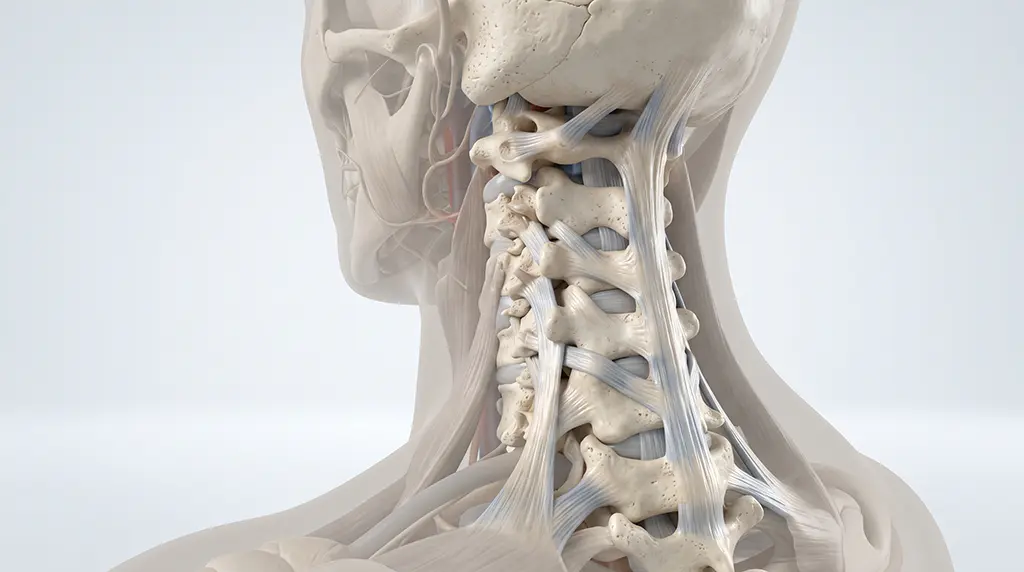
Ligaments connect bone to bone. Their mechanical role includes guiding normal joint movement, limiting excessive translation and angulation, controlling excessive rotation, and helping maintain mechanical stability.
Ligament function is therefore directly related to motion control. A static image can provide information about ligament anatomy. But when the clinical question is whether the ligamentous system is adequately restraining a motion segment, the joint must be evaluated while it moves.
How Can Ligament Injury Affect Cervical Motion?
If cervical ligaments are stretched, sprained, or otherwise unable to provide normal mechanical restraint, the vertebrae may move differently. Possible functional consequences include:
- excessive vertebral translation
- abnormal segmental angulation
- abnormal coupled motion
- left-to-right asymmetry
- altered motion sequencing
- excessive movement at one level compared with neighboring levels
This is why cervical ligament injury and cervical instability are not simply anatomical questions. They are also biomechanical and functional questions.
What Does Digital Motion X-Ray Evaluate?
Digital Motion X-Ray is a real-time, upright, weight-bearing motion study of the cervical spine.
DMX uses fluoroscopy to record the vertebrae while the patient performs controlled cervical movements. This allows the provider to evaluate how the cervical spine functions while supporting the head and moving.
Vertebral Translation
Translation describes sliding movement of one vertebra relative to an adjacent vertebra. Some translation is normal. The clinical question is whether the amount or pattern of movement remains within expected biomechanical limits.
Segmental Angulation
Angulation describes the changing angle between adjacent vertebrae. Angular movement is also normal. The question is whether the amount and pattern of angulation remain appropriately controlled.
Motion Asymmetry
The cervical spine may behave differently when moving in opposite directions. This can be especially relevant when a patient reports, “Turning left is fine, but turning right causes my symptoms.”
Motion Sequencing
The cervical spine normally distributes motion among multiple segments. DMX allows the provider to observe how the spine moves from one position to another, rather than only comparing two isolated endpoint images.
How Are MRI, CT, Static X-Ray, and DMX Different?
| Imaging Study | What It Primarily Evaluates |
|---|---|
| CT | Detailed bony anatomy and acute traumatic bony injury; generally static and non-weight-bearing |
| Conventional MRI | Discs, spinal cord, nerve roots, and many soft tissues; generally static and non-weight-bearing |
| Static X-Ray | Alignment and bony relationships in a selected position; may be upright but remains a still image |
| Digital Motion X-Ray | Functional cervical biomechanics while the patient is upright, weight-bearing, and moving |
The important distinction is: static imaging primarily evaluates anatomy; DMX evaluates function under weight bearing and motion.
When Should Movement-Triggered Neck Pain Be Evaluated Further?
- symptoms began after a car accident or other trauma
- one direction repeatedly causes symptoms
- rotation causes painful catching
- movement triggers headaches or dizziness
- arm tingling appears in certain positions
- symptoms interfere with driving
- treatment has plateaued
- previous imaging has not explained the functional problem
Digital Motion X-Ray in Miami for Local and Traveling Patients
DMX Miami serves patients throughout Miami, Miami Beach, South Miami, Coral Gables, Kendall, Miami-Dade County, Broward County, Fort Lauderdale, and the Florida Keys. We also evaluate patients who travel to Miami from other parts of Florida and the United States, as well as international patients from Colombia, Chile, Argentina, Mexico, and the Caribbean.
If your symptoms repeatedly occur during cervical movement, contact DMX Miami to discuss a dynamic cervical evaluation or call 305-275-7474.
Frequently Asked Questions
Can my neck hurt even if my MRI is normal?
Yes. MRI provides important anatomical information, but persistent symptoms may also involve muscles, joints, nerves, ligaments, or abnormal motion that requires additional clinical evaluation.
Why does my neck hurt only when I turn it?
Rotation changes joint loading, muscle activity, ligament tension, vertebral relationships, and nerve mechanics.
Can ligament injury cause abnormal cervical motion?
Yes. Ligaments help restrain excessive movement. When ligamentous support is compromised, excessive translation, angulation, or other altered motion patterns may occur.
Why does motion matter when evaluating ligament function?
A ligament’s mechanical function is to guide and restrict movement. Functional integrity is evaluated by determining whether the joint remains appropriately controlled during motion.
What does DMX evaluate?
DMX evaluates the cervical spine upright and weight-bearing while it moves, allowing assessment of translation, angulation, asymmetry, and intersegmental biomechanics.
Can DMX be useful after an MRI?
Yes. MRI primarily evaluates anatomy. DMX addresses a different clinical question: how the cervical spine functions under weight bearing and motion.
References
- American College of Radiology / RadiologyInfo – Suspected Spine Trauma
- Wang et al. – The Quantitative Measurements of the Intervertebral Angulation and Translation During Cervical Flexion and Extension
- Published cervical videofluoroscopy and biomechanics literature
DMX Miami serves patients in Miami, Fort Lauderdale, Miami-Dade, Broward, the Florida Keys, Florida, the USA, and visitors from Colombia, Chile, Argentina, Mexico, and the Caribbean.
Learn more: Treatment
Schedule your appointment today:Appointments
Call 305-275-7475 orbook your appointment online

Dr. Rodolfo Alfonso, D.C.
Dr. Mark N. Berry, D.C.
Sunset Chiropractic and Wellness
8585 Sunset Dr. STE 102
Miami, Florida 33143