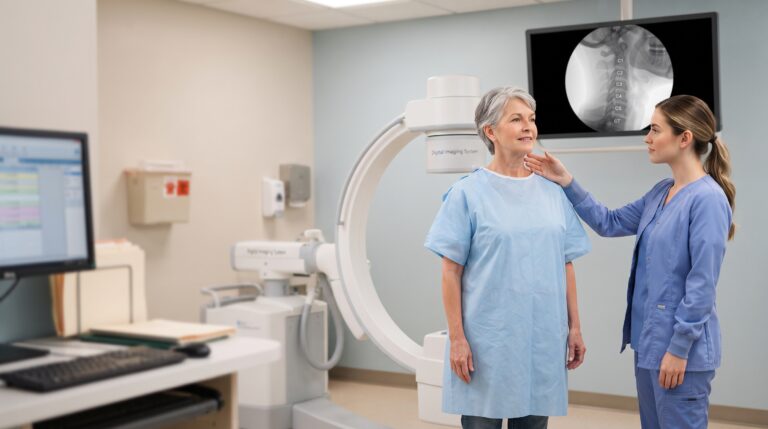
If you have been referred for Digital Motion X-Ray or you are researching DMX because your symptoms occur primarily when your neck moves you probably want to know:
“What actually happens during the examination?”
Digital Motion X-Ray is different from a conventional MRI, CT, or static X-ray because the purpose is not simply to photograph anatomy while you remain still.
DMX evaluates function.
The cervical spine is examined while you are upright, weight-bearing, supporting the weight of your head, and performing controlled cervical movements. The goal is to evaluate how the vertebrae and motion segments behave when the cervical spine is performing its normal mechanical job.
At DMX Miami, we evaluate patients from Miami, Fort Lauderdale, Miami-Dade County, Broward County, and the Florida Keys, as well as patients traveling to South Florida from across the United States and internationally, including Colombia, Chile, Argentina, Mexico, and the Caribbean.
Why Would Someone Have a DMX Examination?
DMX may be considered when a patient’s clinical question involves movement. Examples include:
- neck pain when turning
- headaches triggered by cervical motion
- dizziness with head movement
- painful catching
- symptoms after whiplash
- tingling in specific neck positions
- a feeling of instability
- persistent symptoms despite previous static imaging
The purpose is not simply to obtain another scan. The purpose is to determine whether the cervical spine is functioning normally under weight bearing and movement.
If your symptoms began after a rear-end collision but did not appear immediately, read about delayed neck pain after a rear-end collision.
What Happens Before the Study?
Before dynamic imaging, the provider should understand how the injury occurred, when symptoms began, which movements reproduce symptoms, whether neurological symptoms are present, what previous imaging has shown, and whether certain movements need to be limited.
When available, bring:
- MRI reports
- CT reports
- X-rays
- accident records
- surgical history
- relevant treatment records
This information helps place the dynamic findings into clinical context.
Why Is Screening Important?
DMX is a functional motion study. It does not replace appropriate evaluation of serious acute trauma. For a recent significant injury, CT may be needed to evaluate bony trauma, and MRI may be appropriate when spinal cord, nerve-root, or other soft-tissue injury is suspected.
After serious acute injuries have been appropriately evaluated, another question may remain:
“How does the cervical spine function when the patient is upright and moving?”
That is the question DMX is designed to investigate.
What Happens During the Examination?
The patient stands upright in front of the fluoroscopic imaging system. This means the cervical spine is weight-bearing, supporting the head, and functioning against gravity.
The provider then guides the patient through controlled cervical movements. Depending on the examination, these may include:
- flexion
- extension
- rotation
- lateral bending
- specialized upper-cervical views when clinically appropriate
DMX records real-time X-ray images during these movements. The result is essentially an X-ray movie of spinal motion.
Why Is Upright Weight Bearing Important?
Most symptoms occur during daily life while the patient is upright. People become symptomatic while driving, working, looking over their shoulder, looking upward, using a computer, exercising, standing, or walking.
During these activities, the cervical ligaments and muscles must control vertebral movement while the spine supports the head. A lying, motionless examination creates different mechanical conditions. DMX evaluates the neck under conditions that more closely represent its functional biomechanical role.
What Is the Provider Evaluating?
Translation
Translation is linear sliding movement between adjacent vertebrae. Normal cervical spines have translation. The question is whether that movement remains appropriately controlled.
Angulation
Angulation is the changing angular relationship between adjacent vertebral segments. The provider evaluates whether angular motion remains within expected biomechanical limits.
Motion Symmetry
Movement in one direction can be compared with movement in another.
Segmental Sequencing
The provider can observe when individual cervical levels begin moving and how motion is distributed throughout the movement.
Upper-Cervical Mechanics
When clinically appropriate, specialized views can evaluate motion relationships involving the upper cervical spine.
Why Does Movement Matter When Evaluating Ligament Integrity?
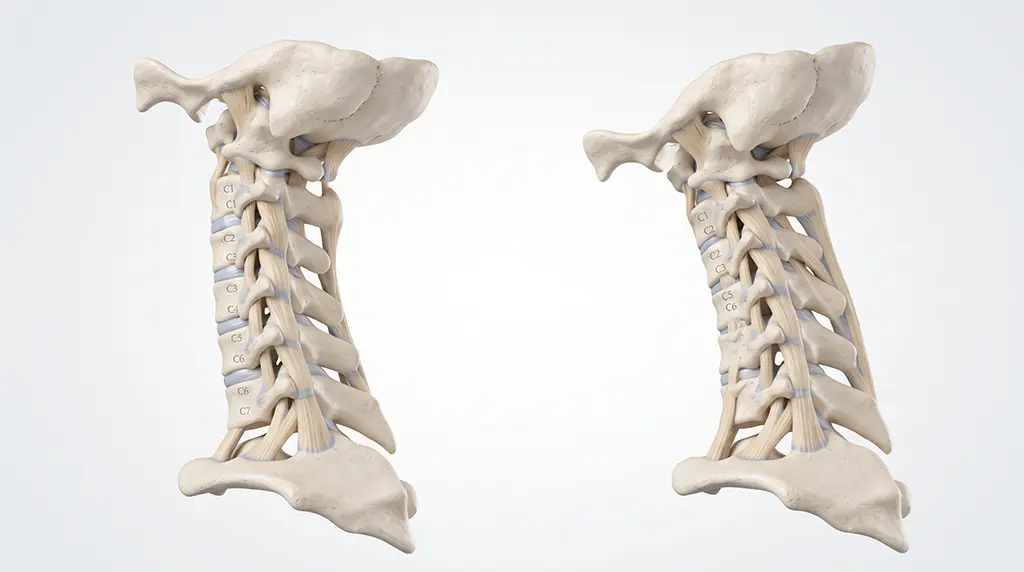
Ligaments do not simply hold bones together while a joint is resting. Their mechanical job is to control movement.
They help guide normal motion, limit excessive translation and rotation, control angulation, and stabilize adjacent vertebrae. Therefore, evaluating the functional integrity of ligamentous restraint requires movement of the joint.
If the ligaments are functioning normally, the vertebrae should remain appropriately controlled during movement. When ligamentous restraint has been compromised, the functional consequence may include:
- excessive translation
- abnormal angulation
- abnormal intersegmental movement
- asymmetry
- altered movement sequencing
- segmental instability
Why Isn’t a Static MRI the Same Test?
MRI provides excellent visualization of many soft tissues. But conventional MRI is generally performed lying down, without weight bearing, and without continuous cervical movement. MRI therefore primarily evaluates structure. DMX evaluates function.
For a deeper comparison, read Digital Motion X-Ray vs. Upright MRI.
If you want to understand why symptoms can appear only during a particular movement arc, read Why Do My Neck Symptoms Happen Only When I Move?.
What Happens After the Study?
The motion study can be reviewed for intersegmental relationships, translation, angulation, asymmetry, abnormal motion patterns, and other relevant findings. When appropriate, measurements may be incorporated into a formal report.
How Can DMX Findings Affect Treatment?
Clinically meaningful findings may influence stabilization-focused rehabilitation, exercise selection, progression of cervical motion, manual-treatment decisions, activity recommendations, and specialist referral.
The value of DMX is not simply identifying an abnormality. The value is helping clinicians understand how the cervical spine is functioning.
Digital Motion X-Ray in Miami for Local and Traveling Patients
DMX Miami serves patients throughout Miami, Miami Beach, Coral Gables, Kendall, South Miami, Miami-Dade County, Broward County, Fort Lauderdale, and the Florida Keys. We also see patients traveling from elsewhere in Florida and across the United States, along with international patients from Colombia, Chile, Argentina, Mexico, and the Caribbean.
Patients traveling to Miami should bring previous MRI, CT, X-ray reports, and relevant medical records when available.
To discuss whether a motion-based examination is appropriate, contact DMX Miami or call 305-275-7474.
Frequently Asked Questions
Is DMX performed standing up?
For cervical evaluation, DMX is performed upright so the spine is supporting the head under weight-bearing conditions.
Does DMX show actual motion?
Yes. Fluoroscopy records the vertebrae during controlled movement rather than producing only individual static images.
What does DMX evaluate?
DMX can evaluate intersegmental translation, angulation, asymmetry, motion sequencing, and other cervical biomechanics.
Why is movement important for ligament evaluation?
The mechanical function of a ligament is to restrain and guide movement. Functional ligament integrity therefore requires assessment of how the joint behaves during motion.
Is DMX the same as MRI?
No. Conventional MRI primarily evaluates static anatomy. DMX evaluates upright, weight-bearing function during movement.
Does DMX use radiation?
Yes. DMX uses fluoroscopic X-ray imaging, so the examination should be performed when dynamic information is clinically relevant.
References
- American College of Radiology / RadiologyInfo – Suspected Spine Trauma
- Wang et al. – The Quantitative Measurements of the Intervertebral Angulation and Translation During Cervical Flexion and Extension
- Published cervical videofluoroscopic motion-analysis literature
DMX Miami serves patients in Miami, Fort Lauderdale, Miami-Dade, Broward, the Florida Keys, Florida, the USA, and visitors from Colombia, Chile, Argentina, Mexico, and the Caribbean.
Learn more: Treatment
Schedule your appointment today:Appointments
Call 305-275-7475 orbook your appointment online

Dr. Rodolfo Alfonso, D.C.
Dr. Mark N. Berry, D.C.
Sunset Chiropractic and Wellness
8585 Sunset Dr. STE 102
Miami, Florida 33143