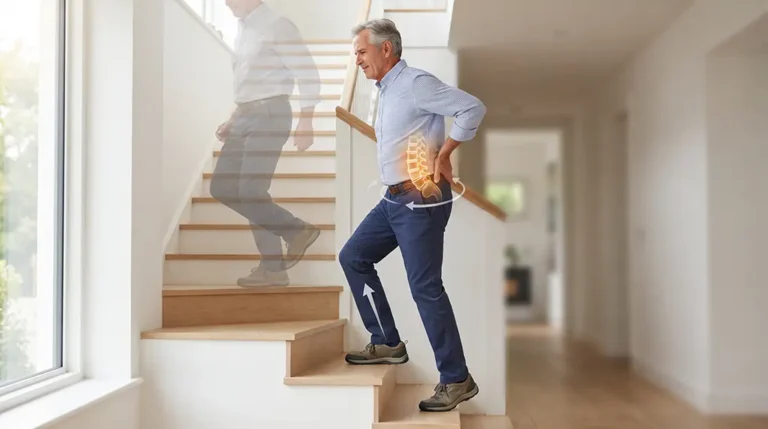
Stairs can trigger low back pain because each step requires hip control, pelvic stability, lumbar stabilization, balance, and repeated single-leg loading. If your back hurts going upstairs, downstairs, climbing parking garage stairs, or using uneven steps, the issue may involve lumbar instability or poor hip-spine load sharing. Digital Motion X-Ray (DMX) evaluates lumbar motion in real time and can help identify translation, angulation, hinge behavior, asymmetry, and instability patterns.
● Stairs create repeated single-leg loading and pelvic control demand.
● Pain going up or down stairs may reveal lumbar instability, hip compensation, or hinge behavior.
● DMX can help guide stabilization-focused rehab and safer stair tolerance progression.
Last updated: April 14, 2026
Reviewed by: DMX Miami clinical team
Stairs are a daily functional test. Patients may tolerate flat walking but struggle with stairs, parking garages, condos, stadiums, boats, cruise ships, hotels, and apartment buildings.
At DMX Miami, we see this in patients from Miami, Fort Lauderdale, Miami-Dade County, Broward County, and the Florida Keys, as well as visitors from the USA, Colombia, Chile, Argentina, Mexico, and the Caribbean.
Patients often say:
● “My low back hurts going upstairs.”
● “Going downstairs feels worse than up.”
● “Parking garage stairs flare my back.”
● “One side of my back catches on steps.”
● “I feel unstable on uneven stairs.”
● “My MRI does not explain why stairs bother me so much.”
This pattern matters because stairs load the spine differently than flat walking.
Why stairs stress the low back
Stairs require:
● single-leg support
● hip control
● pelvic stability
● glute strength
● trunk balance
● lumbar stabilization
● repeated weight shift
● controlled lowering when descending
If the hips or pelvis do not control movement well, the lumbar spine may compensate.
Upstairs vs downstairs pain
Going upstairs
Going upstairs requires power. The hips and glutes must lift the body. If hip strength or control is limited, the low back may overwork.
Going downstairs
Going downstairs requires control. The body must decelerate and lower safely. This can be harder for patients with instability because each step creates impact and balance demand.
Both patterns can reveal different weaknesses in the hip-spine system.
The one-sided stair pattern
Some patients feel pain only when stepping with one leg. This can suggest asymmetry in hip control, pelvic stability, or lumbar motion.
Clues include:
● pain stepping up with one leg
● pain lowering down on one side
● hip drop
● leaning to one side
● holding the rail heavily
● back catching at the same step phase
● buttock pain on one side
The pattern can help guide evaluation.
Why static imaging may not explain stair pain
MRI and standard X-rays are useful, but stair pain is dynamic. It happens during repeated loading, pelvic shifting, hip motion, balance, and fatigue.
Static imaging may not show:
● abnormal lumbar translation
● abnormal angulation
● hinge behavior
● asymmetry
● instability during motion
● poor sequencing
● hip-spine compensation
This is why real-time motion evaluation may be useful when stair symptoms are consistent.
How Digital Motion X-Ray helps
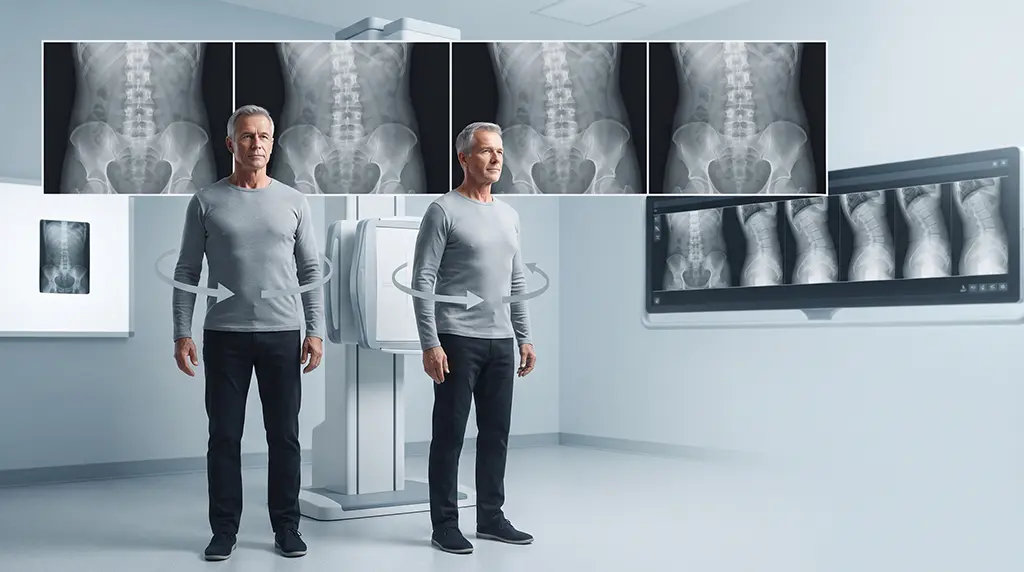
Digital Motion X-Ray evaluates spinal motion using fluoroscopic video imaging. In lumbar cases, DMX may assess:
● Translation: abnormal sliding between vertebrae
● Angulation: abnormal tilting between vertebrae
● Hinge behavior: one segment moving excessively
● Sequencing: whether movement is smooth or irregular
● Asymmetry: differences between movement directions
DMX does not replace MRI, CT, orthopedic evaluation, neurological evaluation, or hip/knee evaluation. It complements them when symptoms are motion-triggered. .
How DMX findings can change care
A motion-based plan may include:
● lumbar stabilization
● glute and hip control
● stair-specific retraining
● balance progression
● single-leg strength work
● safer descent mechanics
● endurance building
● manual therapy modifications
The goal is to improve real-life tolerance, not just reduce pain on a treatment table.
Practical steps while awaiting evaluation
● Use the handrail
● Avoid rushing stairs
● Step with control
● Note whether up or down is worse
● Track which leg triggers pain
● Avoid carrying heavy bags on stairs during flare periods
● Use elevators when symptoms are severe
● Bring stair-specific symptom details to evaluation
Safety note
Seek medical evaluation if low back pain with stairs includes progressive weakness, numbness, falls, bowel/bladder changes, severe trauma, fever, or inability to walk.
FAQs
Why does my low back hurt going upstairs?
Stairs require hip power, pelvic control, and lumbar stabilization. Poor load sharing can stress the low back.
Why is going downstairs worse than upstairs?
Descending requires controlled lowering and impact absorption, which can irritate unstable or motion-sensitive segments.
What does DMX show?
DMX evaluates real-time lumbar translation, angulation, hinge behavior, asymmetry, and motion sequencing.
Does DMX replace MRI?
No. DMX complements MRI/CT/X-ray when symptoms are motion- or activity-triggered.
References
● AAOS OrthoInfo: Low back pain and mechanical movement education
● PubMed-indexed literature on lumbar instability, dynamic spinal biomechanics, and
gait-related loading
Footer: DMX Miami serves patients in Miami, Fort Lauderdale, Miami-Dade, Broward, the Florida Keys, Florida, the USA, and visitors from Colombia, Chile, Argentina, Mexico, and the Caribbean.
Learn more: Treatment
Schedule your appointment today:Appointments
Call 305-275-7475 orbook your appointment online

Dr. Rodolfo Alfonso, D.C.
Dr. Mark N. Berry, D.C.
Sunset Chiropractic and Wellness
8585 Sunset Dr. STE 102
Miami, Florida 33143