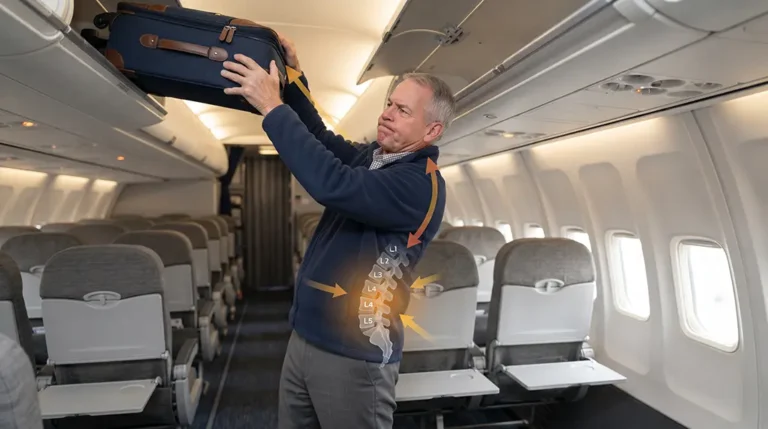
Lifting luggage into an overhead airplane bin can trigger low back pain because it combines bending, lifting, reaching overhead, twisting, balance control, and fatigue from travel. If your back catches, locks, or flares while lifting a carry-on bag, the issue may involve lumbar instability or poor hip-spine load sharing. Digital Motion X-Ray (DMX) evaluates lumbar motion in real time and can help identify translation, angulation, hinge behavior, asymmetry, and instability patterns.
- Overhead-bin lifting combines load, reach, rotation, and awkward posture.
- Travel fatigue, airport walking, and sitting can reduce spinal tolerance before the lift.
- DMX can help evaluate real-time lumbar motion when pain is activity-triggered.
Last updated: September 9, 2026
Reviewed by: DMX Miami clinical team
Many patients do not injure their low back during a workout. They flare while doing something ordinary, like lifting a suitcase into an overhead airplane bin.
At DMX Miami, we see patients from Miami, Fort Lauderdale, Miami-Dade County, Broward County, and the Florida Keys, along with travelers from the USA, Colombia, Chile, Argentina, Mexico, and the Caribbean, who develop low back pain during travel.
Patients often say:
- “I hurt my back lifting my carry-on.”
- “My back caught when I reached overhead.”
- “I twisted while putting the bag in the bin.”
- “I was already tired from the airport, then the lift set me off.”
- “My back locked up after the flight.”
- “My MRI does not explain why small lifts trigger pain.”
This matters because luggage lifting is not just lifting. It is lifting in a crowded, awkward, rushed environment.
Why overhead-bin lifting stresses the low back
Putting a bag into an overhead bin often combines:
- lifting from the floor
- twisting in a narrow aisle
- reaching overhead
- extending the arms away from the body
- standing on an unstable or crowded surface
- bracing while other passengers wait
- fatigue after airport walking
- stiffness after sitting
The lumbar spine must stabilize while the arms, shoulders, hips, and trunk coordinate the load.
Why travel makes the back more vulnerable
By the time a patient lifts luggage, the spine may already be irritated from:
- airport walking
- standing in lines
- sitting at the gate
- carrying bags
- stress
- poor sleep
- dehydration
- long car rides to the airport
- tight seating on the plane
A lift that would normally be tolerated may trigger pain because the system is already fatigued.
The twist-and-reach problem
The most risky moment is often when the patient twists while reaching overhead. The bag may be away from the body, the aisle may be narrow, and the movement may be rushed.
This can stress:
- lumbar discs
- facet joints
- spinal ligaments
- lumbar stabilizers
- hips and pelvis
- thoracolumbar junction
If one lumbar segment moves too much, the back may catch.
The hinge segment problem
A hinge segment is a spinal level that moves too much while nearby regions do not share motion well. Luggage lifting can reveal hinge behavior because it adds load to an awkward motion pattern.
Signs may include:
- sharp one-sided low back pain
- pain during twisting
- catching when returning upright
- buttock tightness
- flare after travel
- stiffness after sitting
- recurring pain with similar lifts
If the same lifting pattern repeatedly causes pain, motion-control evaluation matters.
Why static imaging may not explain luggage pain
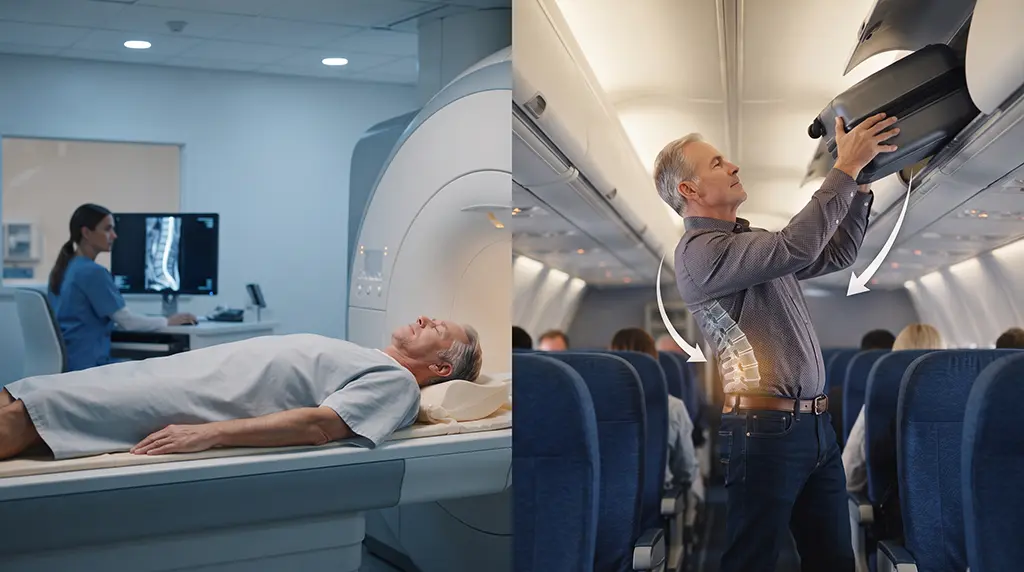
MRI and standard X-rays are useful, but overhead-bin pain is dynamic. It happens during lifting, twisting, reaching, bracing, and fatigue.
Static imaging may not show:
- abnormal lumbar translation
- abnormal angulation
- hinge behavior
- asymmetry
- instability during motion
- poor sequencing
- compensation between hips, pelvis, and lumbar spine
This is where motion-based evaluation can add important information.
How Digital Motion X-Ray helps
Digital Motion X-Ray is fluoroscopic video imaging performed during guided spinal movement. In lumbar cases, DMX may evaluate:
- Translation: abnormal sliding between vertebrae
- Angulation: abnormal tilting between vertebrae
- Hinge behavior: one segment moving excessively
- Sequencing: whether movement is smooth or irregular
- Asymmetry: differences between motion directions
DMX does not replace MRI, CT, orthopedic evaluation, neurological evaluation, or physical examination. It complements them when symptoms are motion-triggered.
How DMX findings can change care
If abnormal motion is found, care may include:
- lumbar stabilization
- hip hinge training
- rotational control
- lifting mechanics
- travel strategy
- luggage modification
- safer manual therapy selection
- graded return to activity
The goal is to make travel safer and reduce repeat flare cycles.
Practical steps while awaiting evaluation
- Pack lighter carry-ons
- Use checked luggage if needed
- Ask for help with overhead bins
- Keep the bag close before lifting
- Turn your feet instead of twisting the low back
- Avoid rushing the lift
- Use both hands when possible
- Avoid lifting immediately after prolonged sitting if your back is flared
- Track whether pain occurs during lift, twist, reach, or after sitting
Safety note
Seek medical evaluation if low back pain includes progressive weakness, numbness, bowel/bladder changes, severe trauma, fever, unexplained weight loss, or inability to walk.
FAQs
Why does lifting luggage hurt my low back?
Luggage lifting often combines bending, twisting, reaching, and load, especially in narrow airplane aisles.
Can overhead-bin lifting reveal lumbar instability?
Yes. Awkward loaded movement can expose hinge behavior or poor hip-spine load sharing.
What does DMX show?
DMX evaluates real-time lumbar translation, angulation, hinge behavior, asymmetry, and motion sequencing.
Does DMX replace MRI?
No. DMX complements MRI, CT, and X-ray when symptoms are motion- or activity-triggered.
References
- AAOS OrthoInfo: Low back pain and mechanical movement education
- PubMed-indexed literature on lumbar instability and dynamic spinal biomechanics
Footer: DMX Miami serves patients in Miami, Fort Lauderdale, Miami-Dade, Broward, the Florida Keys, Florida, the USA, and visitors from Colombia, Chile, Argentina, Mexico, and the Caribbean.
Learn more: Treatment
Schedule your appointment today:Appointments
Call 305-275-7475 orbook your appointment online

Dr. Rodolfo Alfonso, D.C.
Dr. Mark N. Berry, D.C.
Sunset Chiropractic and Wellness
8585 Sunset Dr. STE 102
Miami, Florida 33143