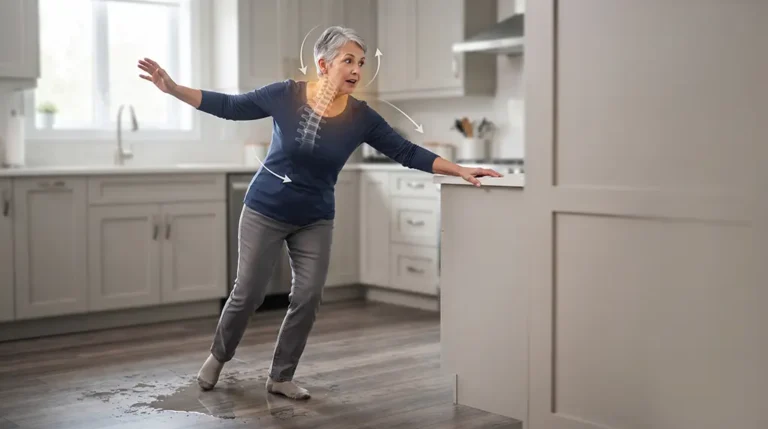
A slip-and-fall does not have to include a direct head impact to trigger neck pain, headaches, dizziness, shoulder-blade burning, or arm tingling. When the body suddenly slips, braces, twists, or catches itself, the cervical spine may experience rapid motion and protective muscle guarding. If symptoms persist after a fall, Digital Motion X-Ray (DMX) may help evaluate real-time cervical translation, angulation, asymmetry, hinge behavior, and instability patterns that static imaging may not show.
- A fall can injure the neck even if the head does not hit the ground.
- Bracing, twisting, catching yourself, or sudden rebound can stress cervical ligaments and joints.
- DMX can help evaluate motion-based cervical instability when symptoms are triggered by movement.
Last updated: September 9, 2026
Reviewed by: DMX Miami clinical team
Many people only worry about the neck after a fall if they hit their head. But the cervical spine can be stressed even when there is no direct head impact. A sudden slip can cause the body to brace, twist, jerk, or recoil quickly. That rapid motion may trigger symptoms in the neck, upper back, head, jaw, or arms.
At DMX Miami, we see patients from Miami, Fort Lauderdale, Miami-Dade County, Broward County, and the Florida Keys, as well as patients traveling from the USA, Colombia, Chile, Argentina, Mexico, and the Caribbean, who develop symptoms after slip-and-fall injuries.
Patients often say:
- “I slipped but caught myself.”
- “I did not hit my head, but my neck hurts.”
- “My headache started after the fall.”
- “My shoulder blade burns since I slipped.”
- “I feel dizzy when I turn my head.”
- “My MRI was mild, but my symptoms are still there.”
This pattern matters because a slip-and-fall is not always a simple bruise. It can be a rapid motion event.
Why catching yourself can stress the neck
When the body slips, the nervous system reacts quickly. The arms may reach out. The shoulders may tense. The jaw may clench. The trunk may twist. The head and neck may move suddenly as the body tries to regain balance.
This can stress:
- cervical ligaments
- facet joints
- upper cervical stabilizers
- suboccipital muscles
- cervicothoracic junction
- shoulder-blade stabilizers
- jaw and neck coordination
- postural control systems
Even if the patient avoids hitting the ground, the neck may still absorb sudden force.
The delayed symptom problem

Symptoms after a fall may not appear immediately. Adrenaline, shock, and protective muscle tension can hide the problem at first.
A common pattern looks like this:
- Patient slips and catches themselves
- Neck muscles tighten quickly
- Patient feels “okay” at first
- Stiffness builds over hours
- Headache, dizziness, or burning appears later
- Turning the head becomes painful the next day
Delayed symptoms should not be ignored.
Why dizziness can happen after a fall
Dizziness after a fall can have several possible causes. It may involve the vestibular system, concussion, blood pressure, medications, neurological factors, or cervical proprioception. If dizziness is severe, sudden, progressive, or associated with neurological symptoms, medical evaluation is important.
When dizziness is clearly triggered by neck movement, cervical motion should also be considered.
Examples include:
- dizziness turning the head
- dizziness looking up
- dizziness rolling over
- dizziness with neck pain
- dizziness with base-of-skull pressure
- dizziness after whiplash-like motion
DMX does not replace neurological, vestibular, emergency, or concussion evaluation. It complements those evaluations when cervical motion appears involved.
Why static imaging may not explain it
MRI, CT, and standard X-rays can be important after trauma. But symptoms after a slip-and-fall may occur during movement, not while lying still.
Static imaging may not show:
- abnormal cervical translation
- abnormal angulation
- upper cervical asymmetry
- hinge behavior
- instability during motion
- sequencing problems
- motion-triggered symptom patterns
This is why a patient may be told that imaging looks mild while still feeling unstable.
How Digital Motion X-Ray helps
Digital Motion X-Ray uses fluoroscopic video imaging during guided cervical movement. It helps evaluate how the cervical vertebrae move in real time.
DMX may assess:
- Translation: abnormal sliding between vertebrae
- Angulation: abnormal tilting between vertebrae
- Asymmetry: left-right motion differences
- Hinge behavior: one segment moving too much
- Sequencing: whether movement is smooth or irregular
DMX does not replace MRI, CT, emergency evaluation, neurological care, or concussion evaluation. It complements them when symptoms are motion-triggered.
How DMX findings can change care
If abnormal motion is found, care may focus on:
- cervical stabilization
- upper cervical control
- posture endurance
- balance and motion tolerance
- safer manual therapy selection
- avoiding provocative end-range motion during flare periods
- coordination with medical or legal providers when appropriate
The goal is to identify whether abnormal cervical motion is contributing to persistent symptoms and then build a safer plan.
Practical steps while awaiting evaluation
- Do not repeatedly test painful neck motion
- Track whether symptoms are worse with turning, looking up, or looking down
- Note whether dizziness, headache, jaw symptoms, or arm tingling are present
- Avoid heavy lifting immediately after a flare
- Bring prior imaging and accident details to the evaluation
- Seek urgent care for red-flag symptoms
Safety note
Seek urgent medical evaluation after a fall if symptoms include severe headache, loss of consciousness, confusion, vomiting, vision changes, progressive weakness, worsening numbness, severe dizziness, trouble walking, or symptoms after significant head trauma.
FAQs
Can a slip-and-fall cause neck pain without hitting your head?
Yes. Bracing, twisting, and sudden head-neck motion can stress the cervical spine even without direct head impact.
Why did my neck pain start the day after the fall?
Delayed stiffness and muscle guarding can appear hours later as inflammation and protective tension build.
What does DMX show?
DMX evaluates real-time cervical translation, angulation, asymmetry, hinge behavior, and motion sequencing.
Does DMX replace MRI or CT after a fall?
No. DMX complements MRI, CT, X-ray, and medical evaluation when symptoms are motion-triggered.
References
- Cleveland Clinic: Whiplash and neck pain education
- Cleveland Clinic: Cervicogenic dizziness and headache education
- PubMed-indexed literature on cervical videofluoroscopy, whiplash, and dynamic spinal motion assessment
Footer: DMX Miami serves patients in Miami, Fort Lauderdale, Miami-Dade, Broward, the Florida Keys, Florida, the USA, and visitors from Colombia, Chile, Argentina, Mexico, and the Caribbean.
Learn more: Treatment
Schedule your appointment today:Appointments
Call 305-275-7475 orbook your appointment online

Dr. Rodolfo Alfonso, D.C.
Dr. Mark N. Berry, D.C.
Sunset Chiropractic and Wellness
8585 Sunset Dr. STE 102
Miami, Florida 33143