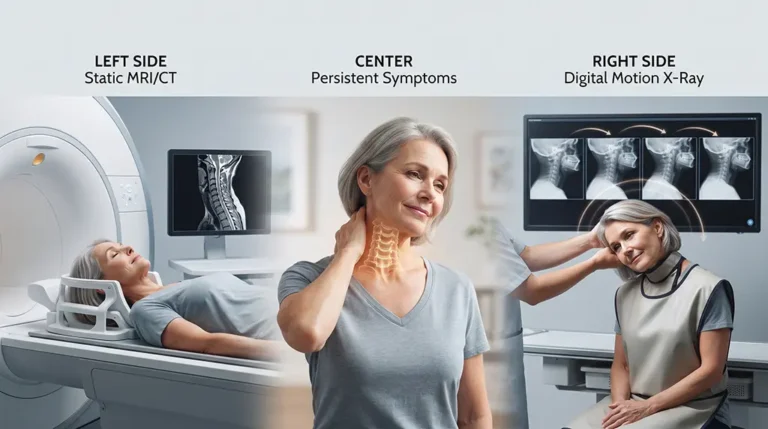
MRI and CT are important imaging tools after trauma, but they answer different questions than Digital Motion X-Ray (DMX). MRI is especially useful for soft tissues, discs, the spinal cord, and other structures, while CT is particularly useful for detailed bone assessment. DMX uses fluoroscopic video imaging to observe cervical vertebral motion during guided movement. When a patient continues to experience motion-triggered neck pain, headaches, dizziness, clicking, shoulder-blade pain, or other symptoms despite unrevealing static imaging, a motion-based evaluation may provide additional information about translation, angulation, asymmetry, hinge behavior, and movement sequencing.
- A normal or relatively mild MRI or CT does not mean a patient’s symptoms are imaginary.
- MRI, CT, and DMX answer different diagnostic questions.
- DMX evaluates cervical motion rather than simply producing another still picture.
- Persistent symptoms after whiplash should be evaluated in context, not diagnosed from any single imaging test.
Last updated: September 15, 2026
Reviewed by: DMX Miami clinical team
One of the most frustrating statements a patient can hear after a car accident is:
“Your MRI looks normal.”
The patient may still have:
- neck pain
- headaches
- dizziness
- shoulder-blade burning
- arm tingling
- clicking or catching
- pain turning the head
- heavy-head fatigue
- symptoms while driving
- pain looking down
- difficulty tolerating work
Yet the MRI or CT does not seem to explain the problem.
At DMX Miami, we see patients from Miami, Fort Lauderdale, Miami-Dade County, Broward County, the Florida Keys, throughout Florida and the USA, as well as patients traveling from Colombia, Chile, Argentina, Mexico, and the Caribbean, who want to better understand persistent motion-triggered symptoms after trauma.
The important question is not:
“Which imaging test is best?”
The better question is:
“What are we trying to evaluate?”
MRI, CT, X-Ray, and DMX Do Different Jobs
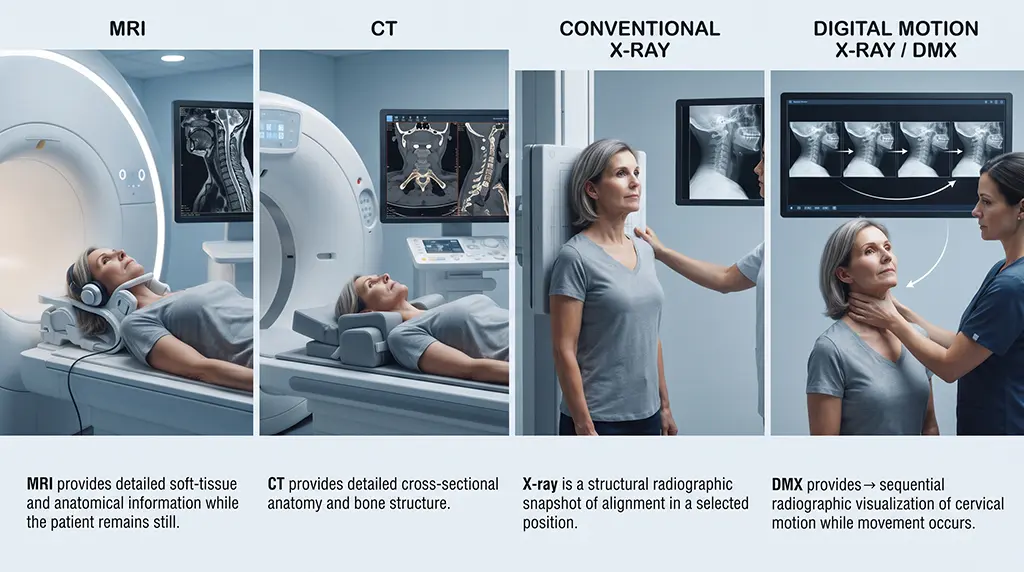
These imaging tools should not automatically be viewed as competitors.
MRI
MRI can be particularly helpful for evaluating:
- intervertebral discs
- spinal cord
- nerve structures
- soft tissues
- certain forms of inflammation or injury
CT
CT provides excellent detail of bony anatomy and can be particularly important after significant trauma when fracture is a concern.
Standard X-Ray
Traditional X-rays can evaluate:
- alignment
- fractures in appropriate circumstances
- degenerative changes
- posture
- certain structural abnormalities
But these are generally static images.
Digital Motion X-Ray
DMX uses fluoroscopic X-ray imaging to observe vertebral movement while the patient performs controlled motion.
That changes the clinical question from:
“What does the neck look like?”
to:
“How does the neck move?”
Why That Difference Matters
Many patients do not hurt while lying motionless.
They hurt when they:
- turn their head
- look over the shoulder
- look down
- look up
- drive
- back out of a parking space
- work at a computer
- carry something
- move after sitting
- encounter a pothole or sudden jolt
Those are dynamic problems.
A scan performed while the patient is still may provide extremely important structural information without necessarily reproducing the movement that triggers the symptoms.
What DMX May Evaluate
During appropriately guided cervical motion, DMX can allow assessment of several characteristics.
Translation
Translation refers to sliding movement between vertebral segments.
Angulation
Angulation describes changes in the angular relationship between adjacent vertebrae.
Asymmetry
The neck may behave differently moving left versus right.
Hinge Behavior
One segment may appear to contribute disproportionately to a movement while neighboring segments contribute less.
Motion Sequencing
Healthy motion is not only about the final position.
The vertebral segments should contribute to movement in an organized sequence.
An abnormal movement pattern may occur during the journey from one position to another even if the final static position does not appear remarkable.
The Whiplash Connection
Whiplash results from sudden acceleration-deceleration forces acting on the head and cervical spine.
Symptoms may include:
- neck stiffness
- neck pain
- headaches
- dizziness
- numbness
- tingling
- shoulder or shoulder-blade symptoms
Some patients notice symptoms immediately. Others develop symptoms hours or even days later.
Whiplash can involve multiple tissues, including muscles, joints, ligaments, nerves, and other cervical structures.
That is why no single test should be expected to explain every patient.
“Normal MRI” Does Not Mean “Nothing Is Wrong”
This is an important distinction.
A normal MRI may mean that the MRI did not identify a particular structural abnormality that explains the symptoms.
It does not automatically establish that:
- the patient has no pain
- the patient has normal movement
- the patient has no functional limitation
- the symptoms are psychological
- every cervical structure is functioning normally
Clinical examination still matters.
History matters.
The accident mechanism matters.
Symptom reproduction matters.
And when symptoms occur specifically during movement, movement itself may deserve evaluation.
What DMX Does NOT Do
DMX should not be presented as replacing every other diagnostic tool.
It does not replace:
- MRI
- CT
- neurological examination
- orthopedic evaluation
- emergency trauma assessment
- vascular evaluation
- vestibular testing
- concussion evaluation
Instead, DMX can provide a different category of information: real-time spinal motion.
How DMX Findings Can Affect the Care Plan
When clinically meaningful abnormal motion is identified, it may change treatment decisions.
Care may emphasize:
- cervical stabilization
- deep neck stabilizer endurance
- upper cervical control
- gradual motion retraining
- avoidance of repeatedly stressing vulnerable positions
- modification of manual techniques
- workplace and driving ergonomics
- coordination with other healthcare providers
In personal-injury cases, objective motion documentation may also become part of the clinical record when appropriate.
The imaging should support clinical decision-making not exist simply to generate another test result.
When Persistent Symptoms Deserve Further Evaluation
Consider further evaluation if you continue to experience:
- pain turning the head
- headaches after movement
- dizziness with cervical motion
- clicking accompanied by pain
- shoulder-blade burning
- arm tingling
- heavy-head fatigue
- repeated flares after ordinary activity
- significant functional limitations despite unrevealing static imaging
Safety Note
After trauma, seek urgent medical care for severe or rapidly worsening headache, loss of consciousness, confusion, progressive weakness, new difficulty walking, major vision changes, severe dizziness, loss of coordination, bowel or bladder changes, or other significant neurological symptoms.
FAQs
Can an MRI be normal after whiplash even if I still have symptoms?
Yes. MRI provides valuable structural information, but persistent symptoms may have several causes and should be interpreted along with history and examination.
What is the difference between MRI and DMX?
MRI primarily provides detailed static images of anatomy. DMX uses fluoroscopic X-ray imaging to observe vertebral motion during guided movement.
Does DMX replace MRI or CT?
No. They provide different information and may complement one another.
Why would movement imaging matter if I only hurt when I turn my head?
Because your symptom trigger is movement. Evaluating how the cervical segments behave during motion may provide additional information that a resting image cannot.
References
- Cleveland Clinic: Whiplash
- PubMed-indexed literature on cervical dynamic imaging and videofluoroscopy
- Published literature addressing dynamic cervical evaluation following trauma and negative static imaging
Footer: DMX Miami serves patients in Miami, Fort Lauderdale, Miami-Dade, Broward, the Florida Keys, Florida, the USA, and visitors from Colombia, Chile, Argentina, Mexico, and the Caribbean.
Learn more: Treatment
Schedule your appointment today:Appointments
Call 305-275-7475 orbook your appointment online

Dr. Rodolfo Alfonso, D.C.
Dr. Mark N. Berry, D.C.
Sunset Chiropractic and Wellness
8585 Sunset Dr. STE 102
Miami, Florida 33143