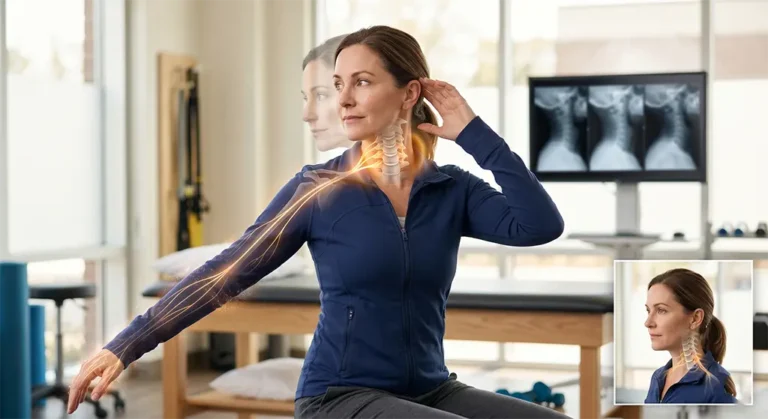
If arm tingling, numbness, or heaviness appears only in certain neck positions like looking up, turning, or combined rotation + extension the irritation may be dynamic (motion-triggered). MRI can be normal because it is static. DMX evaluates cervical motion behavior (translation/angulation, asymmetry, hinge segments) during guided arcs to help clarify whether segment mechanics may be contributing.
- Position-dependent tingling suggests a dynamic mechanical driver, not necessarily constant nerve compression.
- MRI/CT are essential for structure; DMX helps evaluate function in motion when symptoms are arc-specific.
- Motion clarity can guide safer stabilization-first rehab, posture strategy, and appropriate referrals.
Last updated: April 14, 2026
Reviewed by: DMX Miami clinical team
A common complaint sounds like: “My arm is fine most of the day, but when I look up, my fingers tingle.” Others say the tingling appears when they turn their head to check a blind spot, when they look up at traffic lights, or when they reach overhead.
At DMX Miami, we see these patterns in patients from Miami, Fort Lauderdale, Miami-Dade County, Broward County, and the Florida Keys, and in visitors from the USA and from Colombia, Chile, Argentina, Mexico, and the Caribbean. Many have already had an MRI and are confused: “If the MRI is normal, why does this happen every time I move my neck this way?”
Why position-dependent tingling is a different category
Dynamic symptoms are triggered by a movement arc or posture demand. That often means the issue is related to how the spine behaves during motion rather than what it looks like in neutral.
What changes in the neck during motion
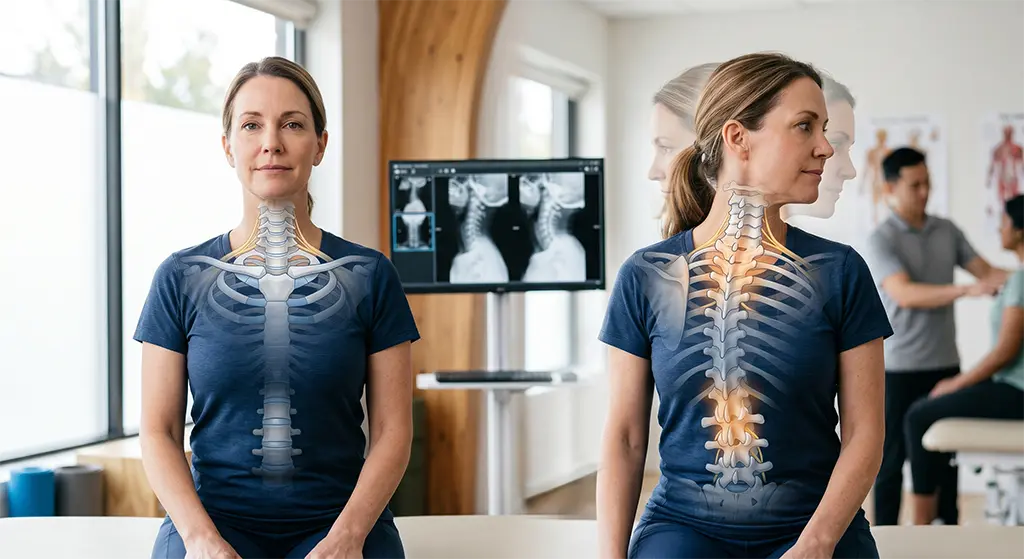
When the cervical spine moves, joint alignment shifts, stabilizers activate, and space/pressure relationships change. In many cases, the nervous system reacts to these changes by producing symptoms only during specific arcs.
Why MRI can be normal even when symptoms are real
A neutral static MRI may not reproduce the same mechanics as the trigger arc. Static imaging may not capture translation/angulation behavior, left-right asymmetry, or hinge sequencing during motion.
What DMX evaluates for dynamic symptoms
DMX evaluates translation, angulation, symmetry, hinge behavior, and correlation to the arc that reproduces symptoms.
Common real-life triggers and why they matter
Driving, traffic lights, overhead activity, and screen posture are consistent “arc tests” that stack posture load and motion.
How motion findings can change your plan
Stabilization-first progression, specific ergonomic rules, safer exercise selection, and coordination with other diagnostics (EMG, MRI re-review, shoulder evaluation) become more practical when the arc is identified.
What patients can do now (general guidance)
Track which arc triggers symptoms, note finger distribution, reduce repeated end-range testing, and use posture breaks.
FAQs
Why does my arm tingle only when I look up?
Extension can change cervical mechanics and stability demand, triggering dynamic irritation.
Can a normal MRI miss a dynamic problem?
Yes. MRI is static; the trigger may occur only during motion.
What does DMX add for position-dependent tingling?
Real-time motion behavior (translation/angulation and asymmetry) during the symptom-trigger arc.
Does DMX replace EMG?
No. EMG and DMX answer different questions and can be complementary.
References:
- Cleveland Clinic: Cervical radiculopathy education.
- PubMed-indexed literature on dynamic cervical imaging and motion-related instability concepts.
Learn more: Treatment
Schedule your appointment today:Appointments
Call 305-275-7475 orbook your appointment online

Dr. Rodolfo Alfonso, D.C.
Dr. Mark N. Berry, D.C.
Sunset Chiropractic and Wellness
8585 Sunset Dr. STE 102
Miami, Florida 33143