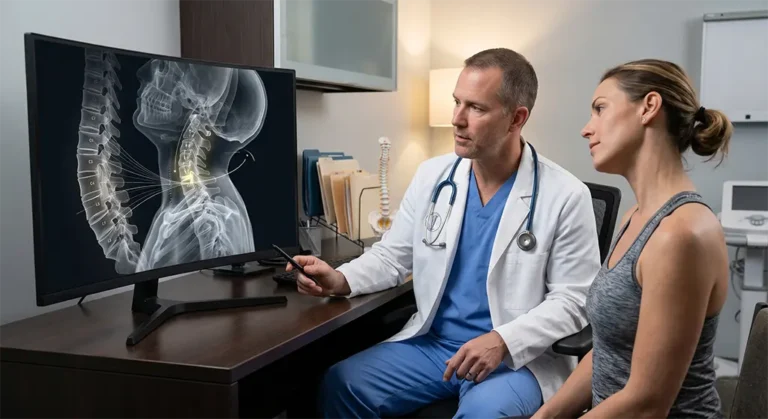
DMX is most valuable when symptoms are reproducible with motion and when stability and segment behavior will change clinical decisions. This guide explains practical indications, what DMX evaluates (translation/angulation, asymmetry, hinge patterns), and how to convert reports into stabilization-first planning and measurable functional milestones.
- Order DMX when the symptom trigger is motion-dependent and static imaging doesn’t match function.
- Use DMX to identify hinge segments and asymmetry and to guide stabilization-first rehab decisions.
- Maximize value by tying findings to triggers, activity rules, and measurable outcomes.
Last updated: April 14, 2026
Reviewed by: DMX Miami clinical team
Introduction
Referring providers often ask: when does DMX add real value beyond MRI, CT, or X-ray?
The answer is when the clinical question involves function in motion particularly stability, hinge behavior, and asymmetry that correlates with reproducible triggers.
DMX Miami serves patients in Miami, Fort Lauderdale, Miami-Dade, Broward, the Florida Keys, Florida, and visitors from the USA, Colombia, Chile, Argentina, Mexico, and the Caribbean.
High-Yield Indications (Pattern-Based)
Consider DMX when you observe:
- Symptoms reproducible with rotation, extension, flexion, or combined arcs
- Driving triggers, such as blind spot checks or looking at traffic lights
- Dizziness or brain fog in visually complex environments linked to head motion
- Catching or clunking sensations with movement
- Relapse loops, where the patient improves in PT and then symptoms recur with real-life triggers
- Short-lived relief after manual care followed by rebound flare cycles
What DMX Evaluates
DMX is fluoroscopic video imaging with guided motion. It allows evaluation of:
- Translation (sliding) between segments
- Angulation (tilting) between segments
- Symmetry, including left-versus-right differences
- Hinge patterns and sequencing
- Global motion sharing across segments
DMX does not replace MRI or CT. Instead, it complements static imaging by showing motion behavior.
How to Maximize Clinical Value: Tie Findings to Triggers
The report is most useful when it answers the following questions:
Which segments behave abnormally?
Identify the levels showing abnormal motion patterns, instability, or asymmetry.
During which arcs do symptoms appear?
Clarify whether symptoms emerge during flexion, extension, rotation, or combined movement patterns.
Do the findings match the patient’s triggers?
Correlate imaging findings with the patient’s real-world symptom triggers to improve clinical relevance.
Which motions should be limited temporarily?
Use the report to determine whether certain provocative movements should be reduced during the initial phase of care.
What is the stabilization priority?
Define which regions or movement patterns should be addressed first in rehabilitation planning.
Translate findings into clear activity rules and measurable milestones whenever possible.
Rehab Translation: Stabilization-First Decision Points

If hinge behavior or instability is present, consider:
- Prioritizing controlled endurance and motor control
- Delaying aggressive end-range stretching into provocative arcs
- Selecting manual techniques that protect vulnerable segments
- Using graded exposure to rebuild tolerance to triggers
Communication Tips for Multidisciplinary Care
For complex cases such as dizziness, tinnitus, or post-trauma headaches—coordinate with ENT or neurology as indicated.
DMX can help clarify whether cervical mechanics are likely acting as an aggravating factor, but it is not a substitute for medical evaluation of red flags.
Implementation Note
Use the FAQ section below for schema-ready patient education and referring-provider clarity.
FAQs
When should a provider order DMX?
When symptoms are reproducible with motion and stability behavior will change clinical decisions, especially if static imaging doesn’t match function.
What does DMX measure?
DMX evaluates translation (sliding), angulation (tilting), symmetry, and hinge or sequence behavior during guided arcs.
Does DMX replace MRI or CT?
No. DMX complements static imaging by evaluating motion behavior.
How should providers use DMX reports?
Providers should tie findings to triggers, set activity rules, prioritize stabilization-first rehabilitation, and define measurable milestones.
References
- AAOS OrthoInfo: General spine pain evaluation and mechanical trigger education
- PubMed-indexed literature on spinal biomechanics, instability, and dynamic fluoroscopic motion assessment
Si quieres, también te lo puedo devolver en una versión más elegante y editorial, lista para pegar directamente en WordPress con mejor ritmo de lectura y acabado más profesional.
Learn more: Treatment
Schedule your appointment today:Appointments
Call 305-275-7475 orbook your appointment online

Dr. Rodolfo Alfonso, D.C.
Dr. Mark N. Berry, D.C.
Sunset Chiropractic and Wellness
8585 Sunset Dr. STE 102
Miami, Florida 33143