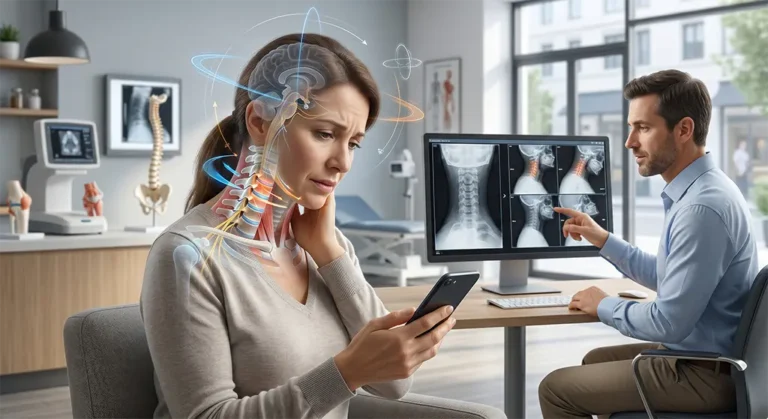
If looking down at a phone or laptop triggers neck pain, nausea, dizziness, or pressure, the cause may be more than “bad posture.” Flexion can reveal motion-sensitive cervical mechanics, especially after whiplash, falls, or chronic instability. Digital Motion X-Ray (DMX) evaluates cervical motion in real time and can document translation, angulation, asymmetry, or hinge patterns that static imaging may miss.
- Looking down increases cervical load and can reveal motion-sensitive segments.
- Nausea or dizziness with neck flexion may involve cervical proprioception and motion control.
- DMX can help guide stabilization-focused rehab and safer posture strategies.
Last updated: April 14, 2026
Reviewed by: DMX Miami clinical team
Phone posture is one of the most common modern neck stressors. Many patients are told, “You just have tech neck,” but some symptoms go beyond ordinary stiffness.
Patients may say:
- “Looking down makes me nauseous.”
- “My neck pressure builds when I read on my phone.”
- “I feel dizzy or foggy after laptop work.”
- “My headache starts at the base of my skull when I look down.”
- “I can’t tolerate screen time after my accident.”
At DMX Miami, we see this in patients throughout Miami, Fort Lauderdale, Miami-Dade County, Broward County, and the Florida Keys, and in visitors from the USA, Colombia, Chile, Argentina, Mexico, and the Caribbean. Many have already tried posture correction, stretching, massage, or physical therapy, but the same symptoms return with phone or laptop use.
Why looking down can trigger symptoms
Looking down places the cervical spine into flexion. In a healthy system, that motion should be controlled and well-distributed. But if a segment is irritated, unstable, or moving abnormally, flexion can reveal the problem.
Flexion loads the posterior cervical tissues
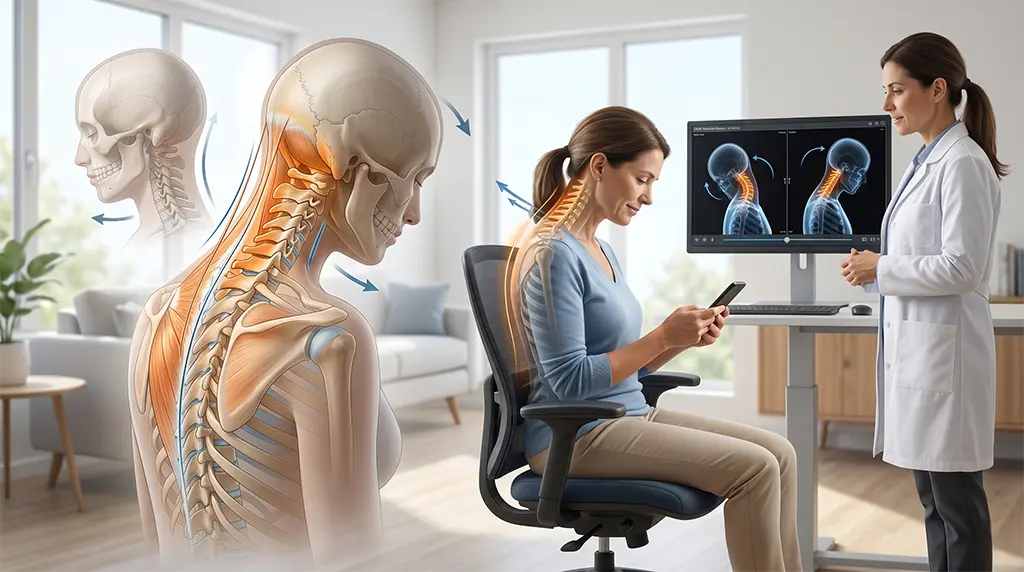
When you look down, the back of the neck lengthens and the head shifts forward. This can increase demand on ligaments, muscles, and stabilizing tissues.
Flexion can expose a hinge segment
A hinge segment is a level that takes too much motion while other areas remain stiff. Instead of the whole neck sharing motion smoothly, one level may “dump” into the movement. That can trigger pain, pressure, headaches, or neurological-type symptoms.
Flexion affects proprioception
The neck contains sensors that help the brain understand head position. If cervical motion is irregular, the brain may receive noisy input. In some patients, this can contribute to dizziness, nausea, fogginess, or visual discomfort.
Why nausea matters
Nausea with neck movement should not be ignored. It does not automatically mean the neck is the only cause, but it does suggest the nervous system is being irritated by the movement or posture.
Nausea can be related to:
- Vestibular issues
- Concussion history
- Cervical proprioception problems
- Migraine mechanisms
- Medication or metabolic factors
- Motion sensitivity after whiplash
Because multiple systems can be involved, evaluation should be thoughtful. DMX can help clarify whether cervical motion is part of the trigger pattern.
Why static imaging can be unrevealing
A standard MRI may be normal or mild because the patient is lying still. The symptoms occur when the person looks down, holds posture, and fatigues.
Static imaging may not capture:
- Flexion-related translation
- Abnormal angulation
- One segment hinging too much
- Left-right asymmetry
- Motion that worsens as the neck fatigues
This is where motion imaging can add value.
What DMX evaluates
Digital Motion X-Ray (DMX) uses fluoroscopic video imaging to evaluate the cervical spine during guided motion. Providers can observe how segments move through flexion, extension, and other arcs.
DMX may help identify:
- Translation, or sliding between vertebrae
- Angulation, or tilting between vertebrae
- Hinge segments
- Motion asymmetry
- Segmental instability patterns
DMX is not a concussion test, vestibular test, or replacement for MRI. It answers a different question: How does the cervical spine behave during motion?
When DMX may be helpful for phone-posture symptoms
Consider motion-based evaluation when symptoms:
- Reproduce consistently with looking down
- Worsen with phone or laptop posture
- Include nausea, dizziness, or fogginess
- Began after whiplash, a fall, or sports impact
- Improve temporarily with traction or posture change
- Return quickly after stretching or manual care
How DMX findings can change treatment
Stabilization before stretching
If flexion reveals instability, aggressive stretching may not be the first priority. The goal may be controlled motor stability.
Better ergonomic rules
Instead of generic “sit up straight,” the plan can become specific: reduce sustained flexion, raise devices, take motion breaks, and limit provocative arcs during early recovery.
Safer exercise progressions
Some neck exercises may worsen symptoms if they load the unstable pattern. DMX findings can help guide what to avoid and what to progress.
Coordinated care
When nausea or dizziness is present, providers may coordinate cervical stabilization with vestibular, neurological, or visual evaluation when appropriate.
Practical steps while awaiting evaluation
- Raise your phone to eye level more often
- Use voice-to-text to reduce prolonged flexion
- Take 2-minute posture breaks every 30–45 minutes
- Avoid testing the painful motion repeatedly
- Track whether symptoms are worse with flexion, extension, or rotation
- Note whether nausea appears immediately or after sustained posture
Safety note
Seek medical evaluation promptly for severe or worsening nausea, neurological symptoms, fainting, severe headache, vision changes, or symptoms following head trauma.
FAQs
Can looking down cause nausea from the neck?
In some cases, cervical motion and proprioception can contribute to nausea or dizziness, especially after injury.
Why does phone posture make my neck symptoms worse?
Sustained flexion increases load and may reveal motion-sensitive segments or instability patterns.
What does DMX show?
DMX evaluates real-time motion behavior, including translation, angulation, asymmetry, and hinge patterns.
Does DMX replace vestibular or concussion evaluation?
No. DMX complements care when cervical motion appears to be part of the trigger pattern.
References
- Cleveland Clinic: Neck pain and cervicogenic dizziness education
- PubMed-indexed literature on cervical proprioception and whiplash-associated disorders
Learn more: Treatment
Schedule your appointment today:Appointments
Call 305-275-7475 orbook your appointment online

Dr. Rodolfo Alfonso, D.C.
Dr. Mark N. Berry, D.C.
Sunset Chiropractic and Wellness
8585 Sunset Dr. STE 102
Miami, Florida 33143