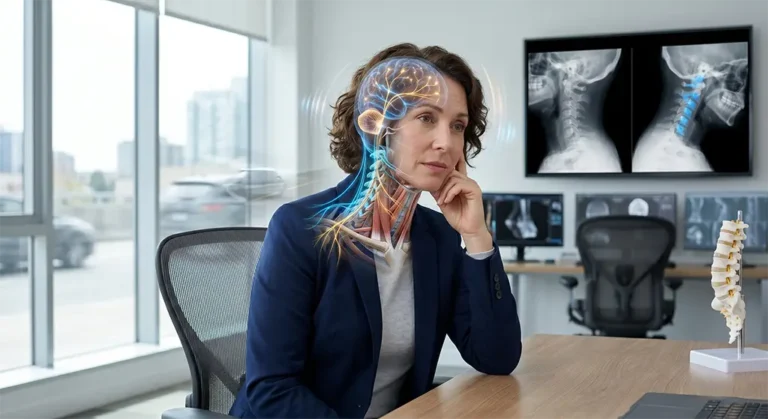
“Brain fog” after a crash or fall feeling slowed down, mentally tired, visually overwhelmed, or unable to tolerate screens can overlap with cervical injury. When symptoms worsen with head motion, posture load, or late-day neck fatigue, cervical mechanics and proprioception may be contributing. DMX evaluates cervical spine motion in real time (translation and angulation) to help clarify whether abnormal motion behavior, asymmetry, or hinge patterns could be driving motion-triggered symptoms, especially when MRI/CT are unrevealing.
- Brain fog can overlap with neck injury and is often worse with posture load and head motion.
- Static imaging is valuable but may not capture motion-dependent instability or hinge behavior.
- DMX findings can guide stabilization-first rehab, ergonomic strategy, and coordinated care when symptoms are motion triggered.
Last updated: April 14, 2026
Reviewed by: DMX Miami clinical team
In South Florida Miami, Fort Lauderdale, Miami-Dade, Broward, and the Florida Keys many people live on screens and spend hours driving. After whiplash, falls, or sports impacts, some develop symptoms that don’t feel “orthopedic” at all: brain fog, visual overload, headaches with screen time, dizziness with turning, and sensitivity to late-day fatigue. We see these cases locally and in visitors traveling through Florida from the USA and from Colombia, Chile, Argentina, Mexico, and the Caribbean.
Important: brain fog can have many causes, including concussion, vestibular disorders, medication effects, sleep apnea, metabolic issues, and more. This article is educational. Seek urgent evaluation for severe or worsening neurological symptoms.
Why brain fog can be linked to neck motion (in some cases)
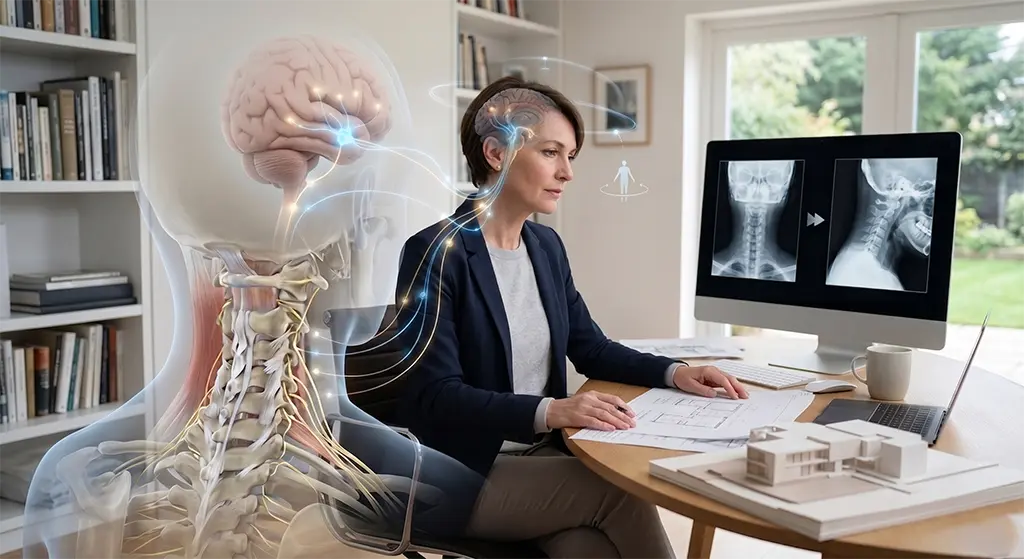
Balance and orientation are not just “inner ear.” Your brain constantly integrates vision, vestibular input, and proprioception from the neck and body. After whiplash, cervical proprioception can become noisy. When signals are inconsistent, the brain spends more effort stabilizing and interpreting input. That extra effort can feel like fog, fatigue, and poor tolerance to motion-rich environments.
A pattern clue: posture load and head motion worsen symptoms
Mechanical contribution is more likely when:
- symptoms worsen with driving or prolonged screen time
- symptoms worsen in crowded stores or airports
- quick head turns provoke dizziness or “pressure”
- symptoms build through the day as the neck fatigues
- one direction of rotation is consistently worse
Why static imaging can be “normal” in motion-triggered cases
MRI and CT are excellent for structural diagnosis, but they are typically performed in still positions. Motion-dependent symptoms can occur even when static anatomy looks acceptable. Static studies may not capture translation/angulation during movement arcs, asymmetry, hinge patterns, or sequencing problems.
What DMX evaluates (and what it doesn’t)
DMX is fluoroscopic video X-ray performed with guided motion. Providers evaluate translation, angulation, symmetry, and hinge patterns. DMX does not replace neurological evaluation, vestibular testing, MRI, or CT. It complements them when the question is motion and stability.
How motion findings can change the plan
DMX is most useful when it changes decisions:
- stabilization-first progression (controlled motor control before end-range mobility).
- ergonomic strategy becomes specific (posture breaks, arc modification).
- exercise selection improves (avoid feeding extension dominance/hinge patterns).
- coordinated rehab when appropriate (stabilization + vestibular/vision support).
Practical trigger mapping (general guidance)
Track what environments trigger symptoms (stores, screens, driving), which motions trigger (turning left/right, looking up/down), time of day, intensity and recovery time, and what reduces symptoms.
When to seek urgent evaluation
Severe worsening headache, new weakness, speech changes, facial droop, fainting, or vision loss warrant urgent medical evaluation.
FAQs
Can neck injury cause brain fog?
In some cases, yes especially when symptoms are motion and posture triggered and overlap with neck pain, headaches, or dizziness.
Why doesn’t MRI show the cause?
MRI is static. Motion-dependent instability, asymmetry, or hinge patterns can contribute even when static anatomy appears normal.
What does DMX add?
DMX evaluates real-time motion behavior (translation/angulation) through guided movement arcs and can reveal asymmetry or hinge patterns.
Does DMX replace concussion evaluation?
No. If concussion is suspected, neurological assessment is essential.
- CDC: Concussion and head injury education.
- PubMed-indexed literature on cervicogenic dizziness, cervical proprioception, and whiplash-associated disorders.
References
Learn more: Treatment
Schedule your appointment today:Appointments
Call 305-275-7475 orbook your appointment online

Dr. Rodolfo Alfonso, D.C.
Dr. Mark N. Berry, D.C.
Sunset Chiropractic and Wellness
8585 Sunset Dr. STE 102
Miami, Florida 33143