
If you wake with neck pain repeatedly even after changing pillows the issue may be motion sensitivity or stability demand rather than a one‑time sleep position. DMX evaluates cervical motion behavior (translation/angulation, asymmetry, hinge segments) to help clarify whether abnormal segment motion contributes to morning flare cycles when static imaging is unrevealing.
- Repeating morning flares often reflect motion sensitivity and guarding, not just a pillow.
- DMX evaluates function in motion; MRI/X‑ray are mostly static.
- Motion findings can guide stabilization-first rehab, ergonomic strategy, and safer manual care choices.
Last updated: April 14, 2026
Reviewed by: DMX Miami clinical team
Introduction
Many patients describe a repeating pattern: “I slept wrong and my neck is wrecked.” When it happens repeatedly even after changing pillows the issue may be motion sensitivity or stability demand rather than a one‑time sleep position. At DMX Miami, we see these patterns in patients throughout Miami, Fort Lauderdale, Miami‑Dade County, Broward County, and the Florida Keys, and in visitors from the USA, Colombia, Chile, Argentina, Mexico, and the Caribbean especially after whiplash, falls, and long-term screen posture strain.
Why sleep can trigger neck pain even without “weird positions”
Sleep is long stillness. Stillness increases stiffness, and stiffness increases motion sensitivity. When you finally move in the morning turning the head, looking down at a phone, getting out of bed the first arcs of motion can reveal hinge segments and asymmetry. If one segment is sensitive, your body may guard overnight, creating tight traps, suboccipital pressure, and a “heavy head” morning.
Why changing pillows sometimes doesn’t solve it
Pillows matter, but a pillow can’t fix instability. If a segment moves irregularly during rotation or extension, you can still flare even with an excellent pillow. Many patients spend months trying products without addressing motion control.
Motion sensitivity: the repeating flare mechanism
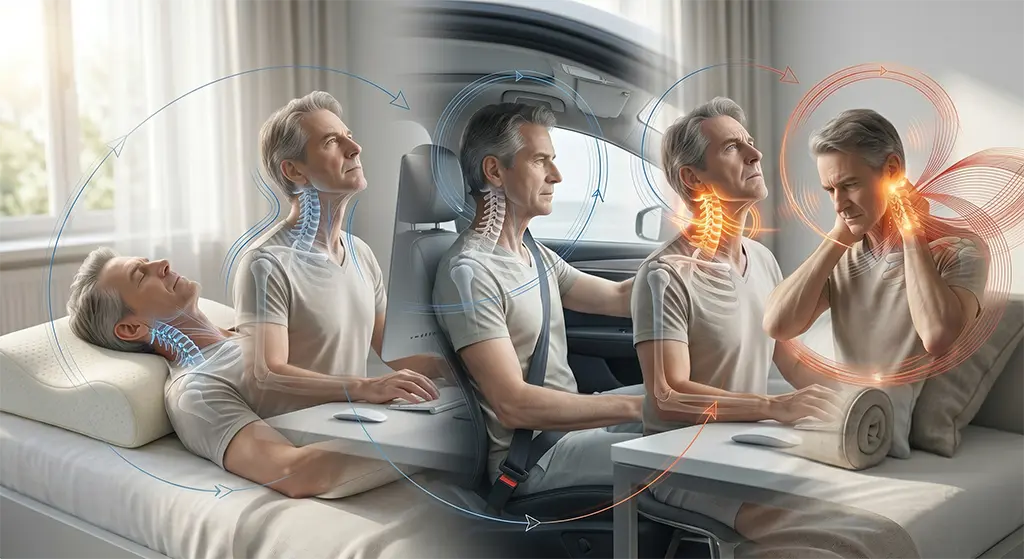
Common clues include:
- Neck feels okay mid-day but worse in the morning or late afternoon (fatigue pattern)
- One direction of rotation is consistently worse
- Looking up/down triggers symptoms
- Driving triggers headaches or dizziness
- Relief is short-lived after stretching or cracking
What DMX evaluates for morning flare patterns
DMX records guided cervical motion so providers can evaluate:
- Translation (sliding) and angulation (tilting)
- Left/right asymmetry in arcs
- Hinge segments that dominate motion
- Sequencing problems during movement
DMX does not replace MRI; it adds motion behavior when symptoms are motion triggered.
How DMX can change your plan
If motion abnormalities are present, providers may shift toward:
- Stabilization-first rehab (endurance and motor control)
- Avoiding repeated end-range extension/rotation early
- More precise manual technique choices
- Ergonomic corrections that reduce cumulative posture load
- Sleep-position guidance based on triggers, not generic advice
Practical sleep and morning strategies (general guidance)
- Morning warm-up: gentle range before full motion
- Avoid immediate phone flexion in bed; sit up first
- Use consistent pillow height to keep the neck neutral
- Track which movements trigger symptoms first (rotation vs extension vs flexion)
- Add posture breaks through the day to reduce end-of-day fatigue
Safety note
Seek medical evaluation for severe or rapidly worsening symptoms, new neurological deficits, or red flags. This blog is educational.
FAQs
Is waking up with neck pain always a pillow problem?
Not always. Repeating morning flare cycles can reflect motion sensitivity and stability demand rather than a single sleep position issue.
Can instability cause morning stiffness?
Yes. Guarding and hinge patterns can create stiffness and pain on waking.
What does DMX add?
Real-time translation/angulation and asymmetry during movement arcs that may correlate with triggers.
Does DMX replace MRI?
No. DMX complements MRI/CT/X‑ray when motion behavior is the key question.
References
- Cleveland Clinic: Neck pain education and posture-related symptom patterns.
- PubMed-indexed literature on whiplash-associated disorders and dynamic cervical motion assessment.
Learn more: Treatment
Schedule your appointment today:Appointments
Call 305-275-7475 orbook your appointment online

Dr. Rodolfo Alfonso, D.C.
Dr. Mark N. Berry, D.C.
Sunset Chiropractic and Wellness
8585 Sunset Dr. STE 102
Miami, Florida 33143